New Delhi, Oct 2 : India is rapidly emerging as a global space power. From Aryabhata in 1975 to Chandrayaan-3, Aditya-L1, Gaganyaan and the planned Bharatiya Antariksh Station, India has progressed from the early use of space technology for development to the frontiers of scientific exploration and is now moving towards human spaceflight, according to an article in Tanzania’s The Guardian newspaper.
It also highlights that India’s space programme is not confined to rockets and satellites, but is increasingly a powerful engine of innovation, industrial development, employment, scientific research and socio-economic transformation. Space technologies today touch communications, agriculture, education, healthcare, disaster management, environmental protection, navigation and everyday economic activity.
India is, therefore, moving towards a new identity as an increasingly important developer, explorer and provider of space capabilities worldwide.
The success of Chandrayaan-3 in 2023 demonstrated India’s ability to achieve a highly complex lunar landing. Aditya-L1 subsequently extended India’s scientific reach towards the Sun. SpaDeX demonstrated orbital docking capabilities, while Gaganyaan is preparing the country for human spaceflight.
The more ambitious Chandrayaan-4 project, approved in 2024, is designed to land on the Moon, collect samples and return them to Earth. Sample-return missions require far greater technological sophistication than a landing alone, involving multiple launches, rendezvous and docking, sample collection, ascent from the lunar surface and a safe return to Earth, the article observes.
India’s planetary ambitions are expanding, with 'Shukrayaan' (Venus Orbiter Mission) targeted for launch in March 2028 to study Venus’s atmosphere, surface and subsurface, offering insights into planetary evolution and habitability. Meanwhile, Aditya-L1, positioned about 1.5 million km from Earth, studies solar activity and space weather.
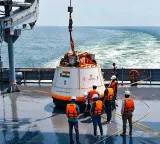
The most visible symbol of India’s technological transition may be Gaganyaan, the country’s human spaceflight programme. Human spaceflight requires a much higher level of reliability. Crew escape systems, life-support technologies, parachutes, re-entry systems and extensive testing are essential before astronauts can travel safely into space. India has therefore adopted a phased approach, using uncrewed missions to validate critical systems before undertaking crewed flights, the article states.
Gaganyaan is now part of a much larger vision. The Bharatiya Antariksh Station is targeted to begin with its first module in 2028, with the broader station envisaged for completion by 2035. The long-term roadmap also includes a crewed Indian lunar mission by 2040. This progression from satellites to astronauts, to a space station, and eventually to the Moon illustrates the scale of India’s emerging ambitions, the article observes.
The greatest contribution of India’s space programme may ultimately be felt here on Earth. Satellite technology has become essential for weather forecasting, agriculture, navigation, communications, disaster management and environmental monitoring. Earth-observation satellites can help identify vulnerable areas before floods, cyclones and landslides, while satellite communications can support emergency response in remote regions.
Space-based data supports environmental management by monitoring forests, water bodies, urban expansion, pollution and weather patterns, thereby strengthening climate action and disaster preparedness. Satellite communications can expand access to healthcare in remote areas, while augmented and virtual reality enable medical education and training. India’s space programme is, therefore, advancing inclusive development by connecting technologically advanced centres with remote and underserved communities.
India’s space programme is also delivering broader technological benefits across the economy. Innovations in advanced electronics, sensors, materials, communications, navigation and manufacturing are finding applications beyond space missions. Technology transfers are strengthening domestic manufacturing and enabling Indian enterprises to enter sophisticated supply chains.
More than 900 application-specific integrated circuits developed by ISRO’s Semi-Conductor Laboratory for railway locomotives illustrate this cross-sector impact. Thus, space investment creates a multiplier effect by generating knowledge, intellectual property, engineering expertise, manufacturing capabilities, and new commercial opportunities across the economy, the article added.
India emerging as global space power: Report