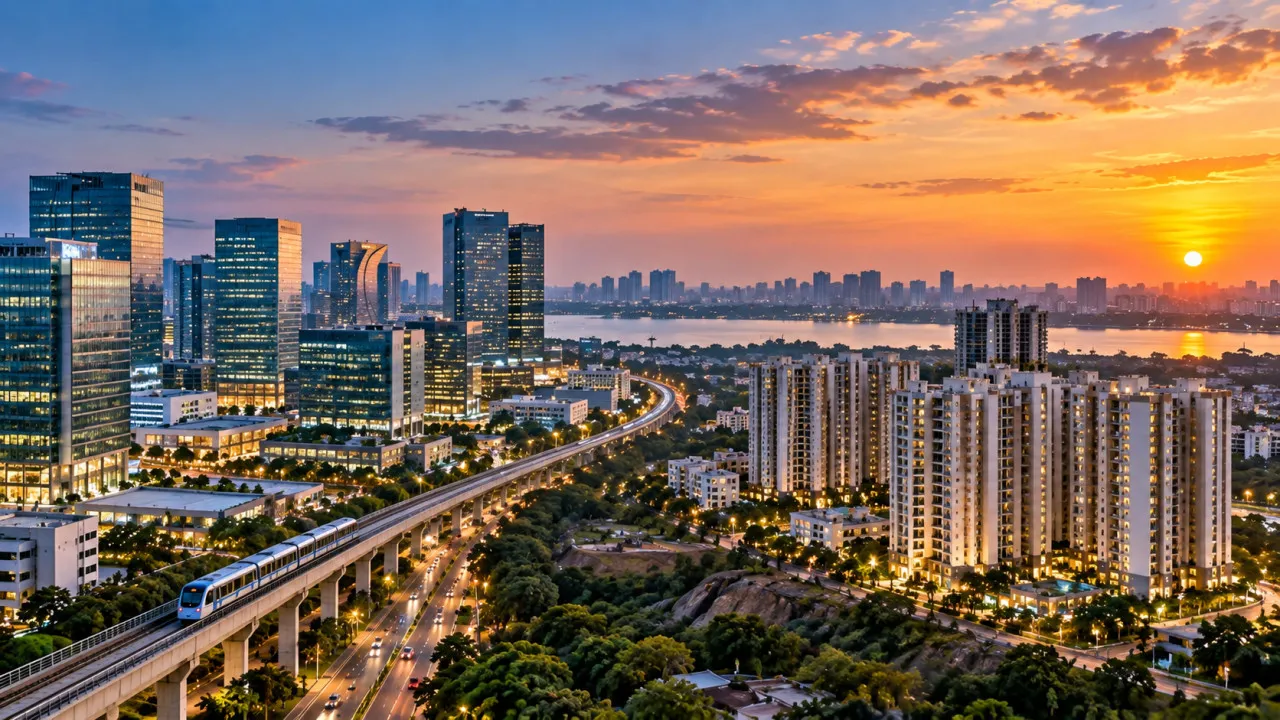
Hyderabad’s real estate market is entering a more cautious phase after years of rapid expansion, with residential growth moderating even as record office leasing and the expansion of Global Capability Centres (GCCs) continue to support employment-led demand.
Knight Frank India recorded 19,249 residential sales in Hyderabad during the first half of 2026, up just 1% from a year earlier. New launches fell 2% to 20,466 units, while average residential prices increased 7% year-on-year to ₹8,258 per square foot. Unsold inventory stood at 56,095 units, up 3%.
West Hyderabad remains the market’s dominant residential hub, led by Gachibowli, Kondapur, Kokapet, Neopolis and areas around HITEC City and the Financial District. Technology-sector employment, GCC expansion and infrastructure development have driven housing demand and substantial price appreciation across the corridor.
Other industry datasets present a somewhat different picture because of variations in methodology. The CREDAI Hyderabad–CRE Matrix Housing Report recorded 26,068 homes sold in the first half, down 13% year-on-year, with sales valued at ₹52,913 crore. It put the average ticket size at ₹2.03 crore and new launches at 49,656 units.
While residential indicators are mixed, Hyderabad’s commercial property market remains robust. Office transactions reached a record 7.5 million square feet in the first half of 2026, up 29% year-on-year, according to Knight Frank. GCCs accounted for 3.4 million square feet, or 45% of leasing. Average office rents increased 7% to about ₹80 per square foot per month, while vacancy declined to 11.5%.
Hyderabad now hosts more than 515 GCCs employing over 300,000 professionals, according to an Anarock Research-FICCI report. More than 70 centres were added in FY25. Anarock estimates GCC expansion could generate another 8–12 million square feet of office demand over the next three to five years, alongside additional demand for flexible and managed workspaces.
“This GCC expansion is already translating into significant real estate demand in the city,” Anarock Group Chairperson Anuj Puri said.
Infrastructure remains another major factor influencing property expectations. Telangana has proposed a 122.9-km Hyderabad Metro Phase-II expansion estimated at ₹38,595 crore, while the Regional Ring Road is also expected to improve connectivity to emerging development corridors. Colliers India said housing prices in Hyderabad’s western periphery had risen more than 50% over five years and projected another 10–15% increase over the following three to five years.
Affordability, however, is becoming a greater concern. Developers are increasingly concentrating on mid-market and premium housing, while inexpensive homes account for a limited share of new supply. Buyers are also becoming more selective after several years of rapid price increases.
The result is an increasingly divided market. Hyderabad’s office sector remains exceptionally strong, supported by GCCs and technology employment, while residential real estate faces higher inventory, affordability pressures and slower sales growth.
The evidence so far points neither to a property collapse nor to a return to unchecked growth. Hyderabad appears to be moving into a more mature cycle in which employment, infrastructure, location and affordability will increasingly determine which projects and neighbourhoods continue to outperform.
Hyderabad Housing Growth Slows While Office Leasing Hits Record High