As of August 2026, NIDHI-PRAYAS 2.0, SAMRIDH, TIDE 2.0, the Startup India Fund of Funds, the Credit Guarantee Scheme for Startups (CGSS) and CGTMSE are among the key government-backed programmes available to eligible startups and small enterprises.
NIDHI-PRAYAS 2.0: From Innovation to Prototype
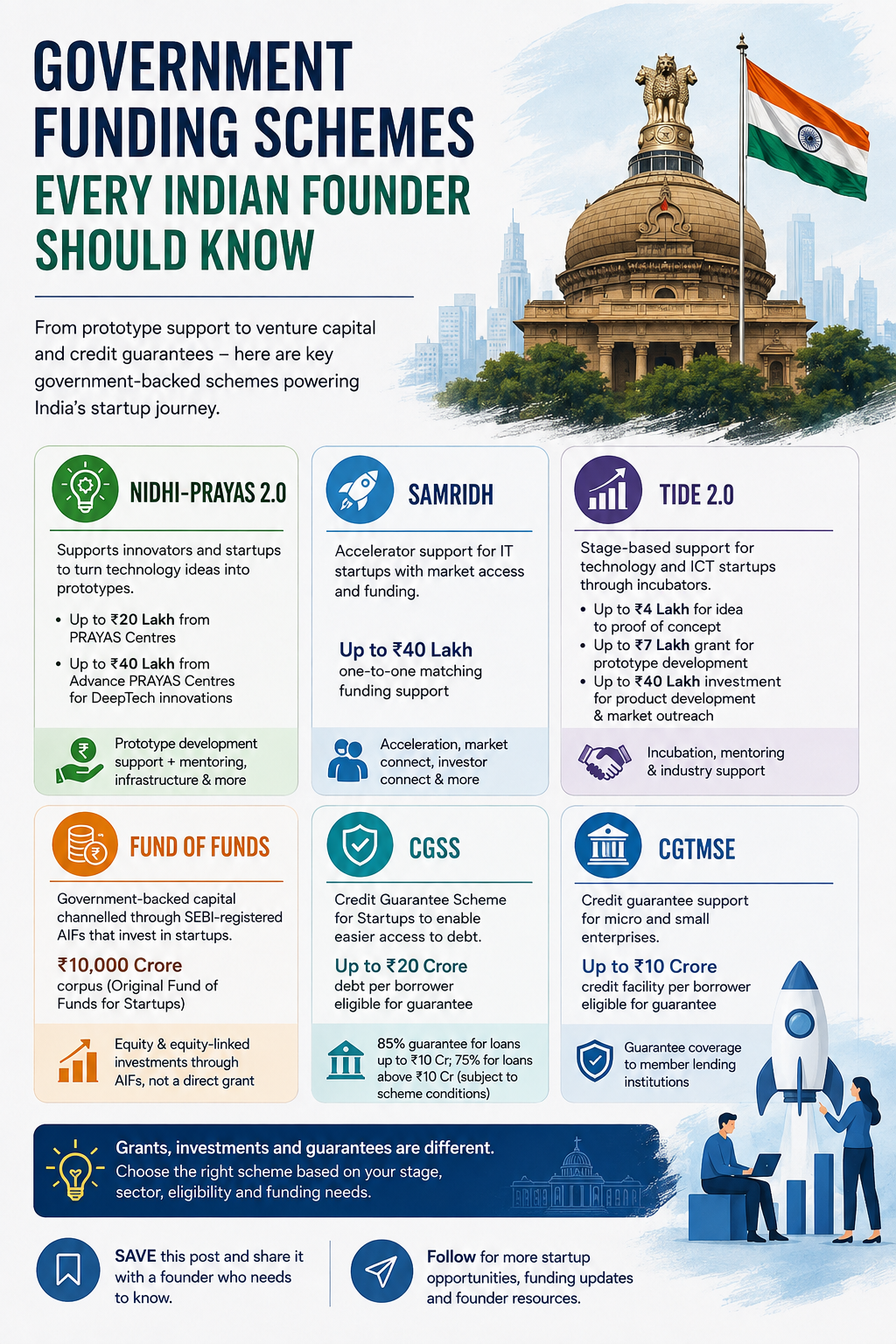
The Department of Science and Technology’s NIDHI-PRAYAS 2.0 supports innovators and startups seeking to convert technology-based ideas into prototypes.
Under the updated programme, PRAYAS Centres can provide support of up to ₹20 lakh per innovator or startup, while Advance PRAYAS Centres can provide up to ₹40 lakh for eligible DeepTech innovations and advanced prototypes. The programme also offers access to prototyping facilities, mentoring and other ecosystem support.
The scheme should not be confused with equity funding. Claims that NIDHI-PRAYAS provides ₹10 crore in equity funding specifically to women-led startups are incorrect.
SAMRIDH: Up to ₹40 Lakh in Matching Support
The Ministry of Electronics and Information Technology’s SAMRIDH programme helps potential IT-based startups scale through selected accelerators.
Participating startups can receive acceleration services along with one-to-one matching funding of up to ₹40 lakh, subject to programme conditions. The initiative also seeks to improve startups’ access to customers, investors and markets.
TIDE 2.0: Stage-Based Technology Support
MeitY’s TIDE 2.0 supports technology and ICT-based entrepreneurship through participating incubators.
According to the Government’s June 2026 Startup Schemes Playbook, assistance can include up to ₹4 lakh for idea-to-proof-of-concept development, up to ₹7 lakh as a prototype-development grant, and investment of up to ₹40 lakh for product development and market outreach.
Fund of Funds: Capital Routed Through Investment Funds
The Fund of Funds for Startups (FFS) follows a different model. The original programme was established with a ₹10,000 crore corpus, with SIDBI committing capital to eligible SEBI-registered Alternative Investment Funds, which in turn invest in startups.
In 2026, the Government notified Startup India Fund of Funds 2.0, backed by a further ₹10,000 crore corpus and with emphasis including DeepTech, innovative manufacturing and early-growth startups.
For founders, the crucial distinction is that Fund of Funds capital is not a direct government grant. Startups generally access the capital through participating AIFs and remain subject to investment assessment and due diligence.
CGSS: Credit Guarantee for DPIIT-Recognised Startups
The Credit Guarantee Scheme for Startups (CGSS) is intended to facilitate debt financing for eligible DPIIT-recognised startups by providing guarantee support to participating financial institutions.
Under the revised framework, debt of up to ₹20 crore per eligible borrower can fall within the guarantee mechanism. For transaction-based guarantees, coverage is 85% of the amount in default for loans up to ₹10 crore and 75% for loans above ₹10 crore, subject to applicable limits and conditions.
CGSS does not mean the Government directly gives a startup a ₹20 crore loan. The financing is provided by an eligible lender, with the scheme providing credit-guarantee support.
CGTMSE: Credit Support for Micro and Small Enterprises
The Credit Guarantee Fund Trust for Micro and Small Enterprises (CGTMSE) provides guarantee coverage to member lending institutions for eligible credit extended to qualifying micro and small enterprises.
Eligible credit facilities of up to ₹10 crore per borrower can currently fall within the guarantee framework, subject to scheme conditions. CGTMSE does not directly lend money to entrepreneurs; businesses approach participating banks or financial institutions for credit.
 Choosing the Right Government Support
These schemes serve distinctly different purposes. NIDHI-PRAYAS 2.0 focuses on prototype development, SAMRIDH combines acceleration with matching funding, and TIDE 2.0 offers stage-based support for technology startups. The Fund of Funds channels government-backed capital through investment funds, while CGSS and CGTMSE use guarantees to facilitate debt financing.
Founders should therefore avoid treating every headline funding limit as a direct government grant. Actual assistance depends on eligibility, startup stage, sector, selection procedures, lender or investor assessment and the conditions of the individual scheme.
Government programmes can also be revised over time. Entrepreneurs should verify current eligibility criteria, application windows and funding limits with the relevant government department or implementing institution before applying.