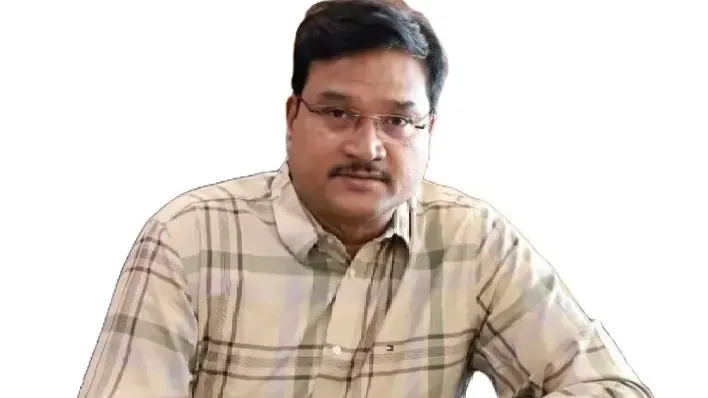
HYDRAA Commissioner and IPS officer A.V. Ranganath has said that the slowdown in Hyderabad's real estate sector is not a consequence of the agency's anti-encroachment drive. He attributed the downturn to structural weaknesses in the market, a large inventory of unsold homes, elevated property prices and broader economic factors.
Advising prospective homebuyers to exercise greater caution, he said purchasing a property should involve the same level of scrutiny that families undertake while evaluating a marriage proposal for their daughter, as it often involves investing a lifetime's savings.
Ranganath pointed out that the real estate sector has also slowed in cities such as Delhi, Vijayawada and Karimnagar, where HYDRAA has no role. According to him, Hyderabad's market slowdown is largely driven by international economic conditions, high interest rates and changing employment trends influenced by artificial intelligence.
"There are currently around 3 lakh to 3.5 lakh unsold flats in Hyderabad. Changes in employment patterns due to artificial intelligence, coupled with high interest rates, have weakened demand. Property prices ranging from ₹10,000 to ₹15,000 per square foot are beyond the reach of the average citizen," he said.
He said middle-class families are increasingly being compelled to spend nearly ₹2 crore on a 1,200-square-foot apartment and remain committed to equated monthly instalments for nearly two decades. In his view, the market has required a correction for a long time.
Rejecting allegations that HYDRAA's enforcement measures are harming the real estate sector, Ranganath said the agency is "redefining real estate" by eliminating illegal practices and protecting public assets rather than damaging the industry.
He said HYDRAA does not intervene in ordinary civil disputes over private property. Instead, its mandate extends to protecting government land and land reserved for public purposes in approved layouts, including roads, parks, schools and hospitals. According to him, restoring such common-purpose land safeguards the rights of genuine plot owners and preserves public infrastructure.
Ranganath said people who encroach upon parks, roads and other common lands often assume that ordinary citizens cannot challenge influential individuals. He said HYDRAA's role is to restore such public assets and ensure they remain available for community use.
Describing the earlier situation as "jungle raj", he alleged that many property owners were forced to visit their plots every few months simply to ensure they had not been encroached upon or subjected to unauthorised construction.
According to Ranganath, HYDRAA has reclaimed approximately 3,350 acres of land valued at around ₹1.5 lakh crore. He said the agency's primary objective is to safeguard government assets and suggested that reclaimed land could be utilised for housing projects benefiting low-income group (LIG) and middle-income group (MIG) families.
He also explained that HYDRAA was created to bring together the efforts of multiple government departments that previously handled encroachment-related issues independently, enabling faster coordination and more effective protection of public assets.
Warning homebuyers against relying solely on builders' marketing brochures or legal-vetting certificates, Ranganath urged purchasers to independently verify every aspect of a property before making an investment.
"When arranging a daughter's marriage, families carefully inquire about the prospective groom's character and background. Why should we not exercise the same level of diligence when investing crores of rupees in a property?" he asked.
He alleged that legal opinions describing disputed properties as "clear" were sometimes issued despite unresolved issues and advised buyers to undertake independent field verification.
According to him, every purchaser should verify three critical aspects before buying property:
Check the Hyderabad Metropolitan Development Authority's lakes map to ensure that the plot does not fall within a lake's Full Tank Level (FTL) area or buffer zone.
Compare the property's location with National Remote Sensing Centre satellite imagery available through the Bhuvan portal to confirm that it is not government land.
Conduct local inquiries, as nearby residents or shopkeepers may be aware of disputes that are not reflected in official records.
Ranganath said HYDRAA's initiatives are intended not for short-term gains but for Hyderabad's long-term sustainability. He stated that nearly 61% of the city's water bodies have already been encroached upon and warned that continued encroachment could result in severe water scarcity and groundwater contamination in the future.
He said the agency aims to restore lakes, protect parks and other public spaces, improve groundwater recharge and help reduce urban flooding as part of its long-term environmental strategy.
"We are not here to turn the city into a concrete graveyard," he said.
Ranganath said HYDRAA's long-term vision is to help transform Hyderabad into a well-planned and environmentally sustainable city comparable to Singapore while ensuring that public assets, property rights and ecological resources remain protected for the next 100 to 200 years.
HYDRAA Is Redefining Real Estate, Not Destroying It, Says Commissioner A.V. Ranganath