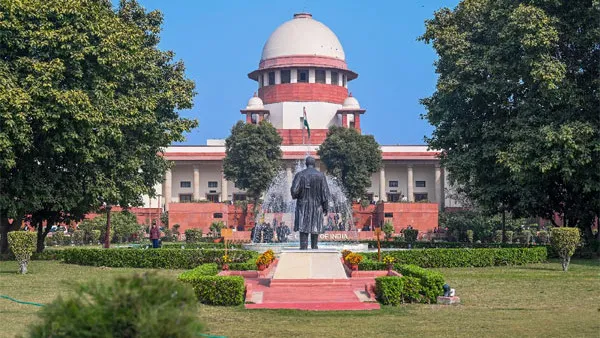
New Delhi, May 18 : The Supreme Court on Monday declined to entertain a public interest litigation (PIL) seeking directions for framing a uniform wage and welfare framework for priests, sevadars, and temple staff working in state-controlled temples across the country.
A bench of Justices Vikram Nath and Sandeep Mehta expressed disinclination to interfere in the matter and refused to entertain the plea filed by advocate Ashwini Upadhyay, who appeared in person.
After the apex court indicated its unwillingness to examine the issue, Upadhyay sought permission to withdraw the petition with liberty to approach the appropriate authorities.
The Justice Vikram Nath-led Bench thereafter dismissed the matter as withdrawn.
"The petitioner seeks permission to withdraw the plea with liberty to approach the appropriate authorities. The petition is dismissed as withdrawn," the top court recorded in its order.
The plea had sought directions to the Centre and state governments to constitute a judicial commission or expert committee to review the wages and service conditions of priests, sevadars, and temple staff in temples under government control. The petition also sought a declaration that priests and temple staff fall within the definition of "employee" under Section 2(k) of the Code on Wages, 2019, making them entitled to minimum wages and other labour welfare protections.
The plea contended that once state governments assume administrative, financial and economic control over temples, an employer-employee relationship arises between temple administrations and priests or temple workers. It claimed that priests and temple staff in several states survive on "arbitrary honorariums, dakshina-based payments and meagre remuneration", often ranging between Rs 1,000 and Rs 5,000 per month, without pension, healthcare or social security protections.
Referring to statutory frameworks governing temples in states such as Tamil Nadu, Andhra Pradesh, Telangana, Karnataka and Kerala, the plea argued that governments exercise pervasive control over appointments, service conditions, disciplinary supervision, and temple revenues, while simultaneously denying labour welfare protections to temple workers.
The petition further relied on constitutional provisions under Articles 14 and 21, contending that denial of fair wages and dignified livelihood to priests and temple staff violates their fundamental rights.
Referring to judicial precedents, including observations of the Allahabad High Court on minimum wages for temple staff, the plea contended that the issue had nationwide implications and warranted intervention by the apex court.
SC refuses to hear PIL on temple priests' wages
Advertisement