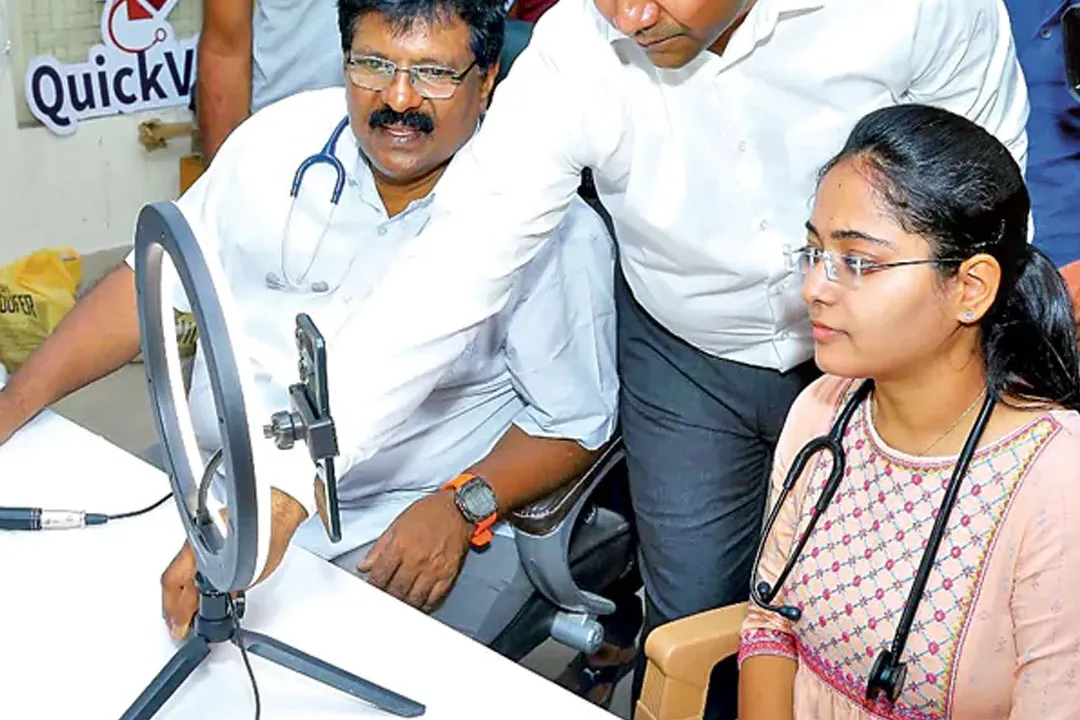
In a pioneering development in the Indian public healthcare sector, doctors at the renowned Niloufer Hospital in Hyderabad have introduced a revolutionary diagnostic technology that enables blood testing without the use of needles. The advanced innovation allows key health parameters to be analyzed simply by scanning the patient’s face, eliminating the need for traditional invasive blood sample collection.
This breakthrough, introduced for the first time in a government hospital in India, utilizes an AI-powered diagnostic device based on photoplethysmography (PPG) technology. The initiative was launched under the ‘Amrit Swasth Bharat’ program, with the device developed by the company QuickVitals.
On the previous day, Niloufer Hospital Superintendent Dr. Ravikumar officially inaugurated the new device. He stated that conventional blood tests not only consume time but also require patients to wait for their reports. In contrast, this new device addresses these issues by offering immediate diagnostic feedback.
Describing its functionality, the PPG device operates with remarkable simplicity. It is mounted on an LED tripod and linked to a mobile phone. Patients are required to look at the phone screen for 30 to 40 seconds, during which the device scans their face. Within a minute, it provides a comprehensive set of vital health statistics. These include blood pressure, blood oxygen saturation (SpO2), heart rate, respiratory rate, heart rate variability (HRV), stress levels, hemoglobin percentage, pulse respiratory quotient, and the functional status of both sympathetic and parasympathetic nervous systems.
Speaking about the rollout plan, Dr. Ravikumar stated, “In the initial phase, we will conduct tests on approximately 1,000 children over a two-month period using this device and will closely study the resulting data. If the trial proves successful, we will recommend its adoption in other government hospitals across the state.”
Doctors emphasized that this innovation is especially beneficial for children, as it allows for painless and non-invasive testing, eliminating the fear associated with needles.