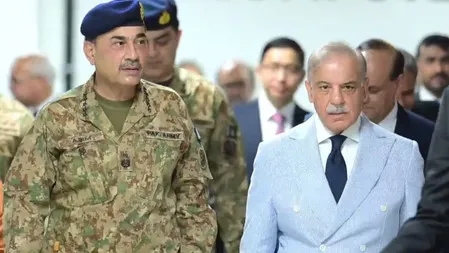
Islamabad, Oct 16 : Pakistan's political landscape is currently defined by the confrontation between the army chief, Asim Munir, and former Prime Minister Imran Khan.
While Khan remains imprisoned, along with hundreds of his party members, and his Pakistan Tehreek-e-Insaf (PTI) party faces sustained pressure, the General Munir-led military establishment has expanded its hold over the country’s political affairs through constitutional manoeuvring facilitated by the current Shehbaz Sharif government. For Khan and his supporters, this confrontation has taken on a personal dimension, with accusations that the army chief is using his power to settle scores with the former Prime Minister, who once presided over his removal from the country’s intelligence leadership.
These allegations are not new and merit scrutiny as the relationship between the two men had deteriorated well before Khan’s removal from office in April 2022. The chronology of events over the years reveals how a series of institutional confrontations and political decisions have fuelled suspicions of personal animosity on both sides. It raises a question of whether a dispute between powerful individuals has become inseparable from the military’s continuing role in Pakistan’s political order.
The roots of the conflict go back to 2019 when Khan was Prime Minister and Munir was serving as Director-General of the Inter-Services Intelligence (ISI), a position widely regarded as the most powerful in the country after the army chief. Munir held the position for approximately eight months before being replaced by Lieutenant General Faiz Hameed. It was the shortest tenure of any military officer in that position. While the military did not publicly explain the change, subsequent accounts alleged that Munir had raised concerns about Khan’s wife, Bushra Bibi, and corruption in her circle. Khan later rejected that account and denied that Munir had presented him with evidence of corruption or had been removed for raising the matter. Instead, his party alleged that Munir tried to reach out to Bushra Bibi after his removal as spymaster to discuss his removal.
The episode nevertheless became an important reference point in later speculation about their relationship. Khan’s critics and supporters have interpreted it differently, while the absence of a definitive public explanation has allowed allegations of a personal grievance to persist. A personnel decision within the intelligence establishment thus became part of a much larger political narrative.
The political relationship between Khan and the military, then led by General Qamar Javed Bajwa, deteriorated further during his final months in office. Disagreements over senior military appointments and the government's direction, including its foreign policy orientation, strained an alliance widely believed to have helped Khan consolidate power after the 2018 election. When Munir was appointed chief of army staff in November 2022, Khan had already been removed through a parliamentary vote of no confidence in April, becoming Pakistan’s first Prime Minister to lose office by that mechanism. Khan’s party alleged that the no-confidence motion, which brought together various smaller parties and saw many PTI members defect, was supported by the army establishment from behind the scenes.
Khan claimed that his removal resulted from a conspiracy involving the United States and Pakistan’s military establishment, with backing from Saudi Arabia. The parliamentary opposition maintained that it had exercised its constitutional right to remove a government that had lost its majority. The vote itself was a parliamentary process, though the broader political environment surrounding Khan’s departure remains contested. The episode intensified his confrontation with the army leadership and turned his political campaign into a direct challenge to the establishment’s influence.
The consequences became more severe after Khan’s arrest on May 9, 2023 triggered protests across Pakistan. Demonstrators attacked military installations and other state property, including the residence of a senior military commander in Lahore. Following this, the authorities launched a sweeping crackdown on PTI leaders and supporters, hundreds of whom have been tried in the military courts.
Khan was arrested again in August 2023 and has remained imprisoned under dozens of charges, including corruption and anti-state activities. Though he has received convictions in cases involving state gifts, a classified diplomatic cable, and his marriage, several of those convictions were subsequently suspended or overturned. In January 2025, he was sentenced to 14 years in prison in the Al-Qadir Trust corruption case with the prosecutors alleging that Khan and Bushra Bibi received land from a property developer in exchange for a favour involving funds returned to Pakistan from Britain.
Nevertheless, the accumulation of cases, protracted incarceration and restrictions affecting his PTI party have strengthened the perception that legal proceedings are operating within a wider political struggle. It should be noted that Pakistan’s military has long shaped the boundaries within which civilian governments operate. Khan himself benefited from a close relationship with the establishment during his rise to power, with his political fortunes changing when that relationship collapsed. It therefore reflects a familiar institutional problem wherein political leaders can gain an advantage from military support but their autonomy becomes precarious when they seek to challenge the institution that helped elevate them.
General Munir’s expanding authority has intensified these concerns. Since his appointment as army chief in November 2022, he has consolidated power at a scale never seen before while retaining the façade of civilian and parliamentary supremacy. Shehbaz Sharif’s government has, in order to preserve the support of the military establishment, pushed one after another constitutional amendments to help Munir consolidate power. These provisions have extended the tenures of armed forces service chiefs from three to five years, with the possibility of an equal second term. The government has also abolished the office of the Chairman of the Joint Chiefs of Staff Committee (CJCSC) and established the position of Chief of Defence Forces (CDF), to be held concurrently by the army chief, further centralising command under the army chief, strengthening his position as the dominant figure in Pakistan’s military hierarchy. This has coincided with the weakening of PTI’s organisational space, continued legal pressure on Khan and an expansion of the military’s influence over national affairs.
The danger lies in the interaction between personal rivalry and institutional power. As such, the Munir-Khan confrontation has moved far beyond the relationship between two individuals. The 2019 intelligence leadership dispute, Khan’s removal in 2022, the May 2023 violence and crackdown, and the ongoing legal proceedings have created a political environment in which personal animosity is widely alleged to underlie the country's current political instability. This evolving situation has raised the challenge of whether Pakistan can prevent the state's power from becoming an instrument of personal or institutional retaliation.
Pakistan’s political stability depends on restoring civilian supremacy, ensuring judicial independence and separating legal accountability from political retaliation. Whether personal animosity has shaped Munir’s approach towards Khan or not, the concentration of military power and the prolonged suppression of political opposition demand scrutiny. Without institutional restraints, Pakistan’s power struggle will continue to undermine democratic legitimacy.
Asim Munir, Imran Khan and personalisation of Pakistan's power struggle