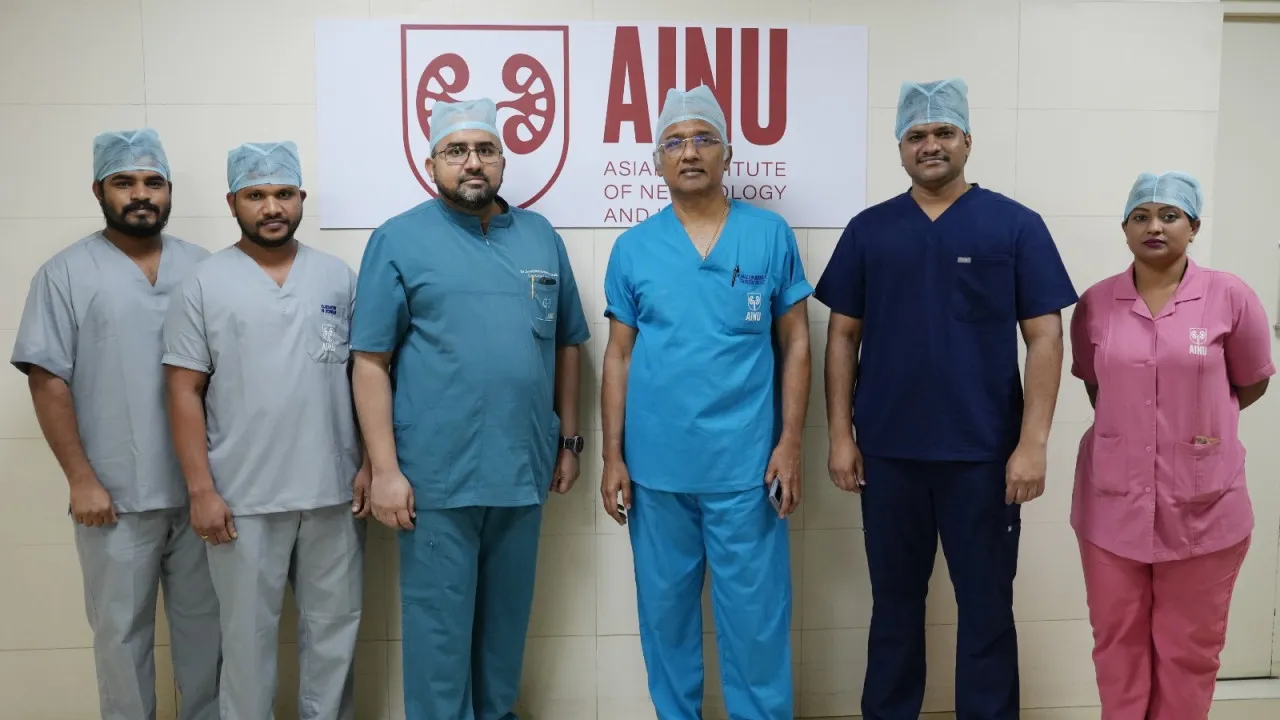
Hyderabad, July 16, 2026: Doctors at the Asian Institute of Nephrology and Urology (AINU) in Hyderabad have successfully removed a kidney tumour from a six-year-old boy born with a rare congenital kidney abnormality known as a crossed fused ectopic kidney, using a highly specialised minimally invasive laparoscopic (keyhole) procedure.
The child, a resident of Hyderabad, was admitted to AINU after passing blood in his urine for two days. Detailed medical investigations revealed a tumour in a crossed fused ectopic kidney, a rare congenital condition in which both kidneys are fused together and located on the same side of the body.
According to AINU, the condition presents significant surgical challenges because of distorted urinary collecting systems and an unpredictable network of blood vessels, making conventional surgery more difficult and potentially riskier.
To address these complexities, the surgical team used advanced three-dimensional imaging before the operation to map the child's unique vascular anatomy and develop a customised surgical plan. During the procedure, laparoscopic intraoperative ultrasound was used to accurately determine the tumour's location, depth and margins within the fused kidney.
The imaging technologies enabled surgeons to selectively control only the blood vessels supplying the tumour while preserving blood flow to the healthy kidney tissue. The tumour was completely removed with clear surgical margins through small keyhole incisions. The child experienced no major complications, retained normal kidney function, recovered well and was discharged in good health.
Commenting on the case, Dr. Syed Md. Ghouse, Director – Robotics and Minimal Access Urology at AINU, who led the surgical team, said, "Operating on a tumour in a crossed fused ectopic kidney is among the most demanding procedures in paediatric urology because every patient's anatomy is unique and conventional surgical landmarks are absent. Success in such cases depends on meticulous planning and the intelligent use of advanced technologies. Three-dimensional reconstruction, intraoperative ultrasound and ICG fluorescence imaging allowed us to precisely identify the tumour and preserve the healthy kidney, giving the child the best possible long-term outcome while avoiding the trauma of open surgery."
Dr. Mallikarjuna C, Managing Director, Chief Consultant Urologist and Robotic Surgeon at AINU, said, "Managing tumours in a fused kidney is exceptionally complex due to the abnormal anatomy and shared blood supply. Using advanced keyhole surgical techniques, we were able to precisely remove the tumour while preserving maximum kidney function—something that is critical, especially in such rare cases."
Doctors at AINU said the successful outcome demonstrates how modern minimally invasive surgery, combined with surgical expertise and precision-guided imaging, can safely treat rare and anatomically complex paediatric kidney tumours while preserving organ function. They added that the case highlights the growing role of precision-guided surgery in improving outcomes for children with complex congenital urological disorders.
The multidisciplinary team that performed the surgery comprised Dr. Syed Md. Ghouse, Director – Robotic & Minimal Access Urological Surgery; Dr. Mallikarjuna C, Managing Director & Chief Consultant Urologist and Robotic Surgeon; and Dr. Rajesh Kumar Reddy Adapala, Consultant Uro-Oncologist.
AINU Surgeons Preserve Fused Kidney in Rare Paediatric Tumour Surgery