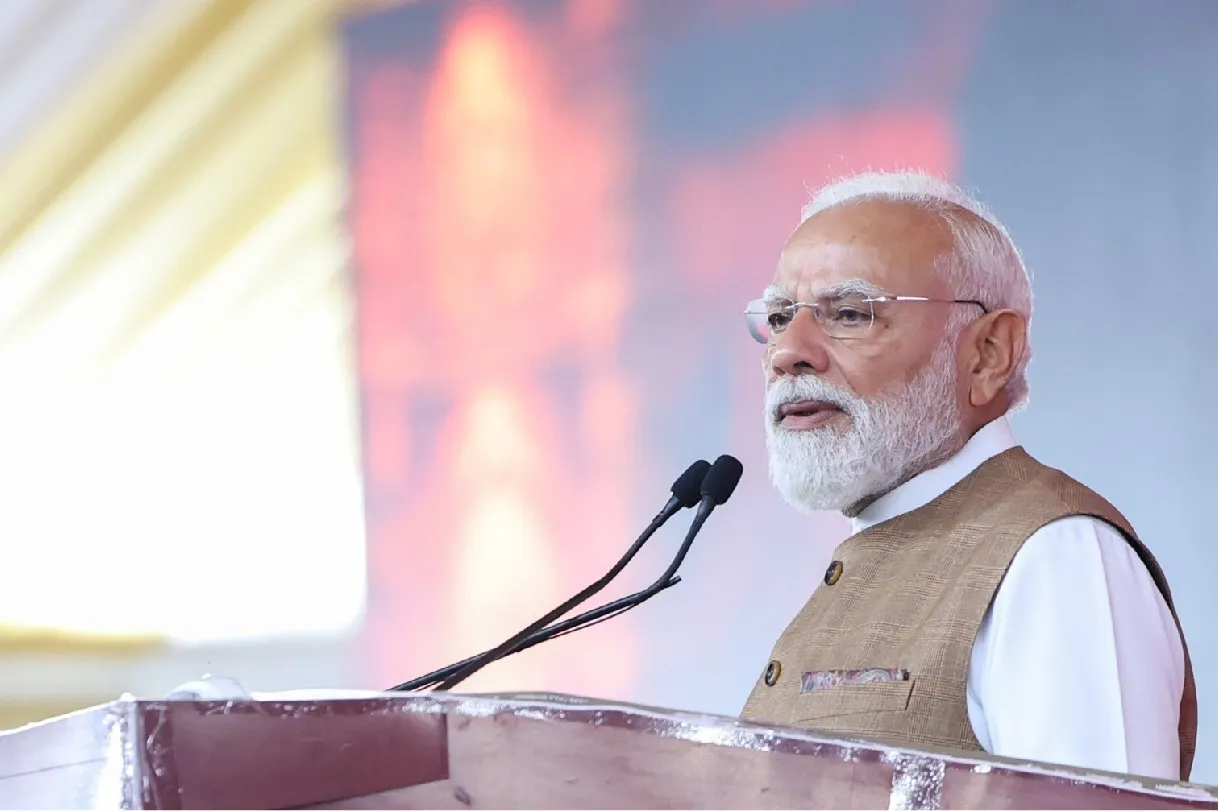
Gandhinagar, March 31 : Prime Minister Narendra Modi on Tuesday highlighted the importance of cultural heritage in addressing global instability as he inaugurated the Samrat Samprati Museum at Koba Tirth in Gandhinagar.
The inauguration, held on the occasion of Mahavir Jayanti, marked the opening of a museum dedicated to preserving India’s civilisational and cultural legacy, with artefacts of the Jain community collected from across the country, some dating back more than 1000 years.
Referring to the current global situation, the Prime Minister said, “At a time when the world is witnessing instability and is scorched by the flames of unrest, the legacy and message of this museum are crucial not only for India but for the entire humanity.”
Describing the institution as more than a repository of artefacts, he said, “This museum is a centre for Jain worship, cultural and heritage preservation,” adding that it would be open to people from all sections of society.
PM Modi said Koba Tirth has long been a place of peace and spiritual practice, where traditions of dedication, study and discipline have continued over time.
He noted that the museum reflects a confluence of Indian civilisation through the preservation of values, strengthening of cultural traditions and promotion of knowledge.
“The design of the museum presents the grandeur of India at every step and reflects unity in diversity, where traditions such as the Vedas, Puranas and Ayurveda are represented,” he said, expressing hope that students and researchers would visit in large numbers.
He also highlighted the contribution of Jain monk Acharya Padmasagarsurishwarji and other ascetics who collected artefacts from across India and Nepal over several decades, dedicating their lives to preserving cultural heritage.
Named after Samrat Samprati, the grandson of Ashoka and known for promoting non-violence, the museum presents the evolution and impact of Jainism through its exhibits.
The museum integrates traditional displays with modern digital and audio-visual technology to create an immersive experience.
It houses seven galleries covering Jain philosophy, the lives of Tirthankaras, ancient manuscripts, temple models and historical artefacts, offering a comprehensive view of India’s spiritual traditions.
Gujarat Chief Minister Bhupendra Patel said, “This museum will serve as a centre for cultural preservation,” adding that 2026 would see India’s culture and traditions showcased on a larger scale, alongside ongoing digitisation of literature and artefacts under the Gyan Bharatam Mission.
Deputy Chief Minister Harsh Sanghavi described the inauguration as a significant moment for the Jain community worldwide.
“It is a matter of pride that the Prime Minister has inaugurated this museum. More than 2,000 artefacts, including ancient texts such as the Vedas and Puranas, are preserved here,” he said, adding that the initiative reflects the vision of ‘Vikas Bhi, Virasat Bhi’.
World witnessing instability, scorched by flames of unrest, says PM Modi at Gujarat event