Washington, March 4 : US senators warned that child sexual abuse images are being shared globally on a scale that outpaces victim identification, as a mother told a Senate hearing her daughter’s abuse material is “still online” more than 25 years later, and lawmakers pressed for tougher action against offenders and online platforms.
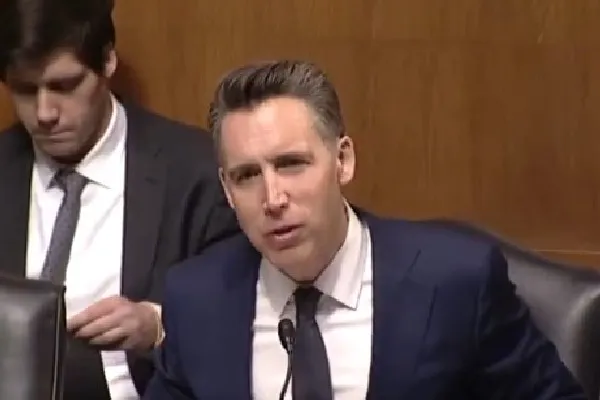
At a Congressional hearing on this issue, Senator Josh Hawley said the issue concerns “children who are being exploited” and “children whose abuse has been recorded and the images of whose abuse is still available, still online, still circulating right now”.
He said “hundreds of thousands of children remain unidentified in global law enforcement databases”, describing the material as “active crime scenes”.
“These are children whom our government could identify and rescue if we had the will and the resources to do it,” Hawley said.
A mother identified as Jane Doe told lawmakers her daughter was abused by her father as an infant, and the abuse was photographed and shared online with other offenders.
“My daughter was an infant when the abuse began,” she said, explaining that the crimes continued for nearly four years before being uncovered by an undercover investigator.
More than two decades later, she said the trauma has not ended because the images remain in circulation.
“Today, more than 25 years later, the harm has not ended,” she said. She told lawmakers she receives Justice Department notifications “now numbering in the tens of thousands” when offenders are found possessing the images.
“They're still online, they've made movies from her images,” she said, describing how perpetrators alter files to evade detection. “They change hashtags. They'll change something in the color of the shirt. They'll add a flower, they'll add a bunny to the picture.”
She said attempts to have the material removed from online platforms have largely failed.
“I've been fighting since day one,” she said, recounting how she was told to contact website operators herself to seek removal.
Tim Tebow, founder of the Tim Tebow Foundation, told the hearing that global databases show a rapidly growing number of unidentified child victims whose abuse images circulate online.
He said early estimates suggested about “20,000 boys and girls” in databases whose identities were unknown. Later reviews found “57,000 boys and girls”.
“It's over 89,000,” Tebow said. “We are losing the battle and we are losing the war and boys and girls are suffering for it.”
He cited a Justice Department map showing online activity linked to child sexual abuse material across the United States.
“Every one of those red dots is a unique IP address that is downloading, sharing or distributing child rape images almost all under the age of 12,” Tebow said, describing a six-month snapshot containing more than 338,000 such points.
Hawley told the hearing that in 2023 alone there were more than 104 million images and videos of suspected child abuse reported in the United States.
Stacey Sheehan of the National Center for Missing and Exploited Children (NCMEC) said the organisation’s Cybertipline — the central reporting mechanism used by the public and online platforms — has received more than 226 million reports related to child sexual exploitation.
“In 2020 alone, we received more than 21 million reports containing more than 61 million images, videos and other content,” she said.
Sheehan added that new reporting requirements have increased data flows to authorities, with a 323 per cent increase in child sex trafficking reports from 2025 compared with 2024.
Yasmine Wafa, executive director of Rights for Girls, told the panel that exploitation often targets vulnerable children such as runaways, youth in foster care and those experiencing homelessness.
“Across urban, rural and tribal communities, children are being bought and sold,” she said.
She argued enforcement frequently targets victims rather than buyers. “Hundreds of children are arrested for prostitution despite being legally incapable of consenting to sex,” Wafa said.
Julia Einbond, CEO of Covenant House New Jersey, said many trafficking victims first encounter authorities through homelessness or criminal charges rather than victim support systems.
“Brandon's story is a blueprint for how children fall through every gap we have failed to close,” she said, describing a child forced into drug dealing after years in foster care and homelessness.
Lawmakers from both parties said stronger laws and resources were needed to combat the growing online exploitation of children.
Senator Richard Durbin said Congress must move beyond discussion and act. “We need legislation not lamentation,” he said.
Child abuse images spread, US senators seek action
Advertisement