
On the other hand, the Organisation for Economic Co-operation and Development(OECD) released the 2022 Agricultural Policy Monitoring Report related to countries that are doing severe injustice to the farmers. Many countries' governments are using their capabilities very limitedly in purchasing and distributing agricultural products of farmers. It mentioned that even in India, farmers are not getting justice. The policies implemented from 2020 to 2022 have resulted in lower prices for our country's farmers compared to international markets. It stated that Indian agricultural policies have done severe injustice to farmers.
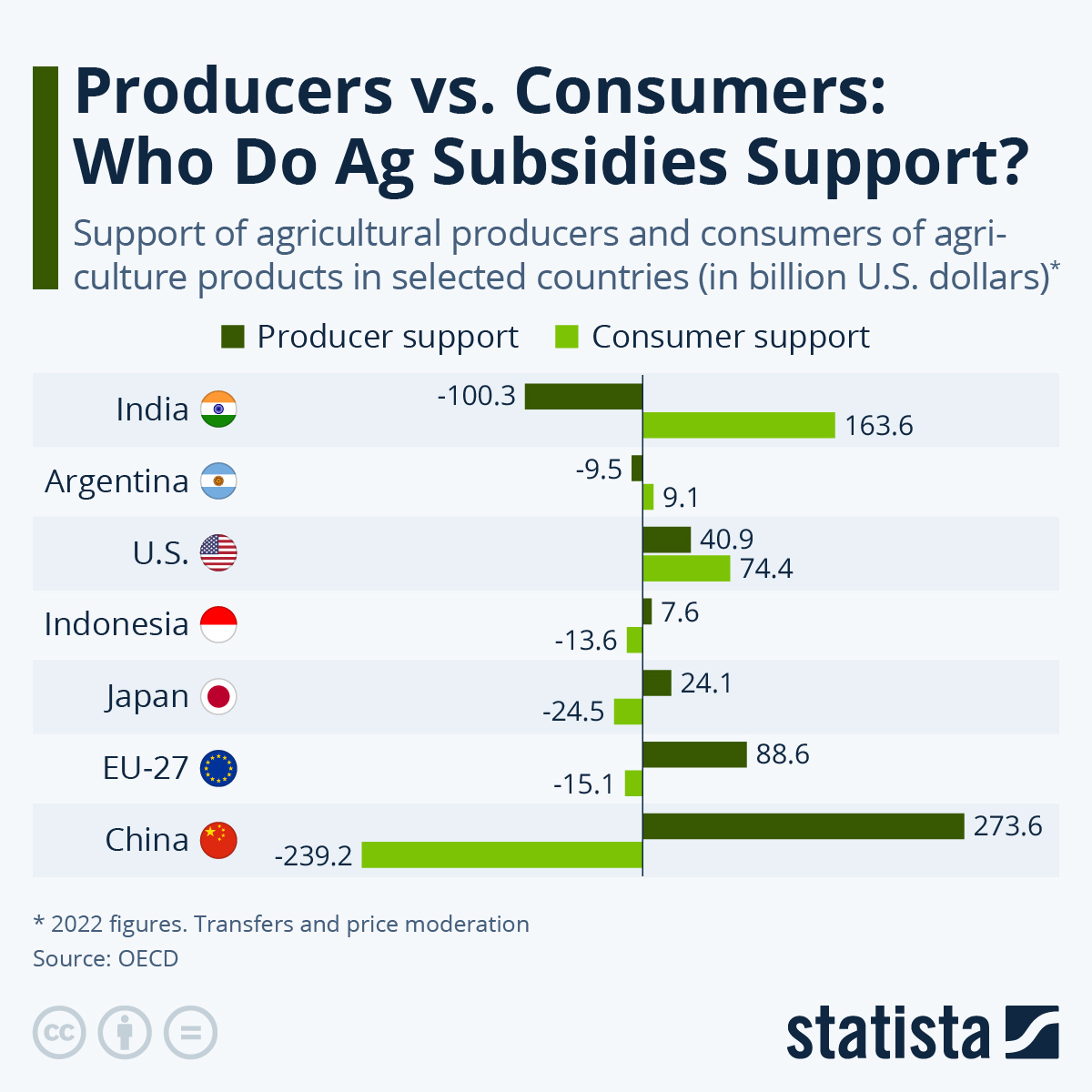
According to the report, in 2022, the Indian government's policies resulted in a loss of $100.3 billion to our farmers. Even after the aid and discounts received from the government, farmers faced such a loss. The situation is so dire that the support to consumers was at $163.6 billion, while the support to our hard-working farmers was at minus $100.3 billion. This statistic helps us understand the plight of the farmers. Despite the high consumption of agricultural products in our country, the lives of farmers are not improving. At the same time, corporate companies marketing agricultural products are making eye-watering profits.
The situation of farmers in China is different from this, where consumer support is horrendously high. However, the government support to farmers there was $273 billion. In this context, the US government supports its farmers by $40.9 billion.
In 2022, the Indian government made significant policy changes to encourage the agricultural sector in the context of global challenges. To increase farmers' income, the minimum support prices (MSP) for major crops like rice, maize, wheat, and pulses were raised. To reduce the burden on farmers due to rising international fertilizer prices, subsidies for fertilizers, including discounts for domestic fertilizer transportation, were increased. Programs such as promoting agriculture resilience to climate change, using drones for crop management, and digitizing land records were initiated to encourage technological progress.