
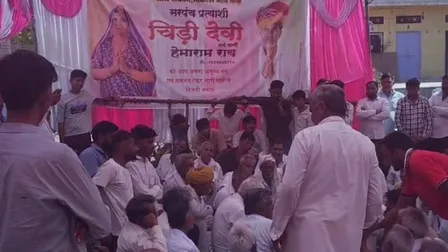
Jaipur, Oct 26 : In a remarkable example of social bonding, villagers in Nagaur district have raised Rs 25 lakh for Chidi Devi after she lost the sarpanch election by just 162 votes. The gesture has drawn attention to the spirit of community support and solidarity in rural Rajasthan.
Amid the results of the 2026 Panchayati Raj elections in Rajasthan, an inspiring story of social unity has emerged from Nagaur district in Bhadaura Gram Panchayat, under Mundwa Panchayat Samiti.
Villagers came together to honour Chidi Devi, a 45-year-old woman from a farming family, after she narrowly lost the sarpanch election.
While electoral defeats often leave candidates and their supporters disappointed, residents of Modi village chose to turn the occasion into a celebration of community spirit.
Following a village assembly, residents collectively raised Rs 25 lakh as a gesture of respect and appreciation for Chidi Devi and her family. Village elders, young people and prominent community members subsequently gathered with the money arranged on a ceremonial platter.
Accompanied by music and celebrations, they visited Chidi Devi’s home to present the amount, turning her electoral defeat into an occasion of honour.
The gesture has become a topic of discussion in Nagaur district and beyond, highlighting how community relationships can extend beyond the outcome of an election.
Chidi Devi, a resident of Modi village in Bhadaura Gram Panchayat, comes from a modest farming family. Her husband, Hemaram Rao, is also a farmer. In the sarpanch election, Chidi Devi contested against Girija Sandu, daughter-in-law of Madho Singh, a retired police Inspector from Bhadaura village. The contest was closely fought. Girija Sandu secured 1,317 votes, while Chidi Devi received 1,155 votes, resulting in a defeat by a margin of just 162 votes.
Although the result disappointed her supporters, the villagers decided to respond differently. Rather than allowing the electoral outcome to overshadow their relationships, they came together to recognise the candidate’s standing within the community.
Following the election results, a special panchayat was organised in the village. During the gathering, villagers and prominent local residents emphasised that electoral victory and defeat were temporary, while brotherhood, mutual respect and social unity were far more enduring.
The gathering was marked by a shared sentiment: “If there is a win, the entire village wins; if there is a loss, the entire village loses.”
Inspired by this spirit of solidarity, residents began contributing money collectively. They eventually raised Rs 25 lakh and presented the amount to Chidi Devi and her husband, Hemaram Rao, at their home. The contribution was intended as a gesture of appreciation and respect, demonstrating that the villagers valued their relationship with the family beyond the result of the sarpanch election.
According to villagers, the affection shown towards Hemaram Rao and his family reflects their longstanding involvement in local welfare activities.
Around two years ago, Hemaram Rao reportedly donated a new tractor to the village’s gaushala (cow shelter) using his personal savings.
He also established a facility providing drinking water to villagers and passersby. In addition, he announced plans to fund the drilling of a borewell to help address the village’s drinking-water needs. These contributions to local welfare are believed to have strengthened the family’s ties with residents and contributed to the widespread support they received after the election.
For the villagers, the decision to raise Rs 25 lakh was not simply about compensating a candidate for an electoral loss. It was also a way of acknowledging the family’s social contributions and reinforcing a sense of shared responsibility.
The unexpected gesture left Chidi Devi and Hemaram Rao deeply moved. Speaking to the media, Hemaram Rao acknowledged that the family had felt disappointed by the election result.
However, the villagers’ response transformed that disappointment into a moment of pride and gratitude. He expressed the view that holding political office was not the only measure of success and that the affection, respect and support of the people around him were far more valuable.
The villagers’ gesture has highlighted a broader message about rural life in Rajasthan: Political competition does not necessarily have to divide communities, and social relationships can remain strong even when election results disappoint individual candidates.
The story offers a striking example of how collective goodwill, community participation and mutual respect can take precedence over electoral victory or defeat.


