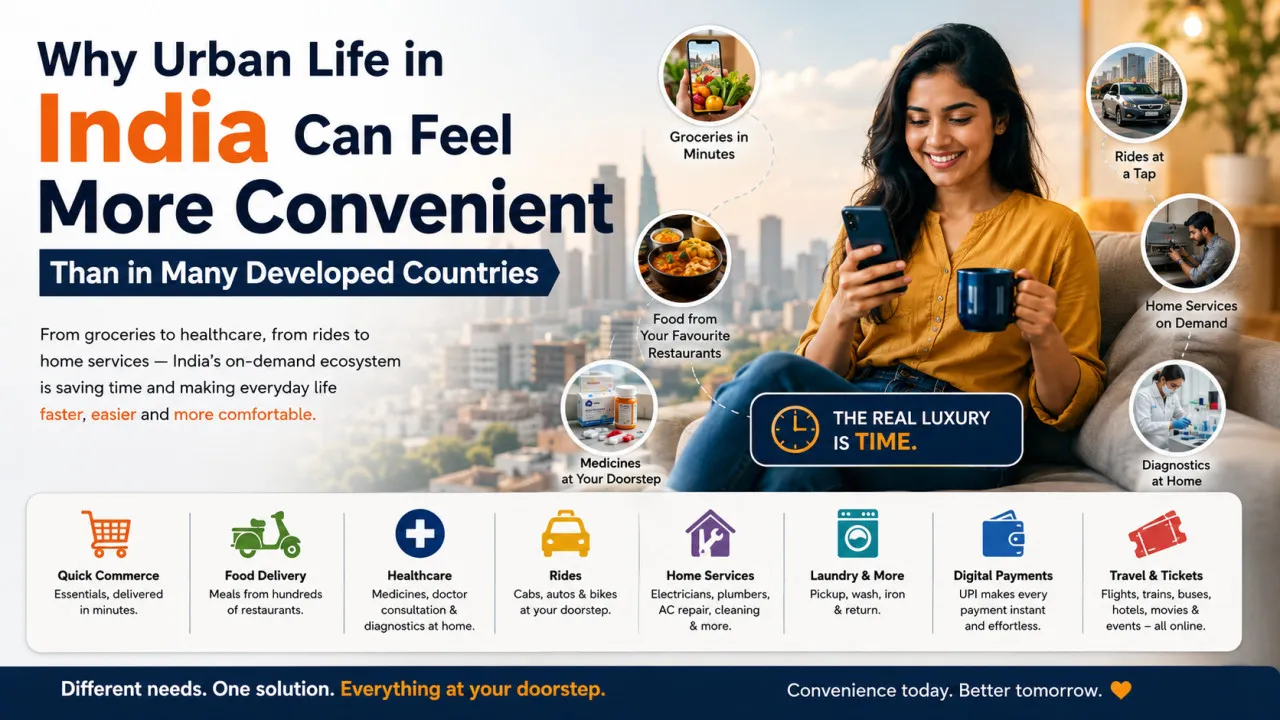
A grocery item needed urgently can arrive within minutes. Dinner can be ordered from hundreds of restaurants. Medicines can be delivered home. A technician can visit to collect a blood sample. A cab or auto can be summoned to the gate. An electrician, plumber, beautician or AC technician can be booked from a phone. Clothes can be collected for laundry and returned. And almost every small payment — from a cup of tea to an electricity bill — can be completed instantly through UPI.
Individually, none of these services is unique to India. Most developed countries have food delivery, e-commerce, ride-hailing and digital banking.
What makes urban India interesting is the combination, affordability, speed and sheer range of services available on demand.
In cities such as Hyderabad, Bengaluru, Mumbai, Delhi, Chennai and Pune, it is increasingly possible to organise much of everyday life without leaving home. That is creating a kind of convenience that can, in some respects, feel greater than what consumers experience in wealthier economies.
When ‘I Need It Today’ Became ‘I Need It Now’
Perhaps nothing captures this shift better than quick commerce.The weekly supermarket visit has not disappeared, but it is no longer essential for every forgotten item. Platforms such as Blinkit, Zepto and Swiggy Instamart have made rapid delivery part of everyday urban life.
Run out of milk in the morning? Order it.
Forgot onions while cooking dinner? Order them.
Unexpected guests arrive? Snacks and drinks can be at the door before the conversation has properly begun.
The remarkable part is not merely that groceries can be purchased online. E-commerce has existed for years. It is that consumers are becoming accustomed to treating the neighbourhood around them almost like an extension of their kitchen cupboard.
The grocery run, quite literally, is becoming less of a run.
India Has Put the Restaurant Industry in Your Pocket
Food delivery has followed a similar trajectory.With Swiggy and Zomato, a consumer sitting at home can browse restaurants across a large part of the city, compare menus and prices, place an order, pay digitally and watch its journey to the doorstep.
Breakfast before work, lunch at the office, dinner after a long day or sweets for unexpected visitors can all be arranged without stepping outside.
Again, food delivery exists across the world. But in India, dense cities, intense competition and a large restaurant ecosystem have helped make it part of the everyday routine rather than an occasional luxury.
The restaurant is still there. Indians continue to enjoy eating out.
What has changed is that going to the restaurant is no longer necessary to access the restaurant.
Healthcare Without Spending Half the Morning Waiting
The convenience becomes more consequential when it extends to healthcare.Medicines can be ordered online through platforms and pharmacy chains, subject to prescription requirements. For someone purchasing regular medicines for elderly parents or managing a chronic condition in the family, that can remove repeated pharmacy visits.
Then consider something as routine as a blood test.
Traditionally, it could mean waking up early, travelling to a diagnostic centre, waiting for registration, giving the sample and returning home.
Today, many laboratories will send a trained technician to the patient's home. The sample is collected there and the report arrives digitally.
Teleconsultations, physiotherapy, nursing and elder-care services have added further layers of convenience for appropriate needs.
This does not replace hospitals or in-person medical care when they are necessary. But it does eliminate a surprising amount of travel and waiting from routine healthcare.
The Cab Comes Looking for You
Ride-hailing may now seem ordinary, but it represented an important reversal in consumer behaviour.Earlier, the passenger looked for transport.
Now, the passenger stands still and the vehicle comes to them.
Apps can identify the pickup point, locate a driver, estimate the fare, navigate the route and handle payment.
That same idea — don't go looking for the service; make the service come to you — has subsequently spread across much of urban India.
And that is where the Indian convenience story becomes particularly interesting.
Need a Plumber? There Is an App for That Too
Anyone who has managed an Indian household knows the old routine.The AC stops cooling.
“Do you know a technician?”
A tap starts leaking.
“Ask the watchman for a plumber.”
An electrical switch fails.
“Call the person who came last time.”
Organised home-service platforms have begun replacing some of that uncertainty.
Electricians, plumbers, carpenters, AC technicians, appliance repair, pest control, deep cleaning and other services can increasingly be scheduled online.
Personal care has joined the same ecosystem. In many locations, beauticians and grooming professionals come home. Laundry can be collected, washed or ironed and returned. Some providers offer doorstep car cleaning and pet grooming.
This is one area where comparisons with developed countries become particularly interesting.
A service may be available in London, Sydney or New York, but the cost of sending a professional to someone's home can make frequent use expensive. India's large service economy and relatively lower labour costs can make such personal services accessible to a much broader section of the urban middle class.
That can make day-to-day life feel unusually convenient even when average incomes are substantially lower.
Even the Errand Can Be Outsourced
Suppose you leave your laptop charger at home.Or a signed document has to reach an office on the other side of the city.
Or a set of keys needs to be delivered to a family member.
Increasingly, the answer is not necessarily, “Who can go?”
It is, “Can someone pick it up?”
Local courier and logistics platforms can move documents, parcels and forgotten items across a city.
It is a subtle but important change.
India's digital economy is no longer merely delivering products.
It is beginning to deliver errands.
Then There Is UPI
If one innovation best represents India's ability to remove friction from everyday life, it may be UPI.The experience is now so routine that its significance is easy to overlook.
A vegetable vendor can display a QR code. A customer scans it, enters an amount and pays.
The same phone can pay a restaurant bill, transfer money to a friend, recharge a mobile connection or settle household bills.
No cash. No card terminal. No search for change.
For many Indians, banking has quietly moved from a place they visit to something running continuously in the background of daily life.
When UPI is combined with food delivery, quick commerce, ride-hailing and home services, the result is more powerful than any one platform.
The payment infrastructure makes the entire convenience ecosystem easier to use.
Almost the Entire City Is Now Inside the Phone
And the list keeps growing.Clothes, electronics, appliances and furniture can be ordered online.
Flights, trains, buses and hotels can be booked from a phone.
Cinema and event tickets can be purchased without visiting a counter.
Insurance can be renewed digitally.
Documents can increasingly be accessed through DigiLocker and other government platforms.
A modern Indian smartphone has, in effect, absorbed parts of the supermarket, restaurant, pharmacy, bank, travel agency, ticket counter, taxi stand and government office.
That is an extraordinary amount of everyday infrastructure concentrated in one device.
So Is India Really More Convenient Than Developed Countries?
Not in every respect — and certainly not everywhere.India continues to face serious challenges in urban infrastructure, traffic, pollution, public transport, pedestrian facilities and the consistency of public services. Convenience also varies enormously between a major metropolitan neighbourhood and a smaller town or rural area.
Developed countries frequently provide advantages India cannot yet match, including stronger public infrastructure, more predictable civic services and, in many cases, better urban planning.
But convenience is not a single measure.
And when the question becomes “How easily can I get an everyday task done?”, Indian cities can be remarkably competitive.
The difference lies in the combination.
Fast grocery delivery.
Affordable restaurant delivery.
Home diagnostics.
Medicine delivery.
Low-cost ride-hailing.
Home beauty services.
Electricians and plumbers on demand.
Laundry pickup.
Local parcel delivery.
Instant digital payments.
Each removes a small piece of friction from everyday life.
Together, they create something much bigger.
India’s Hidden Advantage Is Density
There is an economic reason much of this works.Indian cities are extraordinarily dense. Large numbers of consumers, shops, restaurants, pharmacies and service professionals can exist within a relatively small geographical area.
That makes an on-demand model more viable.
A delivery worker does not necessarily need to travel long distances between customers. A restaurant may have thousands of potential customers within its delivery radius. A neighbourhood warehouse can serve a large population nearby.
Add affordable smartphones, inexpensive mobile data, GPS, UPI and increasingly sophisticated logistics, and the conditions become unusually favourable for an on-demand economy.
India did not simply digitise shopping.
It connected a vast informal and formal service economy to the smartphone.
The Real Luxury Is Time
There is another way to look at all this.Suppose a family spends an hour buying groceries, half an hour visiting a pharmacy, part of a morning getting a blood test, another hour at a salon and several hours arranging a household repair.
Add traffic, parking and waiting, and seemingly minor errands can consume a significant portion of a weekend.
Now imagine that groceries arrive, medicines are delivered, the diagnostic technician visits the home and the electrician turns up at a booked time.
What has the family actually purchased?
Not merely groceries, medicines or repairs.
It has purchased time.
And perhaps that is the most important way to understand India's convenience economy.
Convenience Has Another Side
Of course, all this comfort comes with trade-offs.Delivery and platform charges add up. Constant access can encourage unnecessary consumption. Packaging creates waste. More delivery vehicles add to already congested roads.
There are also legitimate concerns about the income, safety and social security of the gig workers whose labour makes this convenience possible, as well as questions around privacy and the enormous quantities of personal and financial data moving through digital platforms.
The convenience economy should therefore not be romanticised.
But neither should the transformation be underestimated.
From ‘Where Do I Have to Go?’ to ‘Can It Come to Me?’
Perhaps the biggest change is not technological at all.It is behavioural.
A generation ago, everyday life revolved around going somewhere.
You went to the market for groceries.
You went to the restaurant for food.
You went to the pharmacy for medicines.
You went to the laboratory for a test.
You went to the bank to transfer money.
You searched for a taxi.
You found someone who knew an electrician.
Today, the instinct is increasingly different.
Can it be delivered?
Can I book it online?
Can someone come home?
Can I pay for it instantly?
That change in expectation may be one of the clearest signs of how profoundly urban Indian life has evolved.
India may not yet match developed economies on every measure of quality of life. But in one particular area — the ability to get everyday things done quickly, affordably and without leaving home — its largest cities have built something distinctive.
And that explains why an Indian returning home after spending time abroad may occasionally experience an unexpected feeling.
Not that India has suddenly become wealthier than the developed world.
But that, for many of life's small everyday needs, life here can sometimes be remarkably easier.
After all, the most valuable thing being delivered to the Indian doorstep may not be groceries, dinner or medicine.
It may be time itself.