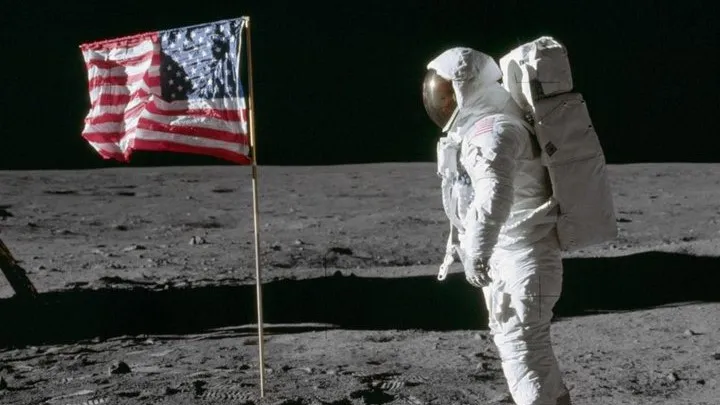
Washington, July 21 : Marking Space Exploration Day, US President Donald Trump hailed America's achievements in space exploration, saying the country would continue to lead humanity into a "new Golden Age of space exploration" while advancing missions to the Moon and, eventually, Mars.
In a presidential message issued by the White House on the 57th anniversary of the Apollo 11 Moon landing, Trump linked America's historic lunar mission to his administration's space agenda, highlighting the Artemis programme, the US Space Force and what he described as a long-term strategy to secure American leadership in space.
"On Space Exploration Day, we commemorate one of the greatest achievements in the history of our Republic: landing Americans upon the surface of the Moon," Trump said. "Inspired by that giant leap, we look ahead with bold resolve, certain that America will continue to lead humanity into a new Golden Age of space exploration."
Recalling the Apollo 11 mission of July 20, 1969, Trump paid tribute to astronauts Neil Armstrong, Buzz Aldrin and Michael Collins, saying their achievement demonstrated that "no frontier lies beyond the reach of a free and unwavering people."
"Fifty-seven years later, the legacy of Apollo still burns in the hearts of all Americans, calling each generation to reach higher into the cosmos than the last," he said.
The President said his administration was building on that legacy through the Artemis programme. He referred to the recent Artemis II mission, saying American astronauts Reid Wiseman, Victor Glover and Christina Koch, together with Canadian astronaut Jeremy Hansen, had "soared into deep space aboard Artemis II for the first time in over 50 years."
The mission has "propelled us toward the Artemis missions, which will return American astronauts to the Moon, establish a human presence, and lay the foundation to reach the red dunes of Mars and the boundless frontier beyond, where American courage will discover what none have ever dared to imagine," the president said.
Trump also used the occasion to underscore the national security dimension of America's space programme.
"This new era rests upon a foundation of unrivalled American strength in space," he said, adding that the same innovation supporting lunar exploration also powers "our incredible United States Space Force, whose innovative technology shields every American family while safeguarding our Nation's national security from above."
Highlighting his first administration's space policies, Trump said he had been "proud to reestablish the National Space Council," describing it as a mechanism to bring together the military, scientists, industry and the Space Force behind "a single purpose: securing American dominance in space for all time to come."
He pledged that "under my leadership, America will continue to push beyond every boundary and lead the world ever deeper into the universe."
Trump Hails US space achievements; pledges push toward Moon, Mars