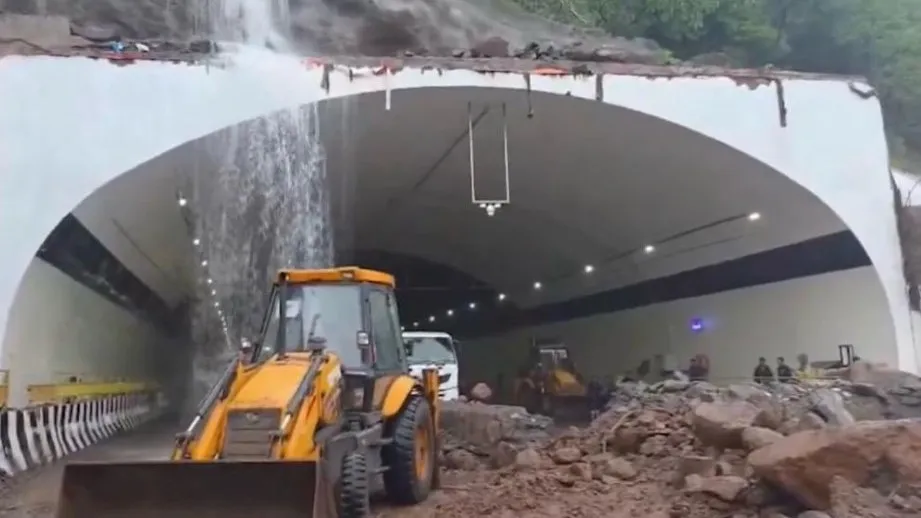
Mumbai, July 6 : Incessant torrential rains over the past two days across Mumbai and Pune triggered a major landslide on the newly inaugurated Mumbai-Pune Missing Link, which was opened to the public just two months ago.
The landslide severely disrupted traffic, temporarily snapping the direct connectivity between the two major cities.
Following the incident, the Maharashtra State Road Development Corporation (MSRDC) has attributed the disaster to nature, calling it an "Act of God."
An MSRDC officer strongly defended the construction team, stating that the contractor was not at fault and that this was purely a play of nature. MSRDC clarified that while landslide mitigation measures and designs were implemented, they inherently had operational limitations.
Further, an MSRDC official classified the event as divine wrath, explaining that rockfall prevention measures certified by IIT-Bombay had been deployed at the site. This included installing rock bolting (iron netting) up to 15 metres in height on the mountain slope directly above the tunnel, which remains intact and secure.
However, the massive boulders that crashed down originated from a height of nearly 150 metres.
The official added that mitigating such a disaster becomes nearly impossible during such 'divine wrath-like' torrential downpours.
He noted that once the rains subside, they will inspect the rocks and evaluate if the netting can be extended higher up the slope. However, he added that this will be an expensive affair and will require utilising forest department land.
The landslide occurred at approximately 3:30 AM on Monday, July 6. According to MSRDC, the debris came crashing down at the exit of the first tunnel on the Pune-to-Mumbai corridor of the Missing Link. The impact damaged the protective retaining wall, rendering the stretch unsafe for transit.
The landslide followed recent political scrutiny after potholes emerged on the 'Missing Link' stretch on Sunday, drawing sharp criticism from opposition parties against the state government. However, Chief Minister Devendra Fadnavis downplayed the issue, labelling it a minor incident.
Despite the disruption, MSRDC emphasised that the existing safety barriers played a crucial role in mitigating the impact. The barriers effectively absorbed the velocity and force of the falling rocks.
It stated that had these safety shields not been in place, the devastation caused by these massive boulders would have been catastrophic.
The mechanism successfully slowed down the tumbling rocks, preventing them from directly crushing vehicles below, and the consequences would have been extremely severe without these measures.
Authorities have announced plans to conduct a fresh geological survey of the terrain once the monsoon season concludes. This survey will help determine whether the rockfall protection system needs to be extended higher up the mountain.
MSRDC added that they will investigate the feasibility of installing additional iron netting at higher altitudes, but this will incur substantial financial costs and require permissions, as the execution will take place on forest department land.
Following the early Monday morning landslide, the Pune-to-Mumbai corridor of the 13.3-km-long 'Missing Link' project has been completely shut down.
While the Mumbai-to-Pune corridor has been restored for smooth transit, vehicles heading towards Mumbai are currently being diverted via the old Mumbai-Pune Highway (NH-48).
Debris clearance operations are actively underway.
‘Act of God’: Landslide disrupts Mumbai-Pune missing link