
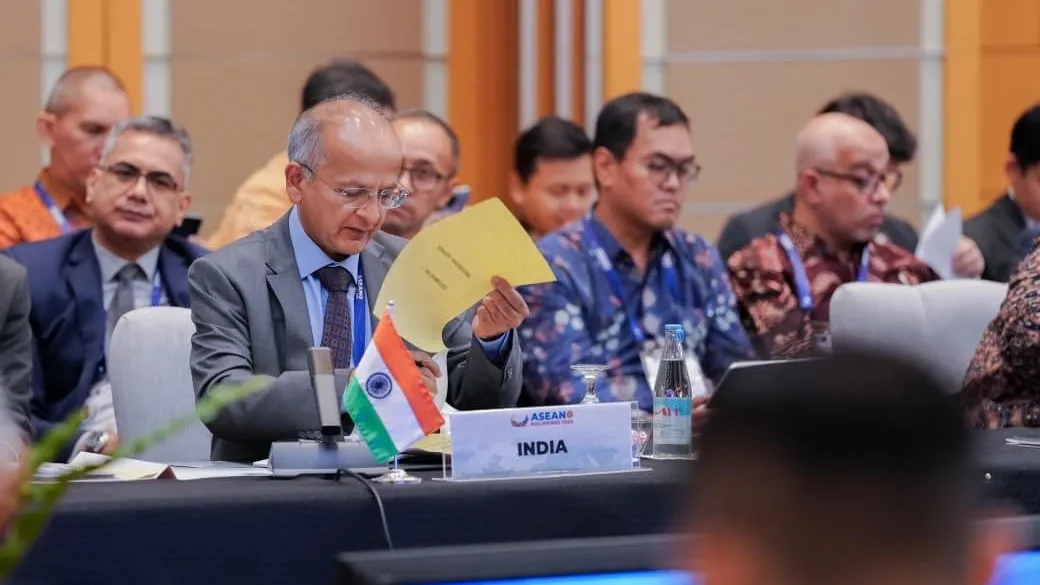
Manila, June 10 : India has highlighted the importance of the Asean Regional Forum (ARF) mechanism and support for dialogue and diplomacy in addressing contemporary geopolitical challenges at the ARF Senior Officials’ Meeting in the Philippines capital, the MEA said on Wednesday.
In a statement shared on X, Ministry of External Affairs (MEA) spokesperson Randhir Jaiswal said: "Secretary (East) Shri Rudrendra Tandon led the Indian delegation at the Asean Regional Forum (ARF) Senior Officials’ Meeting in Manila on 09 June 26. He highlighted the critical relevance of ARF mechanism and support for dialogue and diplomacy in addressing the contemporary geopolitical challenges."
"Deliberations were held on the regional and international security scenario with a call for combined efforts in maintaining a rules-based order for the global commons in the Indo-Pacific," he added.
The ASEAN Regional Forum (ARF) was set up in 1993 as a regional security cooperation and dialogue platform based on deliberations in the ASEAN Post Ministerial Conference between the Foreign Ministers of ASEAN and its full dialogue partners, according to the MEA statement. In 1995, the ARF agreed to an evolutionary approach to effectively tackle security issues and adopted a three-stage process, viz, first stage Confidence Building Measures (CBMs); second stage- development of preventive diplomacy; and third stage - elaboration of approaches to conflicts. Since its inception, ASEAN's values of consensus, confidence-building and progress at a pace comfortable to all have guided the ARF process.
The ARF comprises 27 members - the 11 ASEAN member states - Brunei, Cambodia, Indonesia, Laos, Malaysia, Myanmar, Philippines, Singapore, Thailand, Timor-Leste and Vietnam, the 10 ASEAN Dialogue Partners: Australia, Canada, China, the European Union (EU), India, Japan, New Zealand, South Korea, Russia, and the United States, as well as Bangladesh, North Korea, Mongolia, Pakistan, Sri Lanka, and Papua New Guinea.
In a statement shared on X, Ministry of External Affairs (MEA) spokesperson Randhir Jaiswal said: "Secretary (East) Shri Rudrendra Tandon led the Indian delegation at the Asean Regional Forum (ARF) Senior Officials’ Meeting in Manila on 09 June 26. He highlighted the critical relevance of ARF mechanism and support for dialogue and diplomacy in addressing the contemporary geopolitical challenges."
"Deliberations were held on the regional and international security scenario with a call for combined efforts in maintaining a rules-based order for the global commons in the Indo-Pacific," he added.
The ASEAN Regional Forum (ARF) was set up in 1993 as a regional security cooperation and dialogue platform based on deliberations in the ASEAN Post Ministerial Conference between the Foreign Ministers of ASEAN and its full dialogue partners, according to the MEA statement. In 1995, the ARF agreed to an evolutionary approach to effectively tackle security issues and adopted a three-stage process, viz, first stage Confidence Building Measures (CBMs); second stage- development of preventive diplomacy; and third stage - elaboration of approaches to conflicts. Since its inception, ASEAN's values of consensus, confidence-building and progress at a pace comfortable to all have guided the ARF process.
The ARF comprises 27 members - the 11 ASEAN member states - Brunei, Cambodia, Indonesia, Laos, Malaysia, Myanmar, Philippines, Singapore, Thailand, Timor-Leste and Vietnam, the 10 ASEAN Dialogue Partners: Australia, Canada, China, the European Union (EU), India, Japan, New Zealand, South Korea, Russia, and the United States, as well as Bangladesh, North Korea, Mongolia, Pakistan, Sri Lanka, and Papua New Guinea.


