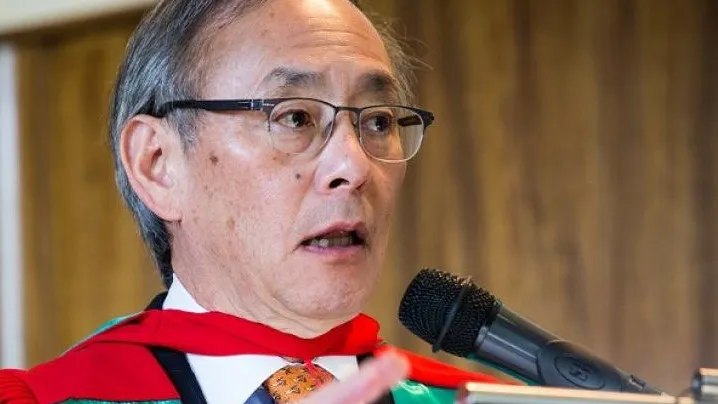
Stanford, April 18 : Nuclear power could anchor India’s energy independence, former US Energy Secretary and Nobel Laureate Steven Chu said, warning that geopolitical tensions are exposing vulnerabilities in global fuel markets.
Chu, who led US energy policy during a period of expanding clean energy cooperation with India, said the bilateral relationship had been strong and focused on sustainability goals.
“Well, when I was energy secretary, I had really close warm relationships with my counterparts in India,” he told IANS in an interview. “They were very serious in those days about sustainability, climate change, all of these things.”
He expressed hope that momentum would continue despite recent policy shifts. “I hope that India remains committed to these ideals. There's been maybe a little setback in the United States, but I'm hoping that we will return back to this commitment.”
Chu emphasised that large economies must move in tandem to address global challenges. “I think it's very important that all the major countries around the world — the EU, US, India, China — all these countries… these are the major movers I see in the world going for the future.”
On areas of future collaboration, he pointed to nuclear energy and emerging reactor technologies. “Well, there's a few things. I think India is developing… breeder reactors, which I think is wonderful,” he said. “These are fast term reactors that help burn down a lot of the fuel for conventional cision reactors.”
He linked recent conflicts to a renewed urgency around domestic energy security. “I think the recent wars — Ukraine, Iran — have made energy security, energy access within your own borders a very important part of this.”
Chu said nuclear power offers a clear advantage in ensuring stable supply. “I see nuclear where you can put the fuel in your country, compact energy generation, and you have years of energy supply,” he said. “Whereas natural gas… is measured in weeks or at most months.”
Asked if nuclear energy could help India achieve energy independence, Chu said: “Yes, as long as they figure out how to build the reactors on budget, on time.”
He cited China’s approach to reactor construction as an example of efficiency. “China has figured this out. They've got two dozen reactors that are on budget, on time, and they're working down the learning curves,” he said. “They use the same crew to build reactor one to two, to three to four.”
“This is the way you can do this. I think the world should follow that example,” he added. “I am very encouraged. I'm a big fan of cision.”
Chu also addressed concerns over nuclear waste disposal, calling it manageable with technological innovation. “The waste problem is a solvable problem,” he said.
He described new techniques being explored. “I'm an advisor to a group trying to look at technologies… used in oil drilling to drill boreholes down a kilometre… and then sideways and deposit nuclear waste in canisters unmanned.”
Such methods, he said, could reduce costs and expand storage options. “It has the potential of making available many more geological sites,” he said. “But most important it will low cost.”
“If you think of human space flight versus unmanned space flight, it's like night and day,” he added. “So if you can deposit things without making tunnels and air ventilation shafts… it would be a big deal.”
Chu said these advances strengthen the case for a revival of nuclear power. “I am very much interested in seeing nuclear have a new renaissance,” he said.
On fossil fuels, he noted the growing role of the United States in global supply but cautioned against overestimating its dominance. “Well, I think… the United States widely has become the big supplier of fossil fuel in the world,” he said.
At the same time, he stressed the interconnected nature of global markets. “Just because United States is now a significant player does not mean the Middle East, Russia, all these other countries are part of this supply,” he said. “And so we need a little bit more world stability.”
Turning to the crisis in the Gulf, Chu warned of prolonged economic effects. “Well, I'm hoping the blockade, everything will end. This is serving no purpose,” he said.
He noted that even limited disruption can have lasting consequences. “Most of the oil production, gas production infrastructure has been preserved. If they started bombing that, that would be tragic,” he said.
“But even without that, it's gonna take months for the economy to recover,” he added. “The oil prices, the gasoline prices, the diesel fuel prices, they're not gonna go down in a week.”
“They may go down in a half a year, but… there's a lag,” he said, highlighting delayed relief for consumers.
Chu underscored the importance of stable trade flows. “It shows you how important it is not to disrupt the trade patterns that have been established that have actually led to a lot of the prosperity in the world.”
India is among the fastest-growing major energy consumers, with demand rising sharply due to industrial growth and urbanisation. The country has been expanding its energy mix, including renewables and nuclear power, to reduce dependence on imports and improve long-term energy security.
Nuclear power key to India’s energy independence: Former US Energy Secretary (IANS interview)
Advertisement