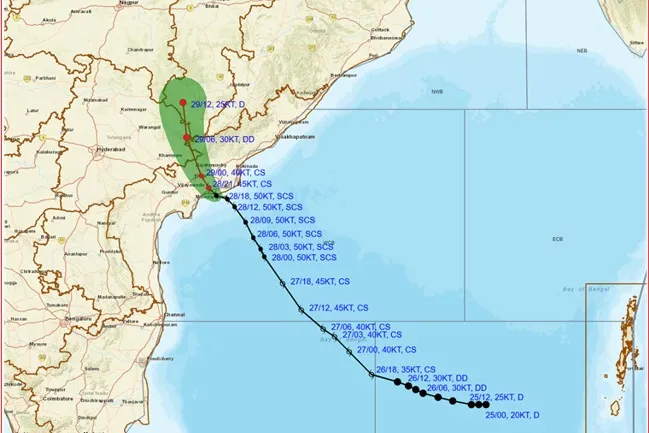
Cyclone Montha, which had caused severe anxiety among coastal residents for the past three days, finally crossed the coast without major damage. The cyclone made landfall near Narasapuram around 1:00 a.m., but it was far less destructive than forecast, bringing relief to both the public and the administrative machinery. Although the region narrowly escaped a major disaster, air and rail transport services were disrupted due to the storm.
How It Weakened
Initially, while still over the sea, Cyclone Montha had intensified into a severe cyclonic storm, reminiscent of Cyclone Michang that struck in 2023. The India Meteorological Department had warned that wind speeds could reach up to 110 kmph during landfall. However, when the cyclone was about 70–100 kilometers offshore, it encountered a “wind shear” effect — a sudden change in wind direction and speed — which disrupted the cyclone’s eye. As a result, the system’s internal structure collapsed, and its strength diminished. By the time it reached land, the winds had weakened to 70–80 kmph, accompanied only by moderate rainfall.
Pre-Landfall Impact in Konaseema
Before reaching the shore, Cyclone Montha had already affected Dr. B.R. Ambedkar Konaseema district. From morning till evening, strong gusts uprooted several coconut and large trees. Electricity poles snapped, cutting off power supply in multiple mandals. Sea waves surged up to three meters high and advanced nearly 300 meters inland, causing coastal erosion. However, after 8:00 p.m., the weather changed unexpectedly — fierce winds subsided and heavy rainfall began to ease.
Overall, Cyclone Montha, which had been expected to cause extensive destruction, eventually passed with relatively mild impact.
‘Wind Shear’ Weakens Cyclone Montha; Coastal Region Breathes a Sigh of Relief