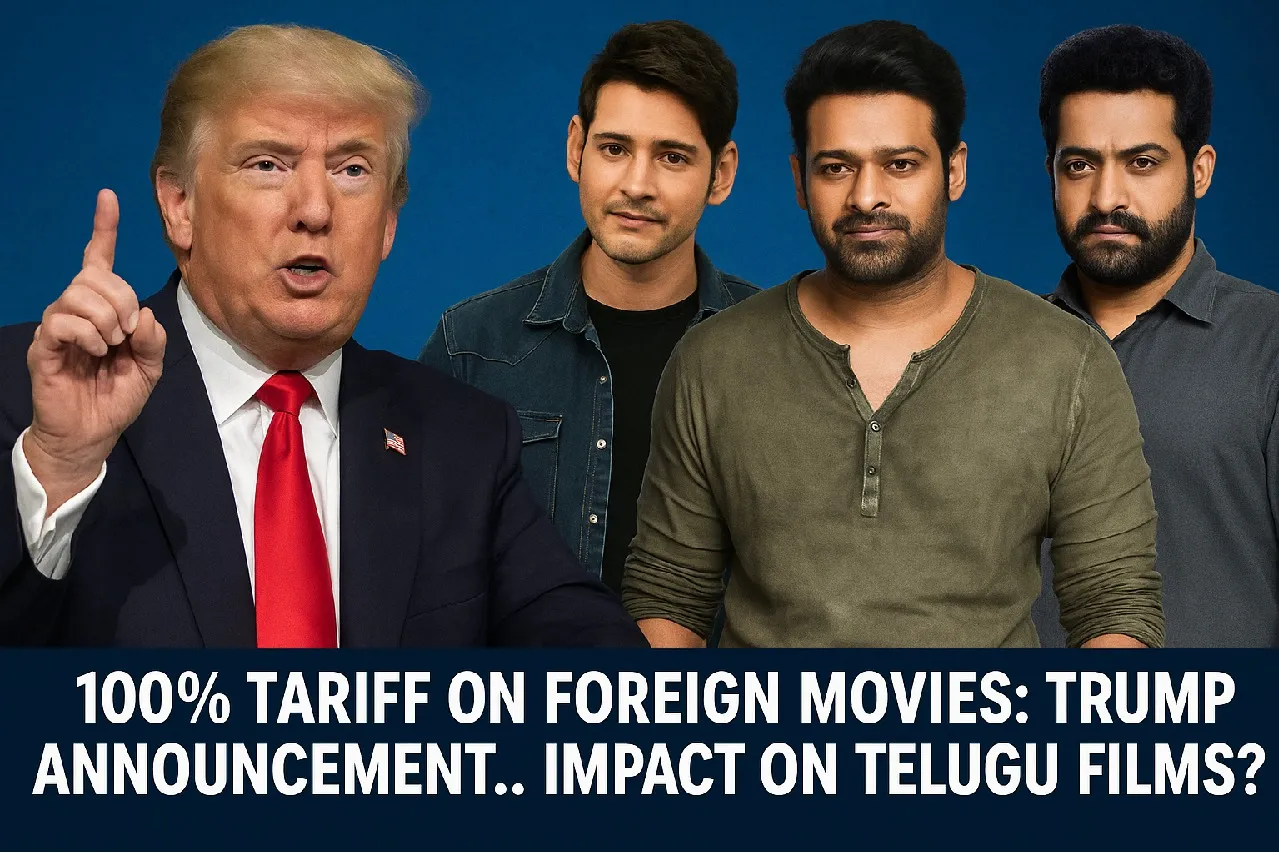
United States President Donald Trump has issued a striking directive that could significantly affect foreign film industries, including the thriving Telugu film market in America. On Monday, Donald Trump announced an immediate imposition of a 100 percent tariff on all kinds of films produced abroad and imported into the United States. He revealed this decision via a post on his ‘Truth Social’ account, stating that he had issued instructions to the U.S. Department of Commerce and the United States Trade Representative accordingly.
Donald Trump expressed concern that the U.S. film industry is rapidly being undermined. He alleged that foreign governments are providing various incentives to attract American filmmakers and studios to operate in their countries. “Hollywood and many regions in the U.S. are being adversely affected by this. It is a collective effort by other countries and thus poses a threat to national security,” said Donald Trump. He further stated that foreign films are also being used for anti-American propaganda and to spread misleading messages. “We want films that are made in America,” he emphasized.
Responding to Trump’s directive, U.S. Commerce Secretary Howard Lutnick stated on the platform ‘X’ that the process has already been initiated.
Potential Impact on Telugu Cinema
Industry analysts have raised concerns that the Trump administration’s decision could place a significant burden on Indian films released in the U.S., particularly Telugu films. At present, Telugu cinema enjoys a substantial market in the United States, with many films entering the million-dollar club and achieving strong box office returns. Even in 2025, several Telugu films have been highly successful in the U.S. market.
With the newly announced 100 percent tariff, import costs for distributors releasing Telugu films in America are expected to double. Experts suggest that distributors might transfer this burden to audiences through increased ticket prices. This could lead to a notable rise in ticket rates, potentially reducing theatre attendance and negatively affecting box office revenues.
Due to rising costs and shrinking profit margins, Telugu film distributors in the U.S. may become more cautious when acquiring films in the future. Only large-budget productions featuring top stars might be able to absorb this additional financial strain. Industry sources expressed concern that the release of small and mid-budget Telugu films in the U.S. could become uncertain.
It remains unclear whether the newly imposed tariffs apply only to theatrical film prints or also extend to content released on digital streaming platforms. Furthermore, it is yet to be clarified whether the regulations target foreign production companies or American companies that shoot films overseas. The film industry is awaiting further details to understand how these developments will ultimately affect the overseas market for Telugu films.
Telugu Films in U.S. May Suffer as Trump Orders Steep Tariff on Import