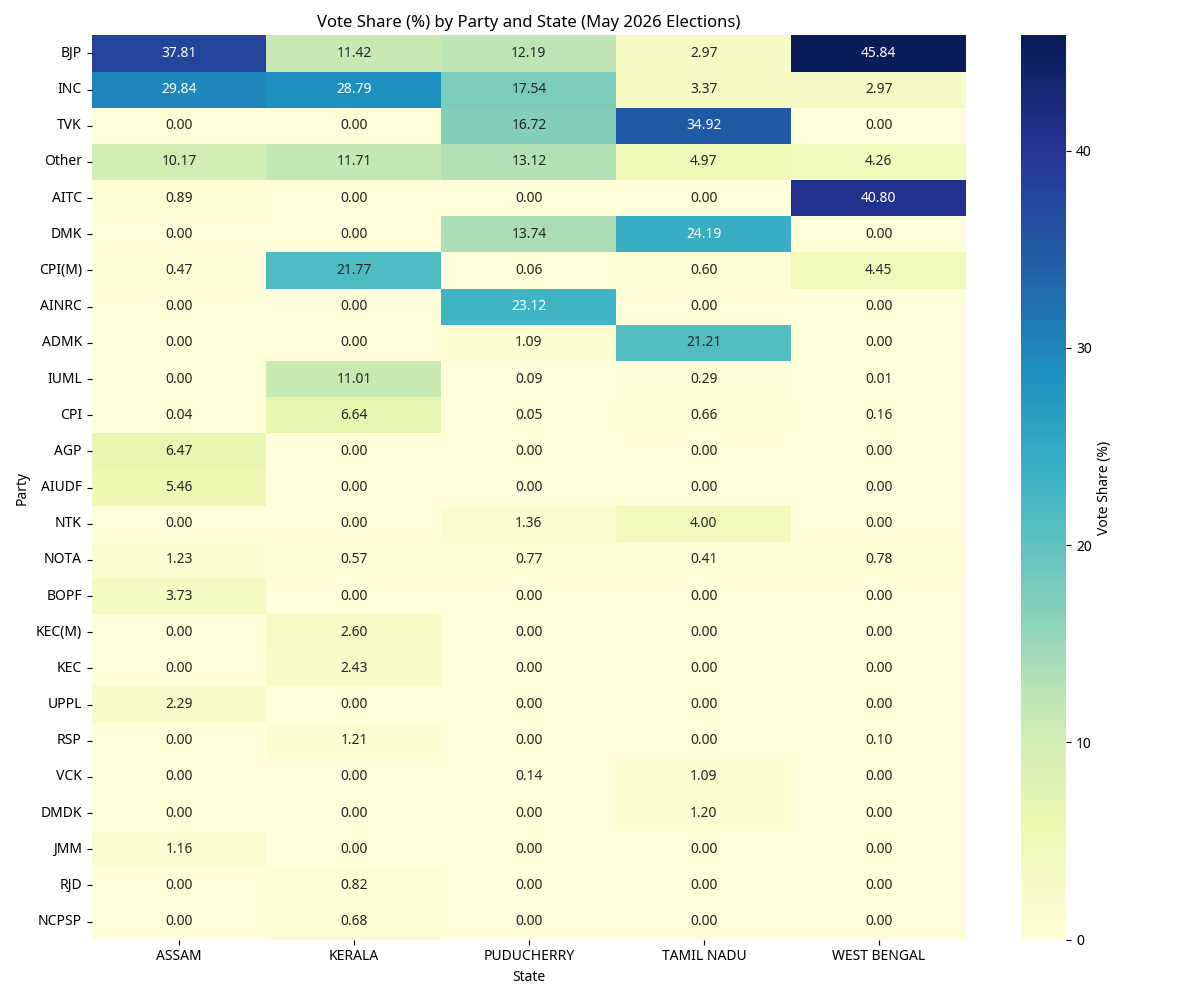
State-wise Party Vote Share (May 2026 Elections)
| State | ASSAM | KERALA | PUDUCHERRY | TAMIL NADU | WEST BENGAL |
|---|---|---|---|---|---|
| Party | |||||
| BJP | 37.81% | 11.42% | 12.19% | 2.97% | 45.84% |
| INC | 29.84% | 28.79% | 17.54% | 3.37% | 2.97% |
| TVK | 0.00% | 0.00% | 16.72% | 34.92% | 0.00% |
| Other | 10.17% | 11.71% | 13.12% | 4.97% | 4.26% |
| AITC | 0.89% | 0.00% | 0.00% | 0.00% | 40.80% |
| DMK | 0.00% | 0.00% | 13.74% | 24.19% | 0.00% |
| CPI(M) | 0.47% | 21.77% | 0.06% | 0.60% | 4.45% |
| AINRC | 0.00% | 0.00% | 23.12% | 0.00% | 0.00% |
| ADMK | 0.00% | 0.00% | 1.09% | 21.21% | 0.00% |
| IUML | 0.00% | 11.01% | 0.09% | 0.29% | 0.01% |
| CPI | 0.04% | 6.64% | 0.05% | 0.66% | 0.16% |
| AGP | 6.47% | 0.00% | 0.00% | 0.00% | 0.00% |
| AIUDF | 5.46% | 0.00% | 0.00% | 0.00% | 0.00% |
| NTK | 0.00% | 0.00% | 1.36% | 4.00% | 0.00% |
| NOTA | 1.23% | 0.57% | 0.77% | 0.41% | 0.78% |
| BOPF | 3.73% | 0.00% | 0.00% | 0.00% | 0.00% |
| KEC(M) | 0.00% | 2.60% | 0.00% | 0.00% | 0.00% |
| KEC | 0.00% | 2.43% | 0.00% | 0.00% | 0.00% |
| UPPL | 2.29% | 0.00% | 0.00% | 0.00% | 0.00% |
| RSP | 0.00% | 1.21% | 0.00% | 0.00% | 0.10% |
| VCK | 0.00% | 0.00% | 0.14% | 1.09% | 0.00% |
| DMDK | 0.00% | 0.00% | 0.00% | 1.20% | 0.00% |
| JMM | 1.16% | 0.00% | 0.00% | 0.00% | 0.00% |
| RJD | 0.00% | 0.82% | 0.00% | 0.00% | 0.00% |
| NCPSP | 0.00% | 0.68% | 0.00% | 0.00% | 0.00% |
| BSP | 0.00% | 0.15% | 0.00% | 0.11% | 0.18% |
| AAAP | 0.14% | 0.17% | 0.00% | 0.00% | 0.00% |
| AIFB | 0.00% | 0.00% | 0.00% | 0.01% | 0.28% |
| CPI(ML)(L) | 0.13% | 0.00% | 0.00% | 0.01% | 0.07% |
| NPEP | 0.16% | 0.00% | 0.00% | 0.00% | 0.00% |
| AIMIM | 0.00% | 0.00% | 0.00% | 0.00% | 0.09% |
| RASLJP | 0.00% | 0.00% | 0.00% | 0.00% | 0.01% |
| NCP | 0.00% | 0.00% | 0.00% | 0.00% | 0.00% |
In West Bengal, the Bharatiya Janata Party (BJP) secured a historic victory, ending the Trinamool Congress's (TMC) 15-year hold on power. The BJP captured a commanding 45.84 percent of the vote, pushing the ruling TMC to second place with 40.80 percent. This decisive five-percent margin proved crucial in securing a clear majority for the saffron party. Similarly, the BJP retained its stronghold in Assam, securing a third consecutive term with a 37.81 percent vote share, comfortably ahead of the principal opposition, the Congress, which garnered 29.84 percent.
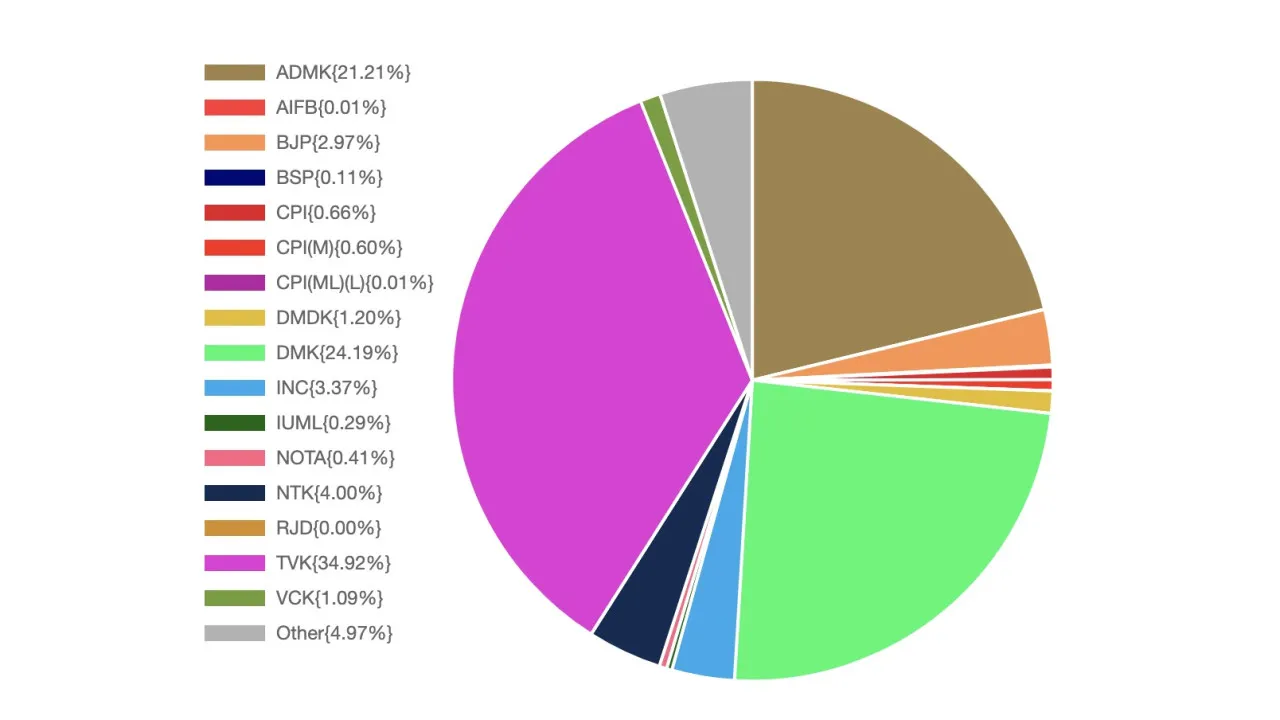
However, the most significant disruption emerged in Tamil Nadu, where actor-turned-politician Vijay's newly formed Tamilaga Vettri Kazhagam (TVK) made a sensational electoral debut. The TVK emerged as the single largest party by vote share, securing a massive 34.92 percent and pushing the state into a hung assembly. Traditional Dravidian heavyweights were left trailing; the ruling DMK secured 24.19 percent, and the AIADMK settled at 21.21 percent, effectively turning Tamil politics into a fierce multi-cornered contest.
In Kerala, voters maintained their tradition of alternating governments, handing a clear mandate to the Congress-led United Democratic Front (UDF). The Congress party anchored this victory with a 28.79 percent vote share, while the CPI(M), the principal party of the outgoing Left Democratic Front (LDF), managed 21.77 percent. Meanwhile, in the Union Territory of Puducherry, the NDA alliance took power, driven largely by the All India N.R. Congress (AINRC), which alone accounted for 23.12 percent of the popular vote.
Ultimately, the vote share statistics from these five states highlight a profound realignment in regional politics. While established parties successfully consolidated power in certain states, the dramatic rise of new political forces indicates a highly dynamic and shifting electorate.