Washington, April 23, : The man remembers the sound first. "It was the loudest noise I ever felt in my entire life… people were screaming… it was just a horrific, horrific heart that I can't get outta my brain," said a 9/11 survivor, his voice breaking as he recalled the moment the second plane struck.
Inside a hall on Capitol Hill, thousands of miles from Kashmir, Mumbai and New York, those memories were not abstract. They were the centrepiece of an exhibition -- The Human Cost of Terrorism -- that sought to collapse geography and time into something more immediate: grief that lingers, families that endure, and lives that never return.
The exhibition, hosted with the support of the Embassy of India, marked a convergence of anniversaries -- one year since the killing of 26 civilians in an attack in Kashmir, and 25 years since the September 11 attacks in the United States.
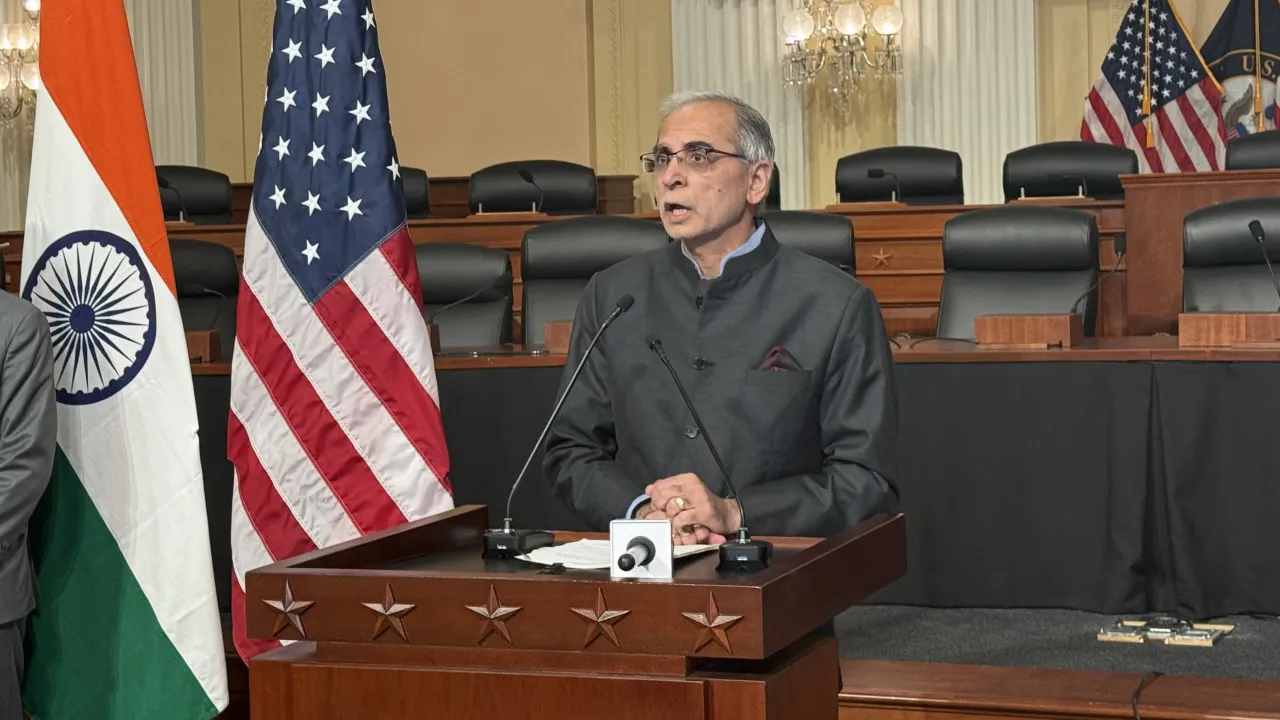
"Today's event is in memory of those who lost their lives," India's Ambassador to the United States, Vinay Mohan Kwatra, told IANS in an interview, "but it's also an expression of continuing resolve… to fight this menace."
Yet for those who spoke, the language of policy -- intelligence-sharing, alliances, deterrence -- repeatedly gave way to something more fragile and more human.
Chris Gruman, a retired US Army sergeant who was inside the Pentagon on September 11, did not speak in abstractions. He spoke in images.
A woman carrying a baby. Flames swallowing corridors. A man's silhouette burned into glass.
"I grabbed the baby… and together we ran for 60 yards away from the burning building," he said, recounting how instinct took over.
He described returning again and again to the building, pulling out survivors and bodies. "I had the honour over 60 hours… with my name on 63 body bags that I pulled out," he said.
Twenty-five years later, the damage has not faded.
"I have asthma, severe asthma," he said. "But I go around talking… because it's an honour."
If the exhibition sought to make a point, it was this: terrorism is not a moment. It is a continuum -- of trauma, memory and consequence.
"What people don't realise is the carnage that comes after that," Gruman said. "The mental carnage, the physical carnage… the family members who lost somebody."
Around him, lawmakers spoke of strategy and solidarity. But even they kept returning to the personal.
Congressman Brad Schneider paused before a panel of photographs.
"They have their names, they have their hometowns, their families, and their stories," he said.
For him, the exhibition was not just about death, but about those left behind. "The survivors, the family members… are forever scarred, forever changed by that."
Congressman Brad Sherman invoked a single story -- a young Indian Navy officer killed days after his wedding, his wife witnessing his death.
"Let us remember… all the victims of the terrorist attacks," he said, linking the grief of India and the United States into a shared narrative of loss.
Congressman Shri Thanedar spoke not as a lawmaker, but as an immigrant who had seen both hardship and opportunity.
"We gotta eliminate terrorism in any form," he said, before pivoting to something broader: "The greatness of this country lies in the contribution of immigrants."
It was a reminder that the victims of terrorism are not only those who die, but also the societies that fracture in its wake.
Congresswoman April McClain Delaney called the exhibition "about remembrance, accountability, and collective action," emphasising that understanding the human toll is central to any response.
For Congressman Rich McCormick, the stakes extended into the future.
"When you consider what America and India together are poised to do… it could usher in an era of peace," he said, before warning of "unique evils that threaten both of us."
And yet, even as lawmakers spoke of alliances and geopolitics, the most powerful moments came from those who had lived through terror.
The 9/11 survivor who addressed the gathering described a life divided into before and after.
"It doesn't leave me every day," he said. "I wake up, and I'm grateful that I'm alive."
The exhibition's organisers said that was precisely the point.
"The objective was to highlight… the pain and the suffering that the families… went through," Ambassador Kwatra said, adding that terrorism "tries to change the ways of your life."
He described it as both remembrance and resistance -- a refusal to allow violence to redefine societies.
Lawmakers echoed that sentiment, though in a different language.
"Terrorism is all about the destruction of human lives," said Congressman Jamie Raskin, calling for global cooperation to counter it.
Congressman Bill Huizenga pointed to intelligence-sharing and coordination as essential tools.
Congressman Raja Krishnamoorthi framed it in terms of shared democratic values. "Terrorism should never be accepted," he said.
But the exhibition itself resisted the pull of policy.
Instead, it lingered on faces, names and moments -- the kind that cannot be reduced to strategy.
Photographs of victims from Mumbai, New York and Kashmir lined the walls. Visitors moved slowly, reading, pausing, sometimes stepping back.
There was no attempt to rank tragedies or compare suffering. The message was simpler: the cost is universal.
India's envoy underscored that universality, listing attacks from Mumbai to Pulwama, from Parliament in New Delhi to cities across the world.
"India and the US are not alone in bearing these scars," he said.
That idea -- of shared scars -- ran through the evening.
Congressman Dave Taylor called for a "unified front".
Congresswoman Julie Johnson said democracies must "stay focused".
Congressman Jonathan Jackson warned that "rising violence is now going to spill over… It's gonna have unintended consequences."
Yet even as they spoke, the room kept returning to the same quiet centre: the human cost.
"I don't know how you measure the human cost of terrorism," said retired Army Sergeant Chris Berman. "I don't think there is a financial value that you can put onto it."
In that sense, the exhibition offered no answers. It did something more difficult. It asked visitors to sit with the consequences. To see terrorism not as a headline, but as a life interrupted. A family altered. A memory that does not fade. In the end, it was not the speeches that lingered. It was the survivor's voice, still carrying the weight of that day.
The Human Cost of Terror: Pahalgam, 9/11 attacks feature in US exhibition
Advertisement