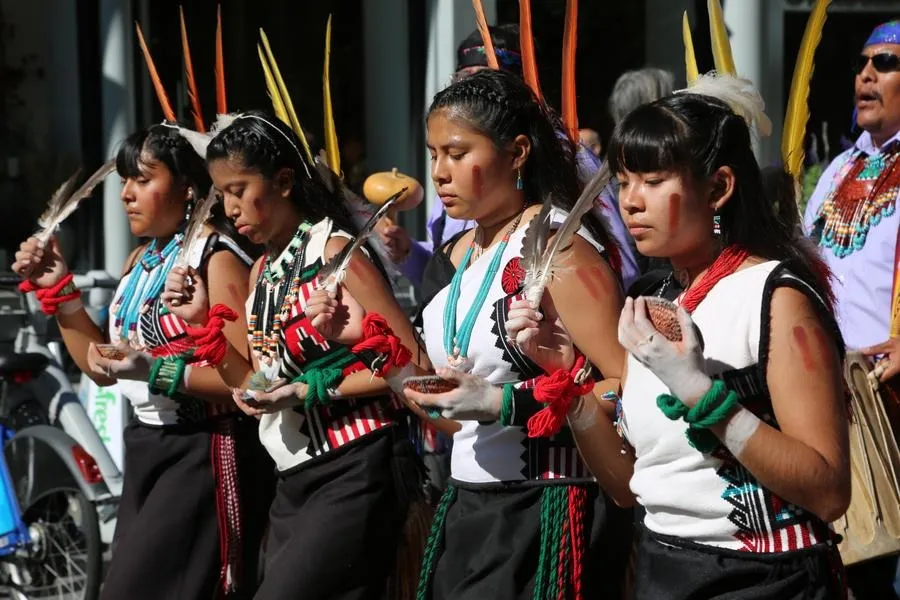
Washington, April 2 : Native Americans, or American Indian tribals, have emerged as a key focus in the US Supreme Court’s hearing on birthright citizenship, which President Donald Trump wants to change, as lawyers debated how early constitutional principles apply to modern immigration.
Arguing for the Trump administration on Wednesday, Solicitor General John Sauer told the court that the 14th Amendment was never meant to grant universal citizenship to everyone born in the United States.
He pointed to a long-recognised exception: children of American Indian tribals were not automatically citizens when the Amendment was adopted.
“The children of tribal Indians are not within the rule of birthright citizenship,” Sauer told the justices.
He said this shows that birth on US soil alone was not enough. Citizenship depended on whether a person was fully subject to US jurisdiction.
However, several Supreme Court justices engaged with the argument, including Clarence Thomas, who asked how the citizenship clause addressed earlier rulings like Dred Scott, and Samuel Alito, who probed how general constitutional rules apply to modern conditions.
Elena Kagan and Ketanji Brown Jackson questioned whether the government’s interpretation departed from long-standing precedent and common law understanding of jurisdiction and allegiance.
The administration argued that American Indian tribals were historically treated as separate political communities, with their own sovereign status. Their members were seen as owing allegiance to tribal governments, not fully to the United States.
That meant they were not entirely under US authority in the same way as other residents.
Opposing the administration, counsel for the challengers argued that this exception is unique and cannot be extended to immigrants.
“They are subject to another sovereign’s jurisdiction even when they’re in the United States,” the lawyer told the court, describing tribal status as a “fiction of extraterritoriality.”
The lawyer said this situation does not apply to foreign nationals, who remain fully subject to US law while present in the country.
Neil Gorsuch and Amy Coney Barrett raised questions about whether the tribal exception was tied to territory or political identity, and whether it could support new limits on citizenship.
Historically, American Indian tribals were excluded from automatic citizenship even if born within US territory. That changed in 1924, when Congress granted citizenship to Native Americans by statute.
The debate highlighted how the 14th Amendment was shaped by two main concerns: guaranteeing citizenship to freed slaves and preserving the distinct status of tribal nations.
“I think the principal focus… had to do really not with immigrants, but with the Indian tribe,” Sauer said.
According to the legal experts, the distinction is crucial because it shows that early citizenship debates were tied to sovereignty, not immigration policy.
The case now asks whether that narrow historical exception can be used to justify broader limits on birthright citizenship today.
The 14th Amendment overturned the Dred Scott decision and established a national definition of citizenship.
For more than a century, that definition has been broadly interpreted under the precedent of United States v. Wong Kim Ark.
The court’s decision could determine whether new exceptions can be created -- or whether the original rule remains unchanged.
Native Americans become focal point in US citizenship case
Advertisement