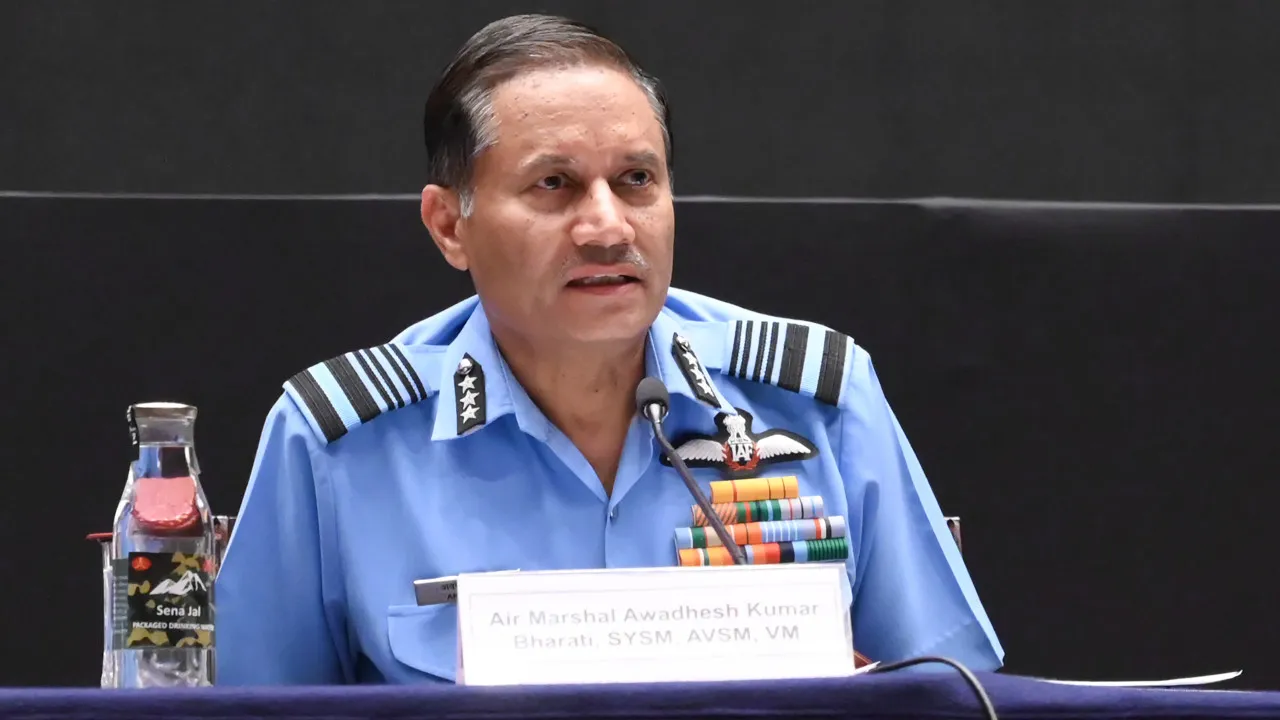
Jaipur, May 7 : Air Marshal Awadhesh Kumar Bharti, who served as the Director General of Air Operations during last year's military operation against Pakistan, on Thursday said that Indian forces had shot down 13 aircrafts and 11 airfields of the rogue nation under the Operation Sindoor.
Addressing a press conference in Jaipur on the anniversary of Operation Sindoor, the Deputy Chief of Air Staff claimed that the operation successfully destroyed nine terrorist hideouts inside Pakistan and Pakistan-occupied Kashmir (PoK), shot down 13 Pakistani aircrafts, damaged their 11 airfields while ensuring that no damage occurred to Indian civilian or military infrastructure.
He emphasised that the armed forces were given complete operational freedom during Operation Sindoor and that every strategic decision was taken jointly by the Army, Navy, and Air Force leadership.
“When our desire for peace is mistaken for weakness, we have no choice but to act. And when we act, there is no room for leniency. It is decisive, lethal and translates into Operation Sindoor,” he said.
Responding to the crucial question that why India agreed to cease hostilities, he said: "I fully understand the anger and emotions of our people, especially the younger generation, given our past experiences with Pakistan."
Clarifying India’s position, the Air Marshal stated that the operation was aimed specifically at terrorists and their support infrastructure.
“We targeted only those elements while ensuring there was no collateral damage. We achieved our objectives and our mission was complete,” he said.
He further added that the situation escalated when the Pakistani establishment decided to "side with terror" and make it their own fight.
“At that point, it was no longer merely a counter-terrorism operation; it became an act of self-defense. Our response was lethal and ruthless,” he said.
According to the Air Marshal, following significant losses, Pakistan sought cessation of hostilities.
He said: “We paused when the request came, we stepped back, but we didn't blink. We had delivered the clear message that misadventure will not go unanswered. Acts of terror will carry consequences."
He underlined that nations which are "forced" into conflicts must always have conflict termination criteria and strategy insight, "otherwise one can go astray and not realise how to terminate the fight".
Emphasising on the lessons of the operation, Air Marshal Bharti said: "Operation Sindoor reaffirmed the primacy of air power, which includes everything and not only the Air Force."
He asserted that terrorists hiding in Pakistan would be "worried" as India is now able to see through its adversary.
"We now have first hand confirmation of the capabilities, capacities and tactics," he added.
"Shot down 13 Pakistani aircrafts, destroyed 11 airfields", Air Marshal Bharti on 1 year of Operation Sindoor