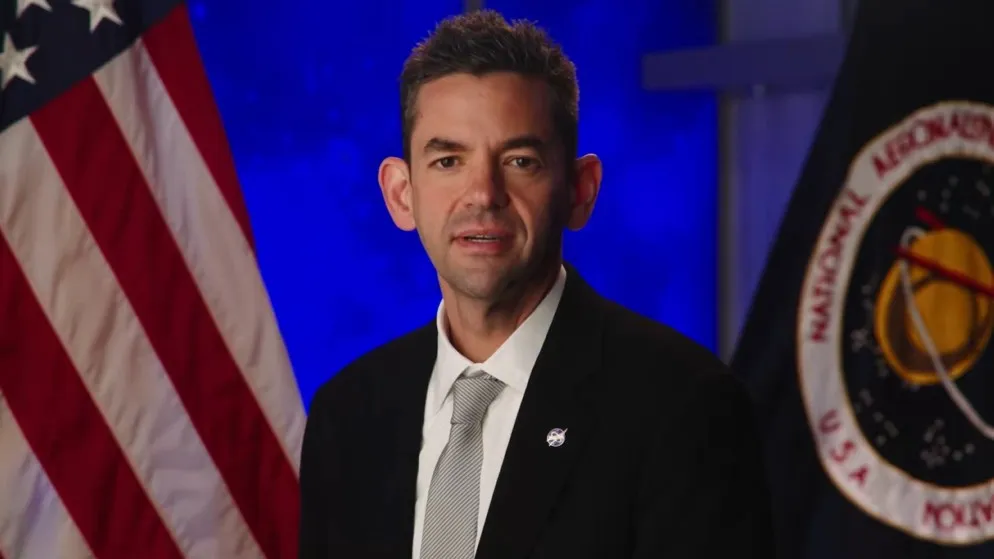
Washington, April 25 : NASA Administrator Jared Isaacman has said that the space agency has three core priorities —returning astronauts to the Moon by 2028, building a sustained lunar base, and expanding commercial partnerships in low-Earth orbit—as part of a broader push to reshape US space strategy.
Testifying before the House Science Committee, Isaacman said the goals are aligned with the administration’s national space policy and are designed to accelerate American leadership in an increasingly competitive global environment.
“Return to the moon, increase launch cadence, and land American astronauts on the surface by 2028,” he said, describing the administration’s directive for NASA’s near-term mission.
He said the agency is also focused on building a long-term presence on the lunar surface through a combination of government and industry efforts. “In parallel, build with industry and Moonbase,” Isaacman said, referring to plans that include landers, rovers, power systems and communications technologies needed for sustained operations.
The third pillar of the strategy involves expanding commercial activity in low-Earth orbit, including transitioning toward private space stations and increasing opportunities for industry participation. “Work alongside industry to expand commercial astronaut payload and monetization opportunities,” he said.
Isaacman said the approach reflects a shift in how NASA allocates resources, moving away from large, costly programmes toward more focused investments that deliver results. He cited past overruns across multiple missions as evidence that reform is needed.
“We cannot establish programmes that are designed to be too big to fail, but at the same time too costly to succeed,” he said, adding that NASA must concentrate on outcomes rather than spending levels.
He also stressed the importance of increasing launch frequency, arguing that long gaps between missions undermine progress. The Artemis II mission, which recently carried astronauts around the Moon and back, demonstrated what is possible when programmes are executed effectively, he said.
“We showed the world the moon again, and we showed humanity Earth again,” Isaacman told lawmakers, calling the mission a moment of global significance.
Under the proposed framework, NASA would rely more heavily on private industry for capabilities such as satellite deployment and Earth observation, while focusing its own efforts on complex missions like deep-space exploration and nuclear propulsion systems.
Lawmakers, however, raised concerns in the latter half of the hearing about whether the strategy can be achieved under the administration’s proposed budget, which includes a roughly 23 per cent reduction from the previous year.
Space Committee Chairman Brian Babin warned that reduced funding could weaken US competitiveness in space, particularly as China accelerates its lunar ambitions. “Shortchanging NASA is simply not smart,” he said.
Ranking Member Zoe Lofgren said the plan risks undermining key scientific and technological programmes, noting that cuts would disproportionately affect areas outside human exploration. “That’s just not a winning strategy,” she said.
Other lawmakers questioned the potential impact on workforce development, Earth science missions and aeronautics research, while expressing concern about increased reliance on commercial providers.
Isaacman responded that NASA would “always follow the law” in implementing congressional appropriations and pledged greater transparency in how resources are allocated.
He maintained that the agency can deliver stronger outcomes even with fewer resources by eliminating inefficiencies and focusing on core objectives.
NASA, established in 1958, has long been at the forefront of global space exploration, from the Apollo Moon landings to the International Space Station. In recent years, renewed geopolitical competition—particularly with China—has driven a renewed emphasis on lunar missions and long-term human presence beyond Earth.
The Artemis programme, which aims to return humans to the Moon for the first time since 1972, is central to that effort and is expected to serve as a stepping stone for future missions to Mars.
NASA sets three priorities for US space strategy: Moon return by 2028, lunar base and commercial expansion