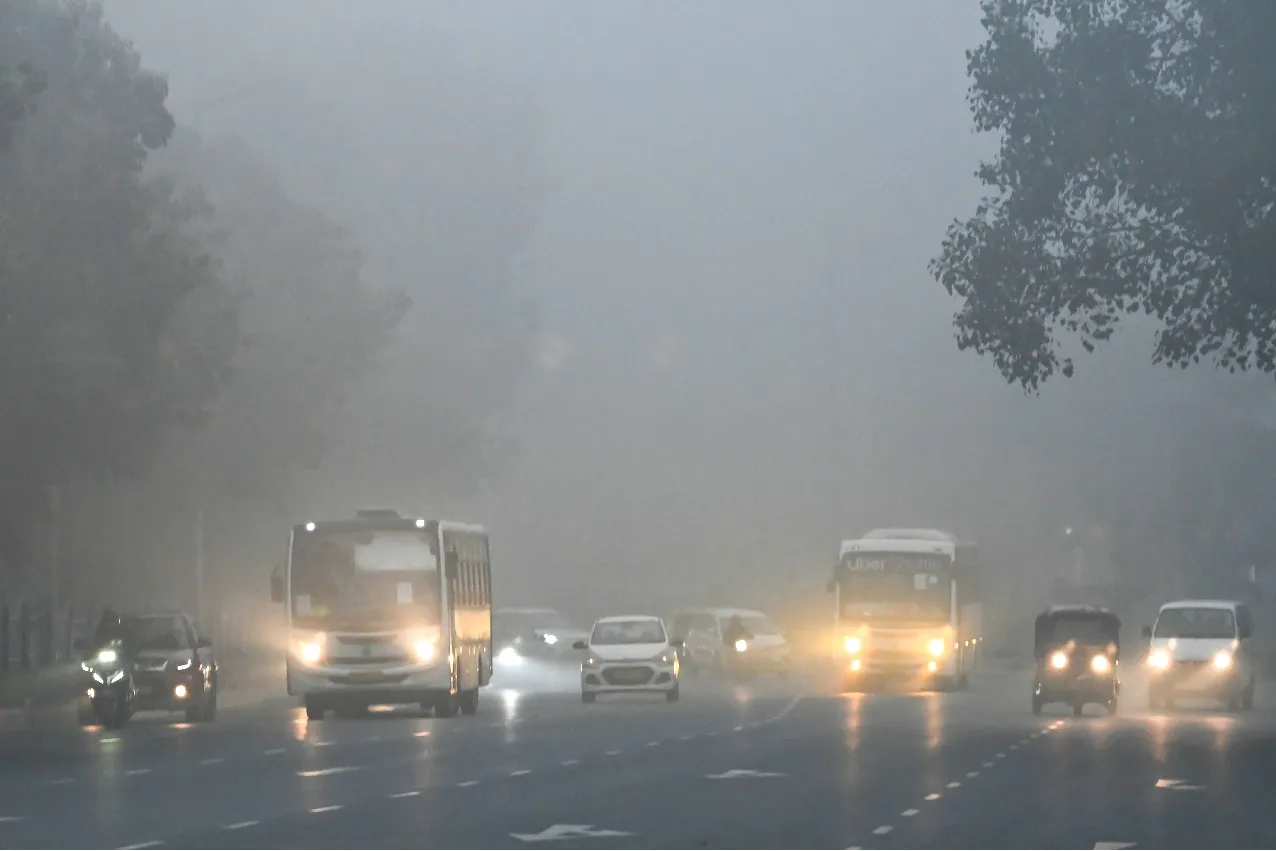
New Delhi, Jan 17 : Delhi and the National Capital Region (NCR) woke up to another harsh winter morning on Saturday, with icy temperatures, dense fog and hazardous air quality combining to intensify discomfort across North India.
The cold wave continued unabated for the sixth consecutive day, while pollution levels breached the “severe” category, prompting authorities to reimpose stringent restrictions under Stage-III of the Graded Response Action Plan (GRAP).
Minimum temperatures across the national Capital dipped well below seasonal norms, deepening the chill. Delhi recorded a low of 4.3 degrees Celsius, while Safdarjung and Ayanagar weather stations reported 4.7 degrees Celsius a day earlier.
The weather conditions were further compounded by dense fog, which significantly reduced visibility during the early morning hours.
At Indira Gandhi International Airport, visibility dropped to around 350 metres at approximately 6:30 am, leading to operational challenges and flight delays. Airport authorities had issued a travel advisory earlier in the morning, confirming that low-visibility procedures were in place for both arrivals and departures.
In a post on social media platform X, Delhi Airport said, “Low Visibility Procedures are in progress at Delhi Airport. All flight operations are presently normal. Passengers are requested to contact the airline concerned for updated flight information.”
Meanwhile, air quality deteriorated sharply, with the Air Quality Index (AQI) crossing the 350 mark in several areas. In response, the Commission for Air Quality Management (CAQM) enforced Stage-III GRAP measures to curb further environmental and health damage.
Under these restrictions, non-essential construction and demolition activities have been halted, including welding, plastering, painting, piling, trenching and flooring work.
Data from the Central Pollution Control Board (CPCB) showed that AQI levels at ITO touched 402, firmly placing it in the “severe” category. According to CPCB standards, AQI readings above 401 indicate severe pollution, posing serious health risks, particularly to children, the elderly and those with respiratory ailments.
Several neighbourhoods reported even higher pollution levels. Anand Vihar emerged as the most polluted area with an AQI of 437, followed by Patparganj at 429, Chandni Chowk at 426, Nehru Nagar at 421 and Vivek Vihar at 418.
Thick smog was visible along major traffic corridors, reducing visibility and worsening commuting conditions.
Authorities have urged residents to limit outdoor activities, especially during early morning and late evening hours, as the twin impact of extreme cold and toxic air continues to grip the region.
Cold wave, dense fog grip Delhi-NCR; air quality slips to ‘severe’ category