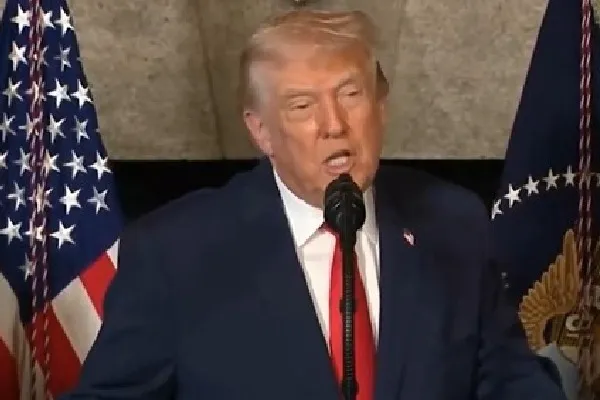
Washington, Dec 23 : US President Donald Trump unveiled plans to begin construction of a new class of massive battleships as part of a broader effort to rebuild US shipbuilding capacity, strengthen deterrence, and restore what he described as American military supremacy.
“Today, I get the great honor to announce that I have approved a plan for the Navy to begin the construction of two — the largest we’ve ever built — battleships,” Trump said at a Mar-a-Lago news conference on Monday.
With Defence Secretary Pete Hegseth, Secretary of State Marco Rubio, and Navy Secretary John Phelan by his side, Trump said he had approved a plan for the Navy to begin construction of two new battleships immediately, calling them the foundation of a new “Golden Fleet.”
“They’ll be the fastest, the biggest, and by far — 100 times more powerful than any battleship ever built.”
Trump said the new ships would be the largest battleships ever constructed, exceeding even the historic Iowa-class vessels, and would be “the most heavily armed vessels built specifically for naval combat.”
He said the ships would carry advanced missile systems, hypersonic weapons, state-of-the-art targeting technology and lasers, and would also be capable of launching nuclear-armed cruise missiles.
“These will be some of the most lethal surface warfare ships,” he said, adding that they would anchor a revival of US maritime power and shipbuilding.
The President said construction would start “almost immediately,” with an initial timeline of about 2.5 years, and that the Navy envisioned a fleet of 20 to 25 such battleships over time.
“We’re going to start with two, and we’re going to quickly morph into 10,” Trump said. “And ultimately, we think it’s going to be anywhere from 20 to 25 of these.”
Trump framed the initiative as both a military and industrial project, saying it would revive American shipyards, create thousands of jobs, and restore domestic manufacturing capacity.
He said new vessels would displace 30,000 to 40,000 tons and would be built in US yards, even as the administration presses defense contractors to accelerate production and reinvest profits into facilities rather than executive compensation or stock buybacks.
“We want the dividends to go into the creation of production facilities,” Trump said. “I don’t want them to buy back their stock. I want them to put the money in plant and equipment so they can build these planes fast, rapidly.”
Hegseth said the announcement marked a generational shift in American defense posture, linking naval expansion to border security, counter-narcotics efforts, and global deterrence.
“This new class… marks a generational commitment to American sea power,” he said, adding that the investments would restore what he called the “warrior ethos” at the Department of Defence.
Navy Secretary Phelan said the future “Trump-class” battleship would be “the largest, deadliest and most versatile warship anywhere on the world’s oceans,” designed to deliver overwhelming offensive firepower and command naval forces across vast distances.
He said the ships would restore the role of battleships as fleet flagships capable of commanding forces “from warships to drones and everything in between.”
Rubio described the announcement as part of a broader effort to rebuild US industrial strength and maintain freedom of navigation. “The US Navy is the single biggest source of peace in the world,” he said, calling the shipbuilding push a tangible reminder of American industrial capacity.
Trump rejected suggestions that the battleships were aimed at any one country, saying, “It’s a counter to everybody. It’s not China.” He said the goal was deterrence through strength and added, “Hopefully, we never have to use them.”
The announcement comes amid longstanding concerns within the US defense establishment about shrinking shipyard capacity, aging fleets, and competition with China’s rapidly expanding navy.
The US Navy has not built a new battleship since the mid-1990s, relying instead on aircraft carriers, submarines, and smaller surface combatants.
Battleships played a decisive role in World War II and later served as symbols of American sea power, though advances in missile and submarine warfare gradually reduced their prominence.
Trump announces ‘Golden Fleet’ battleship push