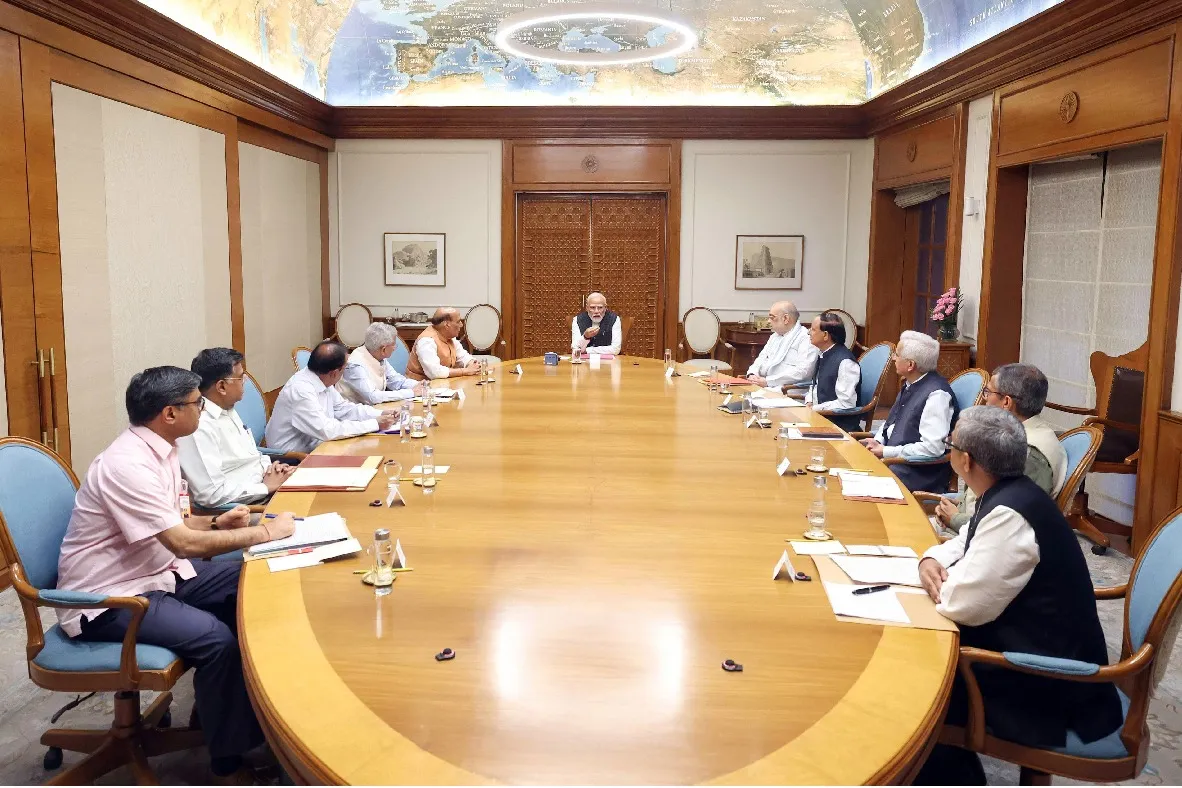
In response to the recent terrorist attack targeting tourists in Pahalgam, Jammu and Kashmir, the Government of India has made a significant and unprecedented announcement. On Wednesday, India declared the immediate suspension of the decades-old Indus Waters Treaty with Pakistan. The decision was taken during a high-level Cabinet Committee on Security (CCS) meeting attended by Prime Minister Narendra Modi and Union Home Minister Amit Shah. This move is considered one of the key retaliatory measures by India against Islamabad following the Pahalgam attack.
What is the Indus Waters Treaty?
The Indus Waters Treaty was signed on September 19, 1960, between India and Pakistan, under the mediation of the World Bank. Then Prime Minister Jawaharlal Nehru of India and then President Field Marshal Mohammad Ayub Khan of Pakistan formalized the agreement in Karachi. The treaty outlines the distribution of the waters of the Indus River and its five tributaries—Jhelum, Chenab, Ravi, Beas, and Sutlej—between the two nations.
As per the treaty, India was granted exclusive rights to use the waters of the eastern rivers—Ravi, Beas, and Sutlej—amounting to approximately 33 million acre-feet (MAF). These waters can be used freely by India for domestic, agricultural, and industrial purposes. On the other hand, Pakistan was given primary rights over the western rivers—Indus, Jhelum, and Chenab—constituting about 135 MAF. India, as the upstream country, was allowed limited use of these waters for non-consumptive purposes such as hydroelectric power generation, household use, and irrigation under strict design and operational parameters. To ensure smooth cooperation and resolution of disputes, a “Permanent Indus Commission” was also established.
Implications of the Suspension
Experts believe that the temporary suspension of the treaty could lead to multiple complications, particularly for Pakistan. Pradeep Kumar Saxena, a former Indian Indus Water Commissioner, shared key insights with PTI. “As an upstream country, India now has several strategic options. If the government remains firm, this could be the first step towards eventual withdrawal from the treaty,” he said. Although the treaty itself does not contain a clause for unilateral abrogation, Saxena cited Article 62 of the Vienna Convention, which allows for treaty termination if fundamental changes in circumstances occur.
According to Saxena, the suspension would mean that India may no longer need to consider objections raised by Pakistan regarding current or upcoming water projects on the western rivers, especially in Jammu and Kashmir. Restrictions on silt flushing from reservoirs—such as those at Kishanganga—could be lifted. “Currently, under the treaty, reservoirs can only be refilled in August following flushing. Without the treaty, India could refill them at any time, potentially affecting Pakistan’s crop calendar,” he explained.
Furthermore, limits on project designs, reservoir operations, and water storage on the western rivers would no longer apply. India would also no longer be obliged to share flood-related data with Pakistan—a move that could adversely impact Pakistan during the monsoon season. Saxena noted that India would gain the freedom to store water on rivers like the Jhelum, aiding flood control in the Kashmir Valley. Additionally, mandatory inspection visits by Pakistani teams could be halted.
Impact on Pakistan
The suspension of the treaty could have profound effects on Pakistan.
Water Shortage:
Pakistan’s agriculture, drinking water supply, and hydroelectric power generation heavily depend on the western rivers—Indus, Jhelum, and Chenab. Any disruption or reduction in water flow could lead to a severe water crisis, threatening food security and livelihoods.
Economic Decline:
Agriculture forms a cornerstone of Pakistan’s economy. A decrease in water availability could damage crops and reduce food production. Disruption to hydroelectric power could lead to electricity shortages. Collectively, these factors could push the country into deeper economic turmoil.
Rising Tensions:
Despite frequent hostilities over the decades, the Indus Waters Treaty had remained a rare diplomatic success between India and Pakistan. India’s unilateral suspension of the treaty could escalate bilateral tensions and contribute to regional instability.
Diplomatic and Legal Challenges:
The treaty includes mechanisms for dispute resolution. In light of India’s action, Pakistan may seek international mediation or the involvement of the World Bank. This could trigger a diplomatic standoff between the two nations.
Having helped resolve water-sharing conflicts following the partition of the Indus Basin after independence, the treaty had endured decades of political and military friction between the two countries. The latest development places the future of this historic accord—and India-Pakistan relations—in a more complex and uncertain trajectory.