
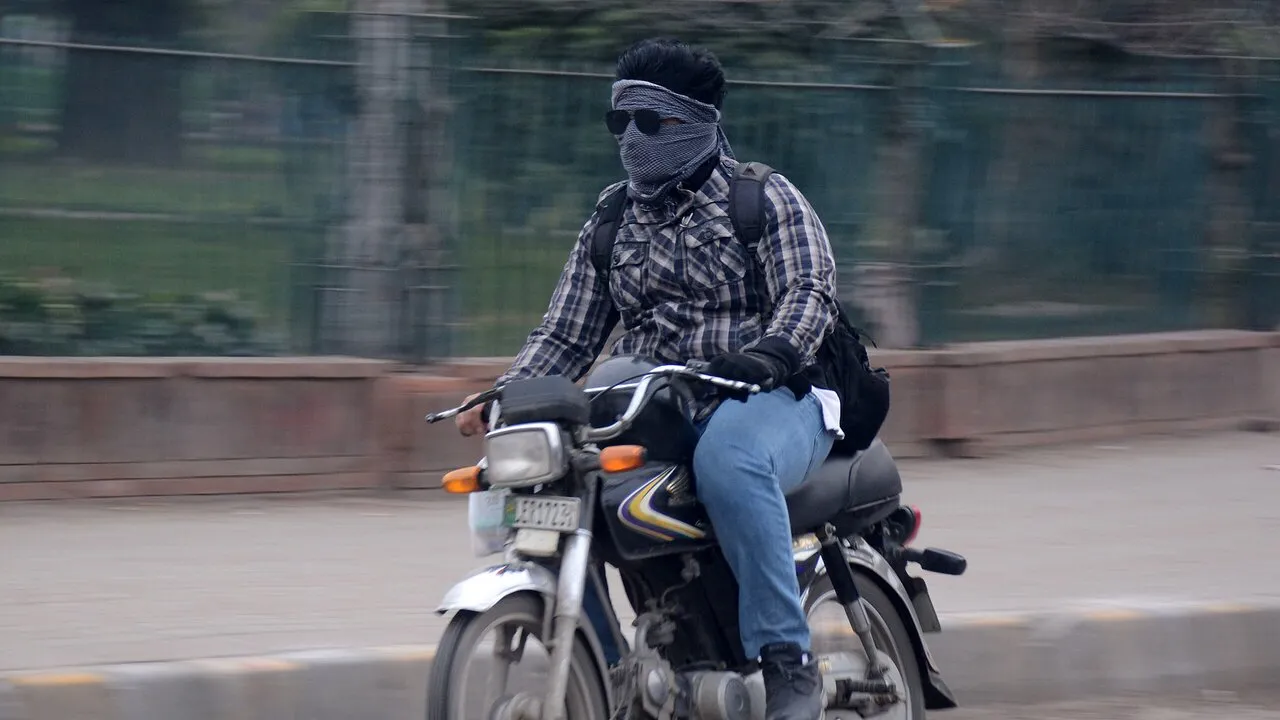
Islamabad, Nov 22 : Pakistan's Lahore was once again ranked as the world's most polluted city on Sunday with Air Quality Index (AQI) reported at more than 500, local media reported.
Lahore topped the list of the world's most polluted major cities with an AQI reading of 537 between 9 a.m. and 10 a.m. (local time) on Sunday, and the quality was classified as 'hazardous', Pakistan-based daily Dawn reported.
Apart from Lahore, other cities of Punjab province also ranked among Pakistan's top 10 polluted urban centres, including Sargodha (392), Faisalabad (338), Gujranwala (347), Sialkot (181) and Bahawalpur (536), according to Swiss air quality monitoring firm IQAir.
In the past few days, Lahore has been ranked as the world's most polluted city. Lahore recorded an AQI of 266 on Saturday, while AQI was reported at 465 on Friday.
Air quality in Punjab continues to decline despite the Punjab Environment Protection and Climate Change Department's enforcement operations against sources of pollution, especially non-compliant brick kilns. Enforcement teams carried out 84,370 inspections of brick kilns in Punjab province from January 1 to November 18, demolishing 1,429 units, sealing 968 and registering 1,248 FIRs against violators. The authorities also imposed a fine of Pakistani Rupees (PKR) 178 million, Dawn reported.
Last month, a report by the Pakistan Air Quality Initiative (PAQI) revealed that air pollution cuts life expectancy in Pakistan by an estimated 3.9 years and contributes to around 128,000 premature deaths each year.
The report said that pollution imposes an economic burden of 6.5 per cent of Pakistan's Gross Domestic Product (GDP), while exposure to polluted air for a long time could reduce life expectancy in Lahore by up to seven years.
The report titled 'Unveiling Pakistan's Air Pollution: A National Landscape Report on Health Risks, Sources, and Solutions' presents Pakistan's first harmonised, multi-sector emissions inventory along with a multi-city analysis of air quality.
The report examines pollution patterns in several cities of Pakistan, such as Karachi, Islamabad, Rawalpindi, Lahore, and Peshawar. It identified the primary sources of emissions in each city and detailed measures that could reduce them by up to 50 per cent, another Pakistan-based daily The Express Tribune reported.
The assessment covers carbon dioxide, fine particulate matter (PM2.5), nitrogen oxides (NOx), and sulphur dioxide (SO2), detailing sector-wise analysis of emissions across the four urban airsheds, The Express Tribune reported.
The report said that Lahore's annual average PM2.5 concentration is more than 110 micrograms per cubic metre, over 22 times the World Health Organisation's (WHO) annual guideline of five micrograms per cubic metre.
Exposure to these pollution levels for a long time could reduce life expectancy in the city by up to seven years, according to the report.
Transport has been identified as the largest source of primary PM2.5 emissions in Lahore, followed by industry at 28 per cent and brick kilns at 17 per cent.
These sources contribute to Lahore's particulate pollution, with winter weather conditions further aggravating the problem.


