
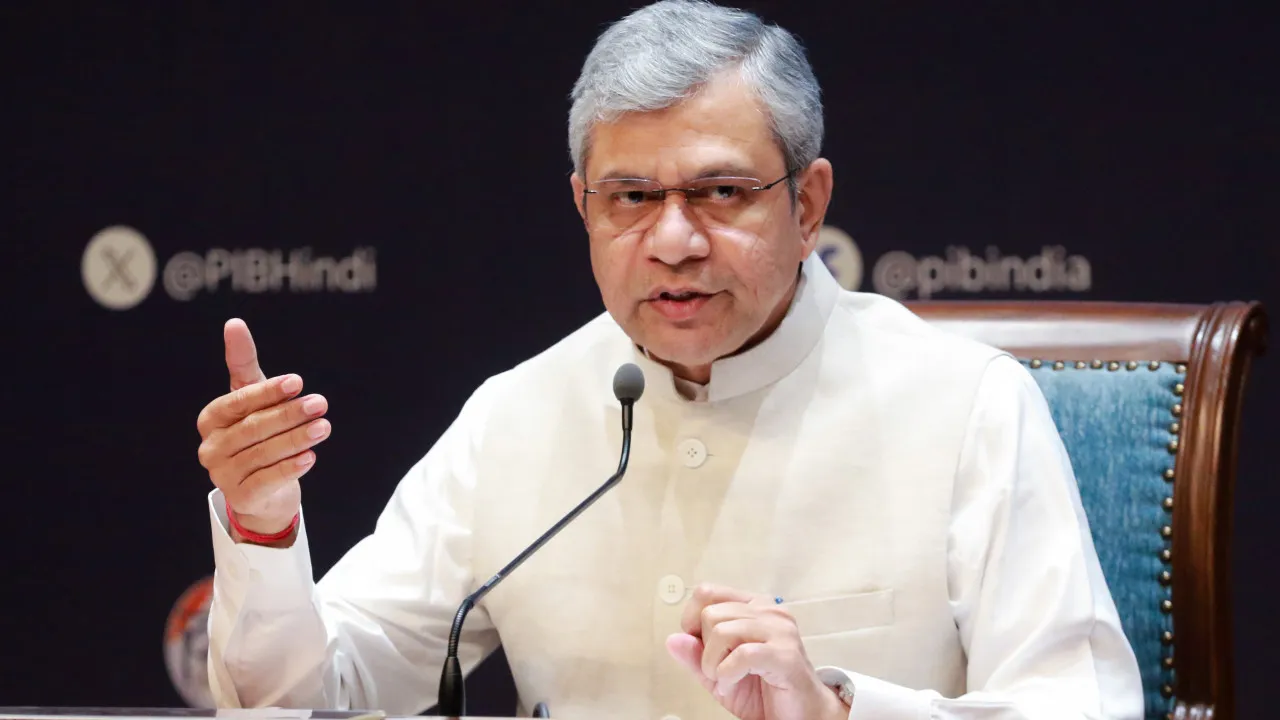
New Delhi, Nov 20 : Union Railway Minister Ashwini Vaishnaw on Friday said that India's first bullet train project between Mumbai and Ahmedabad has moved beyond the planning stage and is witnessing rapid progress on the ground, with the first high-speed rail service targeted to begin operations in the last quarter of 2027.
Highlighting the scale of construction, the minister said the 508-km Mumbai-Ahmedabad High-Speed Rail corridor is one of the country's most ambitious infrastructure projects, aimed at significantly reducing travel time between two of India's largest economic centres.
"India’s first bullet train is no longer an announcement. It is 508 km of construction, moving at full pace. The first service begins in the last quarter of 2027!" Vaishnaw noted.
Once operational, the journey between Ahmedabad and Mumbai will take less than two hours, compared to the current road travel time of around eight to nine hours.
Vaishnaw said the project is much more than a transportation initiative, as it is expected to integrate multiple fast-growing economic hubs across Maharashtra and Gujarat into a single high-growth corridor.
Cities such as Mumbai, Thane, Vapi, Surat, Vadodara, Anand and Ahmedabad will become more strongly connected, enabling faster movement of people, businesses and opportunities.
The minister noted that the project received a major push after Prime Minister Narendra Modi and the Government of Japan laid its foundation stone in September 2017.
Japan has provided its renowned high-speed rail technology, which has operated for over six decades without a passenger fatality. However, land acquisition delays in Maharashtra and disruptions caused by the Covid-19 pandemic slowed the initial pace of execution, with full-scale construction gathering momentum from 2021 onward.
Explaining the technological challenges involved, Vaishnaw said high-speed rail systems require a completely different level of engineering compared to conventional railways.
The corridor has been designed for speeds of up to 350 kmph, with trains expected to operate at 320 kmph. Such speeds demand advanced systems for traction, braking, track infrastructure, aerodynamics and passenger safety.
The minister said the project is being built largely on an elevated corridor to ensure uninterrupted operations. Around 465 km of the 508-km route is being constructed on viaducts, eliminating level crossings and reducing risks from trespassing or cattle movement on tracks.
The elevated design also minimises land-use disruption by allowing roads and agricultural activities to continue beneath the structure.
Providing an update on construction progress, Vaishnaw said that as of September 2026, pier work had been completed over 456 km and viaduct construction over 371 km.
More than six lakh noise barriers have been installed along a 299-km stretch, while 9,300 overhead equipment masts have been erected across 206 km of viaduct.
He added that four mountain tunnels have already been excavated, while work is progressing on the 21-km tunnel in Maharashtra, of which about 5 km has been completed through mountain tunnelling methods. The project also includes India's first undersea rail tunnel beneath Thane Creek.
According to the minister, civil construction work has been completed at eight stations and architectural finishing work is currently underway. Construction is also progressing at the rolling stock depots located at Sabarmati, Surat and Thane.


