

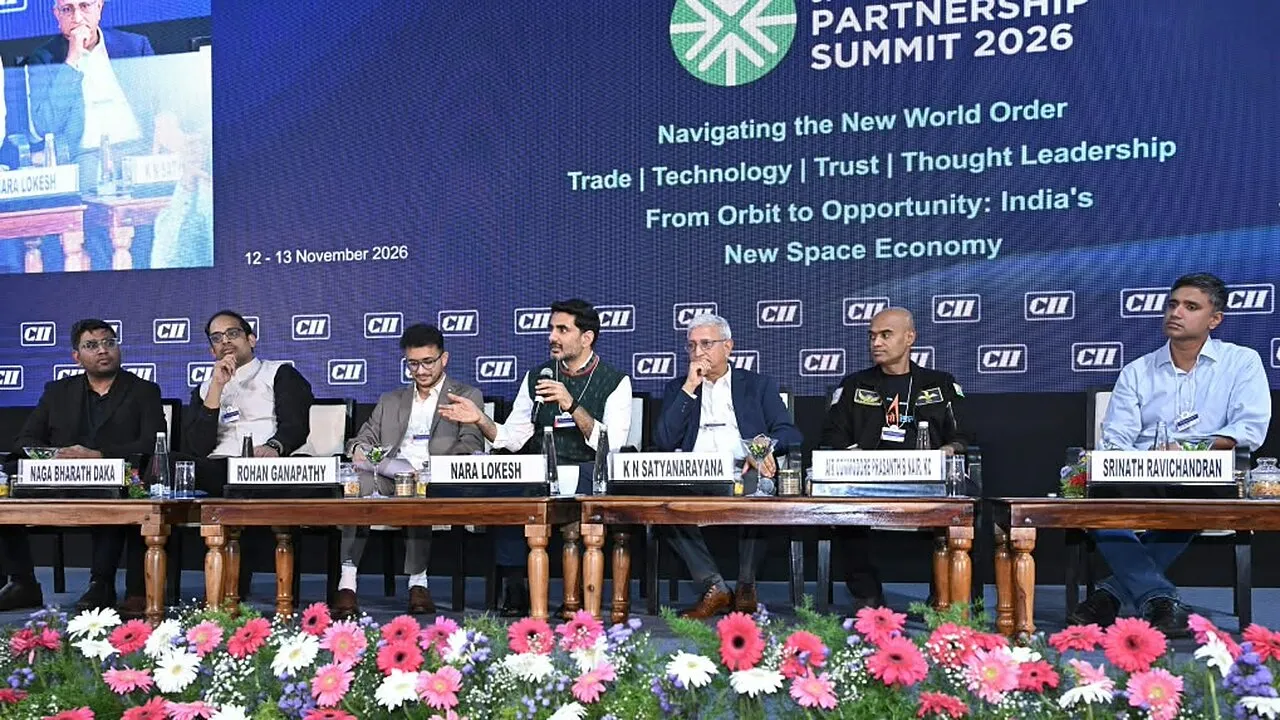
Visakhapatnam, Nov 13 (IANS) Andhra Pradesh Education and IT Minister Nara Lokesh on Friday expressed confidence that Andhra Pradesh, unlike other states, will build a unique space economy ecosystem.
Speaking at a session on India's New Space Economy on the second day of the CII Partnership Summit 2026 in Visakhapatnam, Lokesh said the space economy was at the beginning of an exciting phase, with enormous opportunities yet to be explored.
The Minister said Andhra Pradesh had created a strong sense of excitement around the space economy and was positioning itself differently from other states.
He emphasised that a thriving industrial ecosystem could not be developed merely through incentives or freebies, but required collective efforts and collaboration among all stakeholders.
He highlighting the growing opportunities for startups, entrepreneurs and research institutions.
He stressed the importance of bringing together thought leaders, entrepreneurs and academia to create a sustainable and vibrant space industry ecosystem.
According to him, close collaboration among these groups would be essential to identify opportunities, encourage innovation and translate emerging ideas into successful ventures.
Expressing confidence in the state's vision, Lokesh said that Andhra Pradesh was committed to turning its ambitions into reality.
The Minister added that Andhra Pradesh would work towards building a distinctive and thriving ecosystem for the space economy through collective leadership, entrepreneurship and academic collaboration.
Addressing college students on the emerging opportunities in the space economy, Lokesh noted how state governments can contribute to a sector largely governed by the Central government.
He said Andhra Pradesh is adopting a systematic approach to developing sector-specific ecosystems by identifying key industries, mapping all stakeholders and attracting investments and companies to the state.
He emphasised the need for strong vertical and horizontal integration to build a comprehensive space industry ecosystem.
Vertical integration involves attracting sub-component manufacturers, suppliers and vendors who support major space companies such as Skyroot in developing and launching their rockets.
Lokesh said that a significant number of these supporting companies are Micro, Small and Medium Enterprises (MSMEs), which play a crucial role in strengthening the supply chain.
Citing an example, he mentioned meeting an MSME exhibitor that had manufactured a shield for a rocket.
Explaining horizontal integration, Lokesh said it involves bringing academia and industry together by revamping academic curricula, encouraging research and strengthening testing and certification facilities through Centres of Excellence.
He highlighted the collaboration with IIT Tirupati to establish a Centre of Excellence in the energy sector, particularly in view of the growing cluster of ingot, solar wafer and solar cell manufacturing companies in the region.
Lokesh also stressed the need for a dedicated national policy to develop an integrated space industry ecosystem and said state governments should proactively identify and attract companies such as Skyroot.
He called for a systematic approach to identifying the entire value chain, including component manufacturers, suppliers and vendors, and bringing them together within a common industrial ecosystem.


