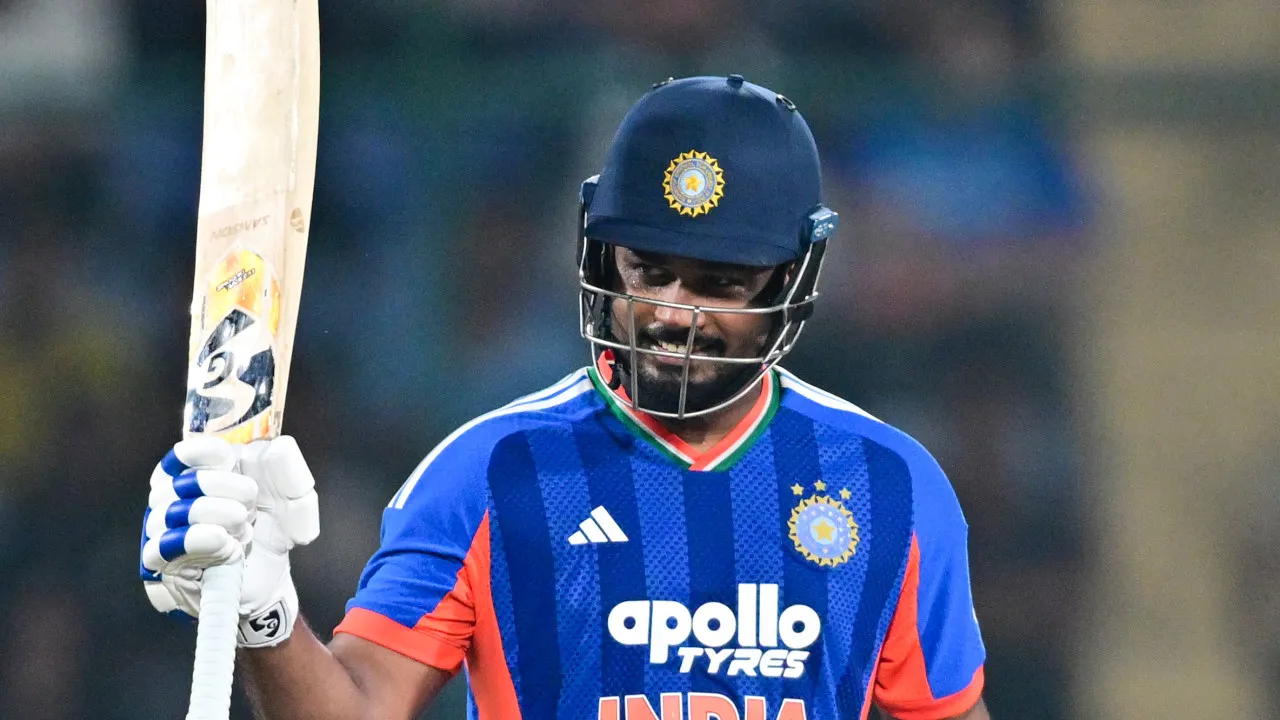
New Delhi, Sep 16 : Sanju Samson acknowledged the weight of expectations that comes with playing for India, admitting that the prospect of another failure can bring a fresh wave of scrutiny, but said he has learned to accept that pressure and continue playing with the same attacking intent.
The India wicketkeeper-batter made the admission after smashing 57 off 22 balls in the second T20I against Afghanistan at the Arun Jaitley Stadium on Tuesday, helping India seal the three-match series with a 2-0 lead.
Samson said failures can be particularly difficult for an Indian cricketer to handle. Yet, he believes experience has taught him to focus on his game rather than the reaction around it.
“Being an Indian cricketer, it’s not easy to face failures, but that’s where my experience comes in. I think I try to shut out the noise and try to be confident and try to come out and still keep scoring at a high strike rate—even taking the chances, even taking the knowing that if I fail again, I’ll be facing a lot of noise again. But I think that’s the way we are built here in Indian cricket, and I just go out there and try to score maximum and contribute,” Samson told reporters at the post-match press conference.
The 31-year-old batter said that approach inevitably comes with a degree of risk.
“To be very honest, I think it’s the nature of the format. I think the nature of the way we have been playing from last two-three years. So, we are actually the world champions now and we have a format, an approach which has been very successful. So, we are just following it as we were following it last two-three years. So, just watching the ball and just trying to get maximum out in the powerplay. Sometimes it works out well, sometimes it doesn’t work out well,” he added.
For Samson, the answer to maintaining consistency is not trying to control the outcome but remaining disciplined in his preparation.
“I think consistency in my process, preparation, consistency in how I’m practicing, how I’m putting my hard yards in. That’s where I try to focus on. You can’t control the consistency in the result in this format.”
He explained why India’s high-intent approach makes result-based consistency an unrealistic expectation.
“You can’t say ‘Okay, let me be consistent in the outcome.’ So, as you know, that we have to strike at 200 strike rate and you just have to hit six or four off every ball. I think then you can’t think about consistency or you can’t think about scoring your own runs. I think consistency has to be in the frame of mind which you’re looking at, and then whatever happens, happens. I think that’s what a fearless mindset is called.”
Samson also opened up on the competition for places in India’s top three, insisting that the players involved do not view one another through the same lens as outsiders.
“They are competitors for the outside world, but we are a team and we are playing for a country and we want to win the game first, and then it comes down to other individuals.”
He said maintaining that attitude is essential in a squad where several players are performing and opportunities are limited.
“So, we try to be as positive as possible and then whoever is playing, we want them to do well. And we just have to be ready for our own opportunity. We can’t sulk or we can’t be in a negative frame of mind ki, ‘No, yaarr, mujhe nahi mila, usko kyu diya?’ So, those kind of mindset don’t work here.”
The wicketkeeper-batter also credited India’s leadership group for maintaining communication with players when difficult selection calls have to be made. Reflecting on his own omission, he said he understood why the team management backed another in-form youngster.
“Taking hard decisions is not easy. Taking very popular decisions is the easiest thing, but as a leadership group, we have been taking some really tough calls keeping the team first. So, that’s where credit goes to our team’s leadership group.”
For Samson, however, dealing with outside noise does not mean being immune to it. He admitted that criticism can hurt before explaining how he brings himself back to what matters.
“I try to turn off my Wi-Fi! But sometimes the Wi-Fi gets turned on and I end up seeing comments, or some senior player says something.
“Initially, it does feel bad; I’m not a machine or a robot to say “No, it doesn’t affect me.” It definitely affects you, and you get a bit impacted, but then you talk to yourself and remind yourself who you are and what you need to do.”
Ultimately, Samson said the ability to block out that pressure is what allows him to play the fearless brand of cricket India expects.
“Outside noise does affect cricketers in India, but you need to be very clear about your mindset, how you need to prepare, and with what mindset you need to play.
“If I focused on those things, I wouldn’t be able to bat this way. Before hitting a shot, I’d think ten times, ‘Man, if I get out, it’ll become a Wi-Fi problem again!’ So I thought, it’s fine.”
His approach now is to accept the scrutiny without allowing it to alter his intent.
“So whatever pressure you are under, you realize what type of player you are, and you just go out there to express yourself keeping the team first.”
‘If I fail, I’ll face a lot of outside noise again’: Samson