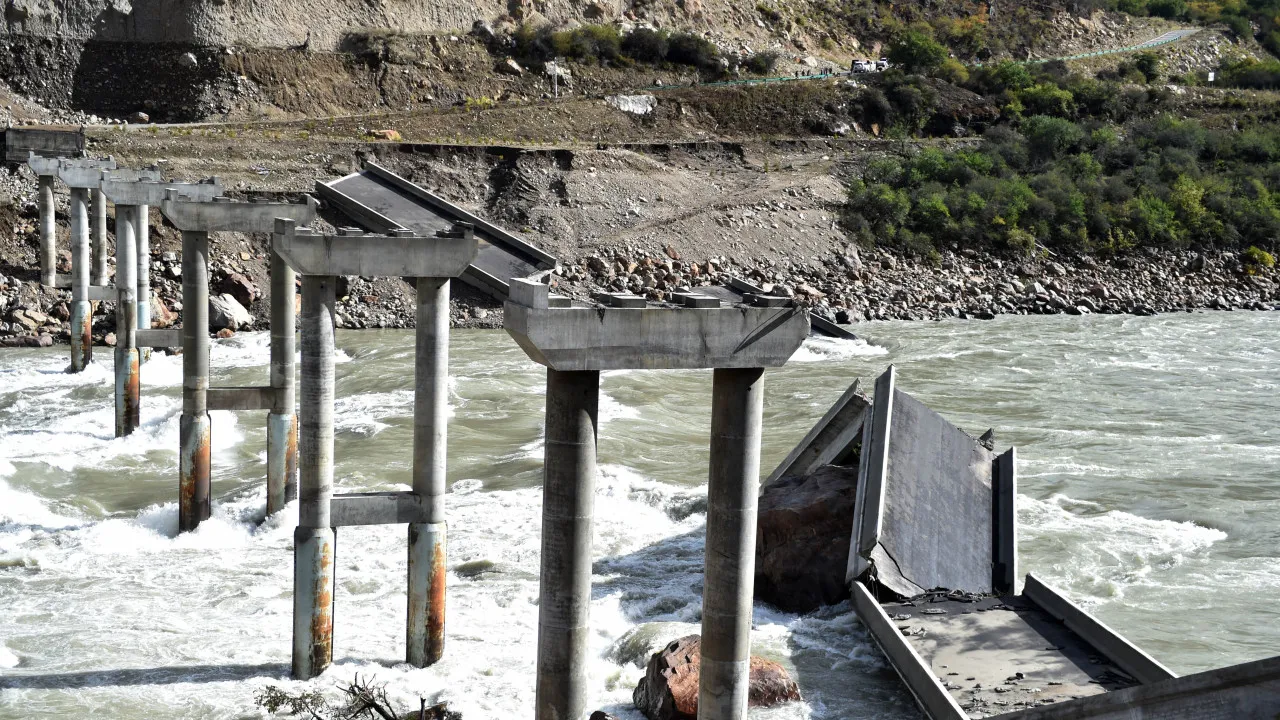
New Delhi, Sep 14 : China’s mega hydropower project on the Yarlung Tsangpo River in Tibet has brought renewed scrutiny to the sustainability of large-scale infrastructure in the ecologically fragile and seismically active Himalayan region, a report has stated.
Farther east, Beijing began construction in July 2025 on the lower Yarlung Tsangpo hydropower cascade near Medog, dubbed the “project of the century.” With an estimated cost of around 1.2 trillion yuan, the project is expected to generate roughly three times the power produced by the Three Gorges Dam.
The river plunges nearly 2,000 metres through a short, seismically active gorge before flowing into India as the Siang in Arunachal Pradesh and eventually the Brahmaputra in Assam, according to a report in 'One World Outlook'.
“Whatever one’s view of the geopolitics, the sustainability question is narrower and harder: What does it mean to pin the energy future of a continent to tunnels and powerhouses in one of the least stable mountain syntaxis on Earth, upstream of tens of millions of people, at the same moment that permafrost, glaciers and monsoon extremes are all moving in the wrong direction?” the report stated.
“A 2022 paper in Nature Geoscience put the problem in the language engineers prefer. Warming is destabilizing rock and ice across High Mountain Asia. Sediment loads are rising. Reservoirs silt. Dams designed for a 20th-century rain flood can be overtopped by a 21st-century ice-and-rock cascade. Two-thirds of Himalayan hydropower projects, the authors noted, sit on potential outburst-flood pathways. That was four years and several wrecked plants ago,” it added.
Nepal’s disaster authority has so far recorded nearly 1400 deaths with over 5,000 people still missing in the aftermath of the devastating floods along the Nepal-China border on August 26. Hundreds of foreign pilgrims, trekkers and over 600 children are among those unaccounted for in two districts of the Himalayan nation.
Chinese authorities have also confirmed several deaths and reported hundreds missing in Gyirong County, where rescue teams were still searching underground powerhouses.
“This is not a natural disaster in the old sense. It is a compound event: a warming cryosphere, a young mountain chain, and a development model that treats the world’s highest range as a construction site on the plains,” One World Outlook mentioned.
The report noted that the Himalayas perform a vital function no dam can replicate, storing winter water as ice and releasing it in spring. It helps sustain the monsoon and prevents vast quantities of soil from being washed into the Bay of Bengal within a single season, with nearly two billion people living with the consequences.
“If the range is developed as a corridor of concrete and blasting powder, the bill will not be itemized as ‘climate’. It will arrive as it did on August 26: suddenly, from upstream, and faster than anyone can run. The question the latest flood asks is not whether the mountains are fragile. They have always been fragile. The question is why we keep staking lives and capital on the pretense that they are not,” the report added.
Mega dam, warming Himalayas: China’s Yarlung Tsangpo hydropower project faces renewed scrutiny