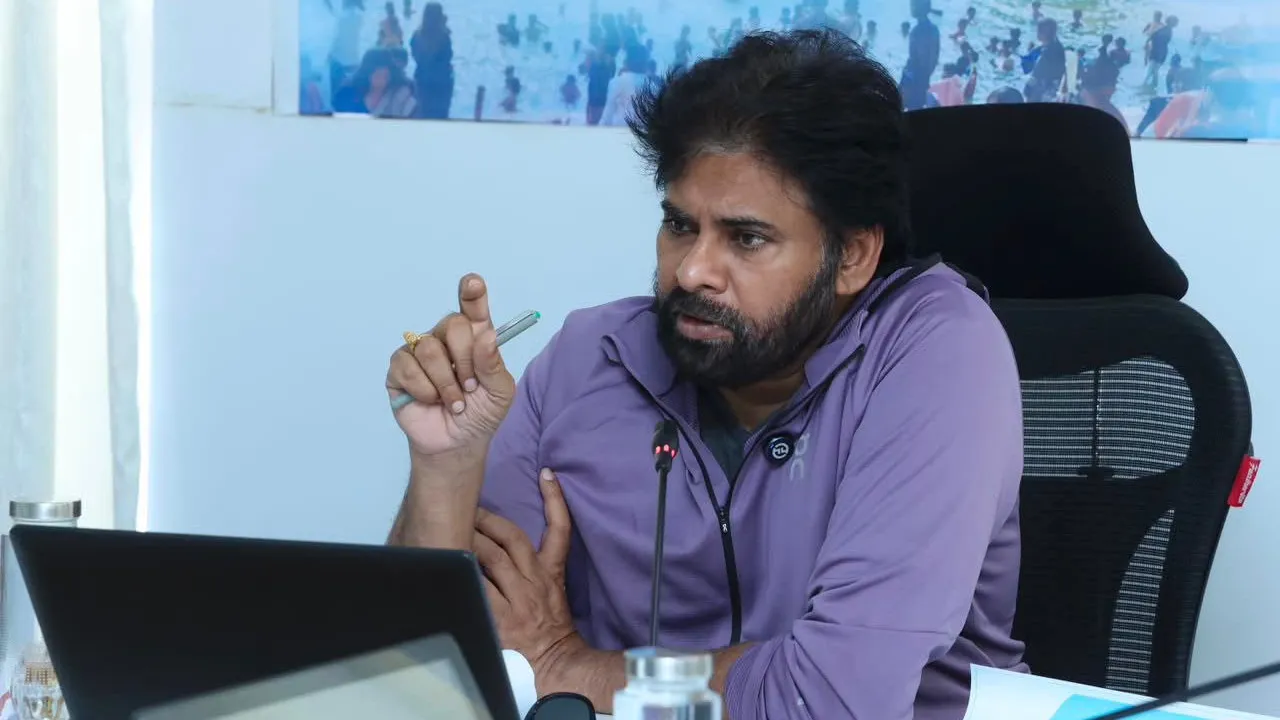
Amaravati, May 29 : With the pollution in the Godavari River reaching an alarming level, Andhra Pradesh Deputy Chief Minister Pawan Kalyan on Friday directed the Pollution Control Board to conduct continuous inspections to prevent industrial effluents from being discharged into the river.
According to Pollution Control Board (PCB) officials, pollution entering the Godavari River—originating from municipalities, industrial zones, rural areas, and the aquaculture sector—has reached a critical and alarming stage.
Approximately 104 million litres of sewage per day, discharged from municipalities across six districts, is currently contaminating the Godavari River. Of this total, the Andhra Paper Mills alone accounts for the discharge of up to 32 million litres of waste daily.
Additionally, another 8.38 million litres of sewage from rural areas, along with substantial quantities of industrial waste, are being discharged into the river on a daily basis.
Compounding this situation is the daily discharge of 13.24 million litres of wastewater from aquaculture operations in the Konaseema and West Godavari districts.
Pawan Kalyan, who is also the minister for environment, directed officials to take immediate measures to curb pollution caused by the discharge of sewage, industrial effluents, and aqua-related waste.
According to an official release, it has been observed that sewage generated by towns situated along the banks of the Godavari River is being discharged directly into the river without undergoing any prior treatment. Large volumes of sewage are currently flowing into the Godavari from major urban centres, including the Rajamahendravaram Municipal Corporation and the municipalities of Kovvur, Narasapuram, and Tanuku.
Currently, the Rajamahendravaram Municipal Corporation generates 75 million litres of sewage daily, of which 50 million litres are being discharged directly into the Godavari River. Furthermore, approximately 11.1 million litres of wastewater per day from Tanuku Municipality, 14 million litres from Bhimavaram, 8.5 million litres from Narasapuram, and 6 million litres from Kovvur are being released into the Godavari through drainage channels such as the Yanamadurru and Gostani drains.
The daily discharge of sewage into the Godavari River also continues from various other municipalities.
Pawan Kalyan emphasised that measures must be implemented to ensure that sewage generated in urban areas is released into the Godavari only after it has undergone proper treatment. To this end, he has issued directives to undertake the construction of Sewage Treatment Plants (STPs) within the jurisdiction of every municipality, ensuring that their capacity is commensurate with the volume of sewage generated in the respective areas.
To ensure the conduct of pollution-free Godavari Pushkarams, Pawan Kalyan has announced an action plan titled 'Swachh Godavari – Pavitra Pushkaralu' (Clean Godavari – Sacred Pushkarams).
He issued directives to transform the 262 panchayats identified across six districts—within the scope of the Pushkarams festivities—into sewage-free zones, and to establish continuous monitoring systems to prevent the discharge of polluting waste into the Godavari River.
He suggested setting up an RTGS-style control room to oversee sewage management in villages and towns, as well as to monitor industrial pollution, thereby establishing a system for continuous, real-time surveillance.
The responsibility for this monitoring would be entrusted to the high-level task force constituted for the prevention of pollution in major rivers.
Pawan Kalyan issued key directives to officials regarding the sewage mitigation measures to be implemented in villages and towns. To this end, he stated that funds from the VBJ Ramji scheme, Swachhandhra, and the Pollution Control Board should be utilised if necessary.
For the purpose of organising the Pushkarams, 262 'Pushkara Panchayats' were identified across the six districts situated within the Godavari river basin.
Following a coordination meeting involving officials from the Deputy Chief Minister's office, the Principal Secretaries of the Panchayat Raj & Rural Development and Forest & Environment departments, and the Secretaries of the Pollution Control Board, a decision was made to transform these 262 panchayats into sewage-discharge-free zones by the time of the Pushkarams.
Pawan Kalyan orders continuous inspection to check pollution in Godavari River
Advertisement