Washington, March 28 : A top US senator has raised sharp concerns over the cost and feasibility of the proposed “Golden Dome” missile defence system, while warning that China’s advancing space capabilities could pose new strategic risks to American assets.
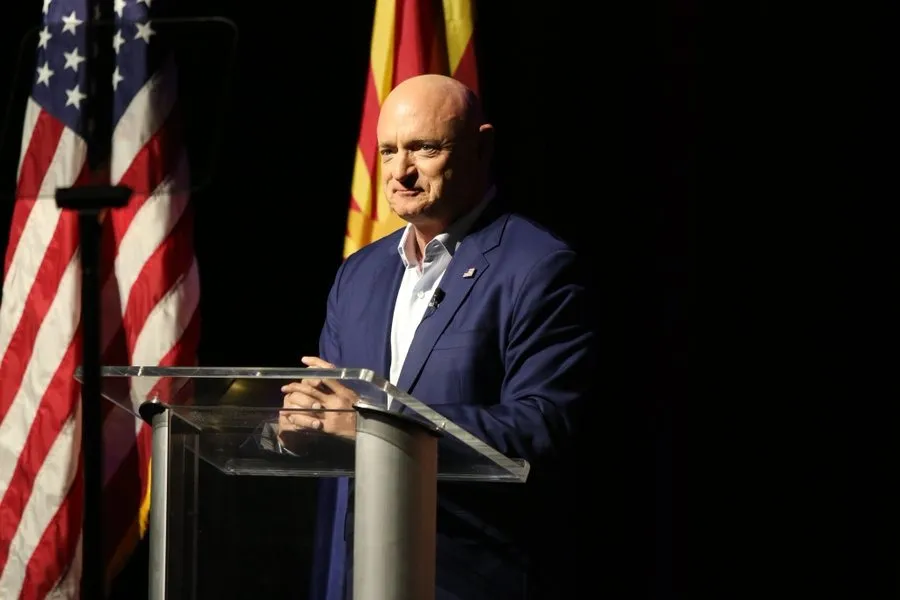
During a Senate Armed Services Committee hearing on US Space Command and Strategic Command, Senator Mark Kelly questioned whether the ambitious missile defence architecture could deliver on its promise at scale.
“I understand the argument that a more robust missile defense architecture could strengthen deterrence by denial and provide additional protection for the homeland, but at scale, this becomes a question of cost, capability, and plain physics,” Kelly said.
“One of my big concerns is that we spend $500 billion, $1 trillion, we get to the end of the timeline, and we have a system that just fundamentally does not work or does not work well enough to increase deterrence.”
The proposed system envisions a layered shield capable of intercepting large-scale missile attacks, including complex threats involving hypersonic glide vehicles and advanced cruise missiles.
Admiral Richard A. Correll, responding to Kelly’s questions, said the effort would begin with strengthening detection and tracking systems. “The work initially on the sensor layer and the capability to detect and track advanced missiles… that is step one in architecture that we are talking about,” he said.
Kelly acknowledged the need to address emerging threats, particularly manoeuvrable hypersonic weapons. He noted the difficulty of intercepting multiple incoming missiles launched from different trajectories and platforms.
Correll said the system would require a range of evolving technologies, including space-based interceptors. “That is one technology that we will need to mature to see what the limits are of that in terms of interception capabilities,” he said, adding that the approach includes examining the entire “kill chain” from pre-launch to impact.
The hearing also turned to China’s growing capabilities in space, which Kelly described as a significant concern.
“There have been reports that last year, China’s SJ 5, SJ 21 maneuvered, we think they may have done a satellite refueling experiment. If confirmed, this would be the first time that a satellite in GEO refueled another,” Kelly said.
He warned that such developments could enable China to extend satellite lifespans, reposition assets and potentially threaten US systems.
General Stephen N. Whiting, head of US Space Command, said Washington is closely monitoring these activities. “China has demonstrated their sophistication on orbit to include starting to deliver a broad maneuver capability on orbit,” he said.
Whiting cautioned that if Beijing develops sustained manoeuvre capabilities in space, it could gain a strategic edge similar to how the United States has historically leveraged manoeuvre in land, sea and air warfare.
“My concern is if they develop that, they will have the ability to maneuver for advantage… I believe we need to deliver our own maneuver warfare capability to make sure we can leverage the advantages the joint force has developed over the decades in space,” he said.
US senator questions cost, feasibility of ‘Golden Dome’ missile defence, flags China space threat