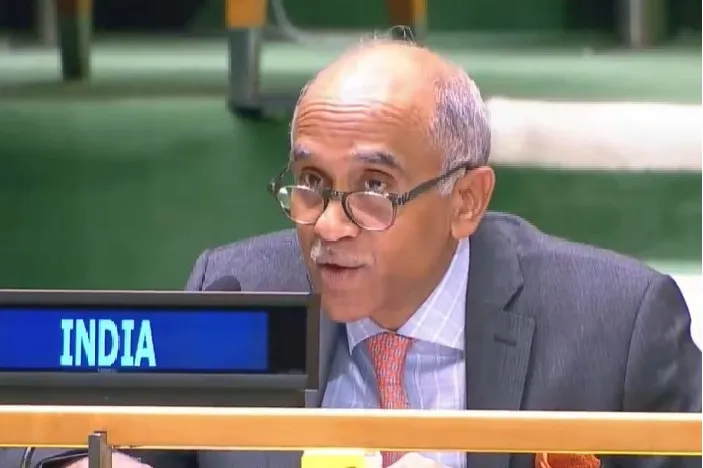
United Nations, March 17 : India has exposed Pakistan’s own Islamophobia manifest in the deadly persecution of Ahmadiyyas, and Islamabad’s representative virtually admitted it was happening.
Referring to Pakistan only as “our western neighbour”, India’s Permanent Representative P. Harish asked rhetorically on Monday (local time), “One wonders what would brutal repression of Ahmadiyyas in this country be termed or the large-scale refoulement (or forced repatriation) of the helpless Afghans or air-bombing campaigns in this Holy Month of Ramadan”?
Pakistan’s Permanent Representative Asim Iftikhar Ahmad jumped in to respond, even though his country was not named, and he did not deny the accusation and, instead, said India was politicising the General Assembly meeting on Islamophobia.
India, as is common in diplomatic practice, Harish did not name Pakistan during the General Assembly commemoration of the International Day to Combat Islamophobia, but dropped a revelatory hint in his statement, so Islamabad did not have to acknowledge that it was accused, while the context left it clear.
But Ahmad chose to respond, virtually acknowledging the persecution of Ahmadiyyas.
A 1974 amendment to Pakistan’s constitution adopted the Islamic fundamentalist rubric of declaring Ahmadiyyas “non-Muslim” and making their persecution official state policy.
Besides the frequent attacks on their religious mosques, the anti-blasphemy laws make them vulnerable to the death penalty.
Again, without naming Pakistan, Harish said pointedly that its propaganda about India only reflected Islamabad’s “terrorist mentality that this country has perpetuated since its inception”.
“That is the real issue at hand”, he said.
As the birthplace of more religions -- Hinduism, Buddhism, Jainism, and Sikhism -- than any other country, India follows the philosophy of Sarva Dharma Sambhava, which calls for equal respect for all religions and inspired the secular ethos of the Indian Constitution, he said.
India “strongly condemns violence and hatred in the name of religion, regardless of the religion under question”, Harish said and sounded sceptical about the UN’s focus on Islamophobia when there was already a declaration that made a universal condemnation of phobias against all religions.
He was referring to the Declaration on the Elimination of All Forms of Intolerance and of Discrimination Based on Religion or Belief, adopted in 1981.
Speaking of the dangers of politicising religion, he urged “caution against frameworks that exclusively focus on one faith, without addressing the broader phenomenon of religiophobia in all its manifestations”.
The 1981 declaration, he said, “remains, in our view, a very balanced and enduring instrument that enshrines the rights of all religious followers without privileging any”.
“I stress that it is important for the UN to take note of the rising trend and dangers of weaponising religious identity and instrumentalising it to serve narrow political ends -- by state and non-state actors alike”, he said.
He added, “India’s western neighbour is an excellent example of fabricating imaginative tales of Islamophobia in their neighbourhood”.
India exposes Pakistan’s Islamophobia in persecution of Ahmadiyyas; Islamabad virtually admits it