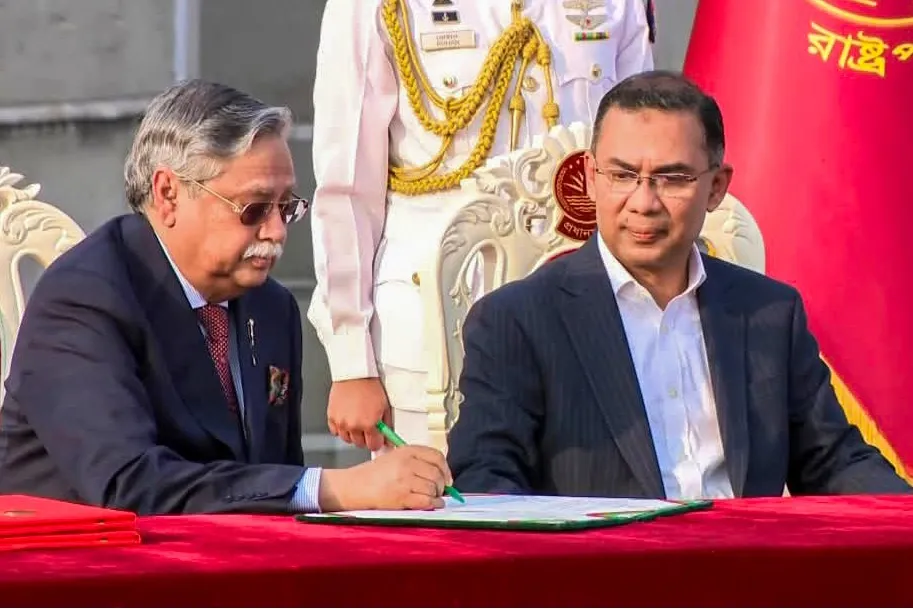
Ankara, March 11 : With its first session scheduled for March 12, Bangladesh’s newly-elected parliament will confront two competing mandates - one rooted in the existing constitutional framework and the other guided by the political commitments of the July Charter. Experts warn that such a dual arrangement may trigger institutional friction as the new parliament convenes, a report has highlighted.
Bangladesh faces an unfamiliar constitutional moment defined by competing visions of political reforms following the 2024 July uprising, Turkey's leading state-run Anadolu Agency reported earlier this week.
“Instead of the procedural calm that typically accompanies the start of a legislative term, the incoming parliament will begin its work amid unresolved questions about constitutional authority and diverging interpretations of the July Charter – the reform blueprint that emerged from the 2024 mass uprising that toppled the government of former Prime Minister Sheikh Hasina,” the report detailed.
It noted further that at the heart of the uncertainty is an unprecedented move - lawmakers taking different oaths depending on their political faction.
“Members of the ruling Bangladesh Nationalist Party (BNP), which holds a two-thirds majority in parliament and occupies the treasury benches, have taken the standard oath as members of parliament. But lawmakers from the opposition – primarily the Bangladesh Jamaat-e-Islami and the student-led National Citizen Party (NCP) – have taken two separate oaths: one as parliamentarians and another as members of a proposed Constitution Reform Council,” it mentioned.
The split, the report said, has produced a constitutional dilemma that could overshadow the opening sessions of parliamentary business.
Under the July charter, the creation of a special constitutional reform body backed by at least 60 members of parliament was envisioned to oversee proposed changes.
“The opposition bloc, comprising Jamaat and the NCP, has already crossed that threshold with its 77 lawmakers and has taken the oath required to establish the council. However, the ruling BNP has refused to take the second oath, arguing that the council has no basis in the current constitutional framework and that any reforms should instead be pursued through the existing parliamentary process,” the report noted.
Heightening the uncertainty, the report noted a fresh legal challenge that has pulled the judiciary into the political debate.
Recently, a group of lawyers – “whom opposition figures claim are aligned with the BNP” – filed a petition in the High Court challenging the legality of both the July Charter and its supporting referendum, Anadolu Agency reported.
The court responded by questioning why both the charter and the referendum should not be struck down, turning a political dispute into a possible constitutional confrontation.
Bangladesh's newly-formed Parliament may face constitutional crisis amid conflicting perspectives: Report