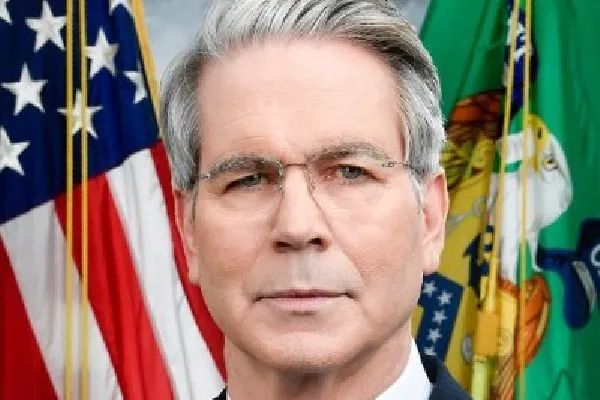
Washington, Feb 21 : US Treasury Secretary Scott Bessent made clear that tariffs will remain a central tool of President Donald Trump’s economic strategy, even after a Supreme Court ruling limited the administration’s use of one legal authority to impose them.
Speaking at the Economic Club of Dallas, Bessent addressed the court’s decision directly. “Six Justices simply ruled that IEEPA (International Emergency Economic Powers Act) authorities cannot be used to raise even one dollar of revenue,” he said.
He pushed back against critics who portrayed the ruling as a setback. “Despite the misplaced gloating from Democrats, ill-informed media outlets, and the very people who gutted our industrial base, the Court did not rule against President Trump’s tariffs,” Bessent said.
Instead, he signalled continuity. “This Administration will invoke alternative legal authorities to replace the IEEPA tariffs,” he said. He cited Section 232 and Section 301 tariff authorities, which he described as having been “validated through thousands of legal challenges.”
Bessent added that Treasury estimates show that the use of Section 122 authority, combined with potentially enhanced Section 232 and Section 301 tariffs, will result in “virtually unchanged tariff revenue in 2026.”
The remarks underscore that trade enforcement and tariff leverage remain integral to what Bessent called an “economic security” agenda.
“Economic security is the foundation that allows a country to fulfill its most basic obligation of safeguarding its people,” he said. He argued that the United States must restore industrial capacity and reduce vulnerabilities created by overreliance on overseas supply chains.
Referring to the “China Shock,” Bessent said the US lost “nearly six million manufacturing jobs” between 1999 and 2011, weakening strategic industries and productive resilience.
“Our policies have compelled firms to reassess their sourcing strategies and pour trillions in new investment back into American manufacturing and strategic sectors,” he said.
For trading partners, the message was direct: the administration will continue to use tariffs as part of its economic statecraft, even if the legal route shifts.
The emphasis on Sections 232 and 301 is significant. Section 232 allows tariffs on national security grounds, while Section 301 targets unfair trade practices. Both have been used extensively in recent years, including in trade actions involving China.
For India, which has engaged Washington in trade negotiations and sector-specific discussions, the continued reliance on tariff tools suggests that economic security considerations will remain tightly linked to US trade policy.
The United States has increasingly framed trade, supply chains and industrial production as national security issues. Under Trump’s second term, that linkage appears set to deepen, with alternative legal mechanisms ready to preserve tariff revenue and leverage.
Bessent’s remarks indicate that while the legal framework may shift, the broader direction of US trade policy — assertive, security-driven and tariff-backed — remains unchanged.
Tariffs stay central to Trump's economic policy: US Treasury Secretary