Oppn resubmits no-confidence motion against LS Speaker Birla after it hits snag over error
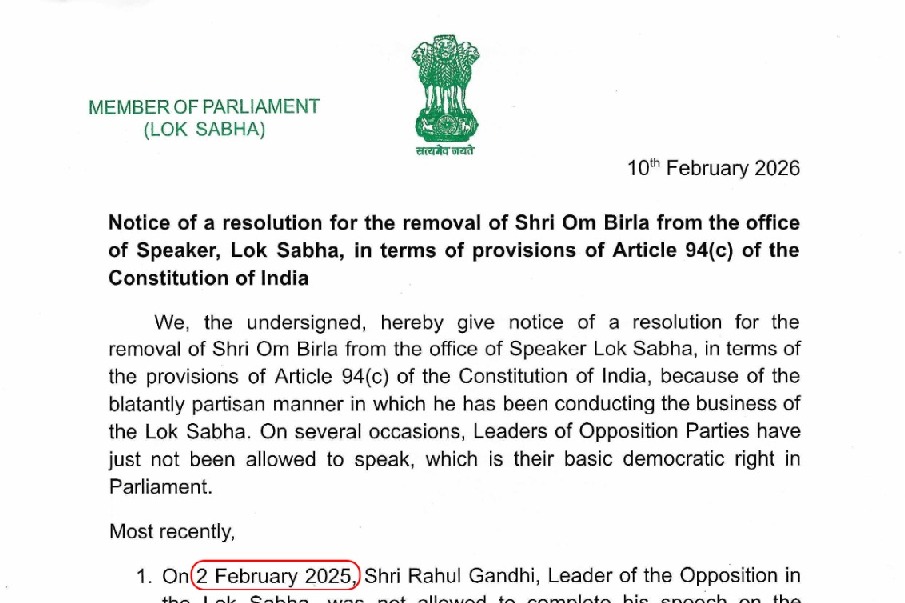
New Delhi, Feb 10 : The Opposition's attempt to move a no-confidence motion against Lok Sabha Speaker Om Birla has run into trouble after technical errors were detected in the notice, in what is being described as a significant procedural lapse. The Congress party had to resubmit the motion with corrections made to it.
The notice repeatedly mentioned the year 2025 instead of 2026, breaching procedural requirements that mandate all details in such a motion must be accurate and factually correct. Following the mistake, the Congress party had to resubmit the motion with corrections.
The development has drawn attention as it comes on the heels of a similar incident in which a motion against then Vice President Jagdeep Dhankhar was rejected on technical grounds due to a spelling error in his surname.
The recurrence of such procedural lapses has added to the controversy surrounding the Opposition's efforts.
While Opposition parties have accused Speaker Om Birla of functioning in a biased manner, the proposed motion is widely viewed as largely symbolic, given the numerical strength required for it to succeed.
The technical mistake, however, has caused considerable embarrassment for the Congress and its allies.
The move comes amid heightened tensions between the ruling government and Opposition parties, who have accused Speaker Om Birla of conducting proceedings of the House in a "blatantly partisan manner".
Opposition parties submitted the notice of no-confidence against Speaker Om Birla under Article 94(c) of the Constitution on Tuesday.
Congress MP Gaurav Gogoi stated that the notice was formally submitted at 1:14 p.m. in accordance with Rule 94C of the Rules of Procedure and Conduct of Business in the Lok Sabha.
According to the Congress, the notice has been signed by 118 Members of Parliament.
The motion has received support from many parties including the Congress, Samajwadi Party and the Dravida Munnetra Kazhagam. However, the Trinamool Congress has not signed the notice so far.
In the notice, Opposition MPs stated that Speaker Birla had repeatedly denied them the opportunity to raise matters of public importance during House proceedings, which they claim prompted the move to bring the no-confidence motion.

The notice repeatedly mentioned the year 2025 instead of 2026, breaching procedural requirements that mandate all details in such a motion must be accurate and factually correct. Following the mistake, the Congress party had to resubmit the motion with corrections.
The development has drawn attention as it comes on the heels of a similar incident in which a motion against then Vice President Jagdeep Dhankhar was rejected on technical grounds due to a spelling error in his surname.
The recurrence of such procedural lapses has added to the controversy surrounding the Opposition's efforts.
While Opposition parties have accused Speaker Om Birla of functioning in a biased manner, the proposed motion is widely viewed as largely symbolic, given the numerical strength required for it to succeed.
The technical mistake, however, has caused considerable embarrassment for the Congress and its allies.
The move comes amid heightened tensions between the ruling government and Opposition parties, who have accused Speaker Om Birla of conducting proceedings of the House in a "blatantly partisan manner".
Opposition parties submitted the notice of no-confidence against Speaker Om Birla under Article 94(c) of the Constitution on Tuesday.
Congress MP Gaurav Gogoi stated that the notice was formally submitted at 1:14 p.m. in accordance with Rule 94C of the Rules of Procedure and Conduct of Business in the Lok Sabha.
According to the Congress, the notice has been signed by 118 Members of Parliament.
The motion has received support from many parties including the Congress, Samajwadi Party and the Dravida Munnetra Kazhagam. However, the Trinamool Congress has not signed the notice so far.
In the notice, Opposition MPs stated that Speaker Birla had repeatedly denied them the opportunity to raise matters of public importance during House proceedings, which they claim prompted the move to bring the no-confidence motion.