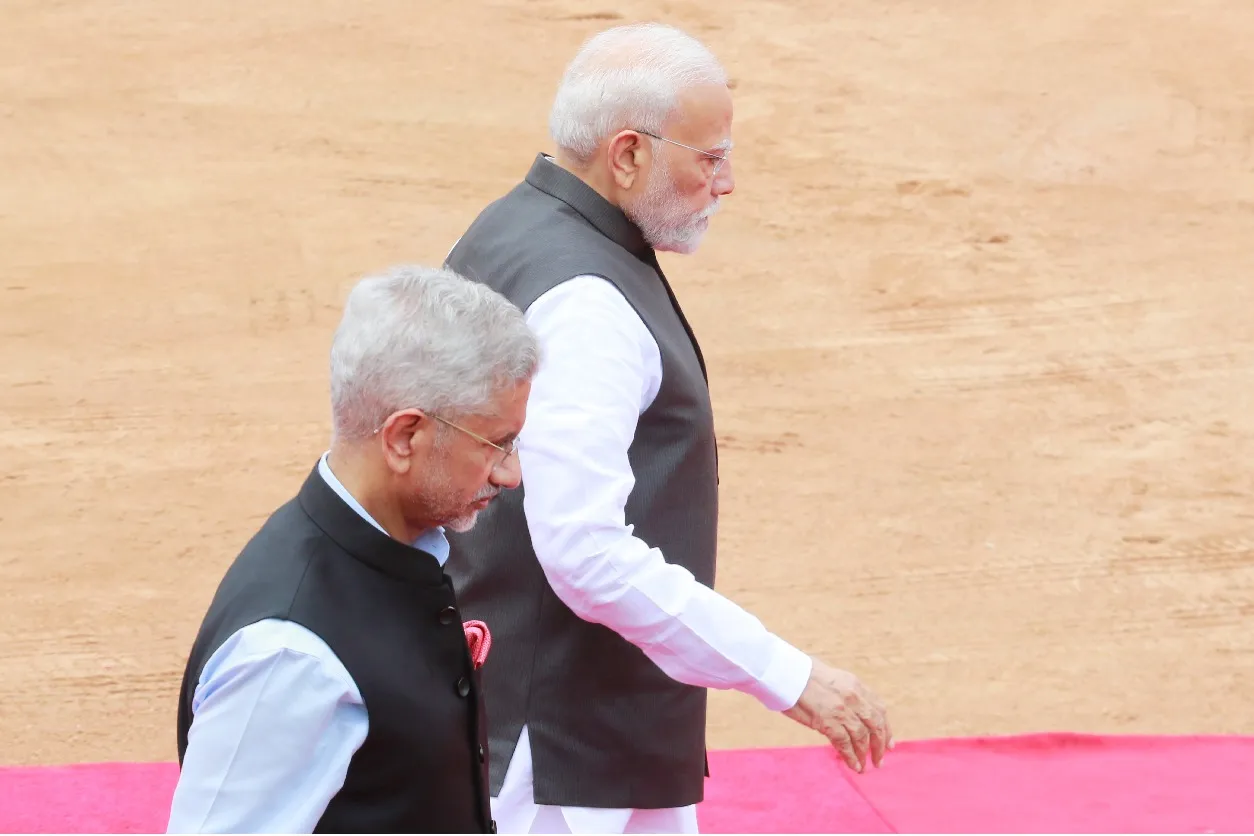
New Delhi, Jan 9 : Prime Minister Narendra Modi on Friday extended warm birthday wishes to External Affairs Minister S. Jaishankar, lauding his distinguished service to the nation and his pivotal role in strengthening India’s foreign policy and relations with countries across the world.
Taking to the social media platform ‘X’, Prime Minister Modi said, “Best wishes to Dr. S. Jaishankar Ji on his birthday. He has served the nation as a distinguished diplomat and is now playing a key role in strengthening India’s foreign policy and ties with the world. Praying for his long and healthy life."
Subrahmanyam Jaishankar, born on January 9, 1955, in New Delhi, is an Indian politician and senior leader of the BJP. He has been serving as India’s External Affairs Minister since 2019 and is widely regarded as one of the most experienced diplomats to enter active politics. Notably, he is the first Indian career diplomat and former foreign secretary to be appointed as the country’s external affairs minister.
Before transitioning into politics, Jaishankar had a long and illustrious diplomatic career spanning more than four decades. He served as India’s Foreign Secretary, the highest bureaucratic position in the Ministry of External Affairs (MEA), from 2015 to 2018. Before that, he held several key diplomatic assignments, including serving as India’s Ambassador to China from 2009 to 2013 and to the United States from 2013 to 2015.
Jaishankar was born into a Tamil family known for its strong intellectual and strategic traditions. His father, Krishnaswamy Subrahmanyam, was a highly respected bureaucrat, strategic affairs analyst, and commentator who played a crucial role in shaping India’s defence and nuclear policies. Growing up in such an environment, Jaishankar developed an early interest in international relations and strategic affairs.
He completed his schooling in New Delhi and Bengaluru and went on to graduate from St. Stephen’s College, University of Delhi. He later earned a Master’s degree in Political Science, followed by an M.Phil. and a PhD in International Relations from Jawaharlal Nehru University (JNU), New Delhi. His academic specialisation was nuclear diplomacy, an area that would later define much of his professional work. He joined the Indian Foreign Service (IFS) in 1977.
Jaishankar began his diplomatic career in Moscow in 1978, where he gained fluency in Russian -- an asset that has significantly contributed to strengthening India-Russia ties over the years. From 1979 to 2006, he held several important postings abroad and within the MEA, gaining deep familiarity with India’s diplomatic framework and global engagements. His overseas assignments included postings in Moscow; Washington, DC.; Colombo, Sri Lanka; Budapest; and Tokyo.
In addition to his diplomatic postings, Jaishankar also served as press secretary and speechwriter to former President of India Shankar Dayal Sharma, further enhancing his understanding of governance, public communication, and statecraft.
Jaishankar returned to India in 2004 and was appointed head of the Americas Division in the MEA. During this period, he played a key role in negotiations that led to the announcement of the landmark Indo-US civil nuclear deal in 2005. The agreement marked a turning point in India’s global standing by enabling civil nuclear cooperation with the international community.
From 2007 to 2009, he served as India’s High Commissioner to Singapore, strengthening bilateral ties and expanding cooperation in trade, education, and regional security. In 2009, he was appointed India’s Ambassador to China, a position he held until 2013, making him the longest-serving Indian envoy to Beijing. His tenure coincided with a critical phase in India-China relations, marked by efforts to stabilise ties amid persistent border tensions.
In 2012, when China issued passports depicting Arunachal Pradesh and Aksai Chin as Chinese territory, the Indian Embassy in Beijing, under Jaishankar’s leadership, responded firmly by issuing visas to Chinese nationals with maps showing the regions as part of India. The move was widely seen as a strong diplomatic assertion of India’s territorial claims.
In 2013, Jaishankar took charge as India’s Ambassador to the United States at a time when bilateral relations were strained due to the arrest of a senior Indian diplomat in New York on charges of visa fraud. He engaged with senior American officials and played a key role in resolving the issue, helping restore trust between the two countries. Jaishankar has often noted that while India-US relations are friendly, they require constant engagement and careful management.
On January 28, 2015, following a meeting of the Appointments Committee of the Cabinet chaired by Prime Minister Modi, Jaishankar was appointed India’s Foreign Secretary. He replaced Sujatha Singh, whose tenure was curtailed by nearly eight months. As foreign secretary, Jaishankar prioritised strengthening ties with neighbouring countries and enhancing engagement with East and Southeast Asia. He also coordinated India’s swift humanitarian response to the devastating Nepal earthquake in April 2015, which claimed nearly 9,000 lives.
After retiring from the IFS in 2018, Jaishankar briefly worked in the private sector. Though he had not initially planned to enter politics, he was invited by Prime Minister Modi to join the Union Cabinet. In May 2019, he was appointed External Affairs Minister in the Modi government’s second term and was elected to the Rajya Sabha from Gujarat as a BJP candidate in July 2019.
As external affairs minister, Jaishankar navigated India’s diplomacy through a period of unprecedented global challenges. During the Covid-19 pandemic, he led India’s 'Vaccine Maitri' initiative, under which India supplied domestically produced vaccines to more than 75 countries. He also oversaw the 'Vande Bharat Mission', one of the world’s largest repatriation efforts, which facilitated the return of hundreds of thousands of stranded Indian citizens from across the globe.
Jaishankar played a crucial role in strengthening India’s strategic partnerships with countries such as the United States, Russia, and Japan, and with multilateral groupings, including the European Union and the Association of Southeast Asian Nations (ASEAN). His approach emphasised India’s growing role as a responsible global power.
Reappointed as the EAM in June 2024 in Prime Minister Modi’s third cabinet, Jaishankar continues to play a central role in shaping India’s foreign policy. Following the terror attack in Pahalgam, Jammu and Kashmir, which claimed 26 lives, India renewed its accusations against Pakistan over cross-border terrorism, leading to a further deterioration in bilateral relations.
With more than three decades of diplomatic experience, fluency in multiple languages, and deep expertise in global affairs, S. Jaishankar remains a key architect of India’s contemporary foreign policy and an influential voice on the global stage.
Distinguished diplomat playing key role in strengthening India’s foreign policy: PM Modi on EAM Jaishankar's birthday