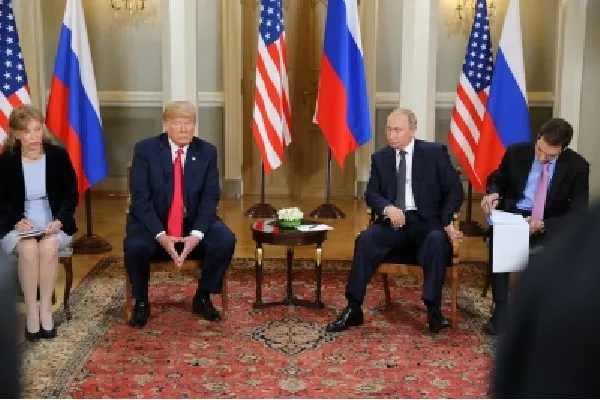
Washington, Jan 6 : Russia at one point signaled a willingness to allow the United States latitude in Venezuela in exchange for Washington easing its position on Ukraine, according to seven-year-old congressional testimony by Fiona Hill, a former senior National Security Council official, an account that has resurfaced amid renewed scrutiny of great-power bargaining.
The episode was recalled in New York Times report on Monday and traces back to testimony Hill delivered to Congress in 2019, when she served as the NSC’s senior director for Russian and European affairs during the first Trump administration.
In that testimony, Hill described what she called strong Russian signaling—much of it in public forums and media—suggesting a linkage between US policy in Venezuela and Russia’s interests in Ukraine.
“The Russians at this particular juncture were signaling very strongly that they wanted to somehow make some very strange swap arrangement between Venezuela and Ukraine,” Hill told lawmakers, referring to a period in early 2019 marked by heightened tensions between Washington and Caracas and Russia’s military support for Venezuelan President Nicolas Maduro.
Hill said the signals emerged as the United States pressed its case in Venezuela, invoking the Monroe Doctrine, while Moscow pointed to what it saw as its own “backyard” in Ukraine.
“You have your Monroe Doctrine. You want us out of your backyard. Well, you know, we have our own version of this. You’re in our backyard in Ukraine,” she told the hearing, summarizing the Russian position conveyed through informal channels and Russian press commentary.
According to Hill’s testimony, the idea of a trade-off was not conveyed through formal diplomatic proposals but surfaced through public statements, commentaries, and media articles. She said the Russians “laid it out in articles,” many of them in Russian, making the linkage apparent to US officials tracking Moscow’s messaging.
Hill told lawmakers that she later traveled to Moscow on an unclassified visit to meet Russian counterparts, including at a think tank, and that the discussions there reinforced the sense that Russian officials were interested in tying Venezuela and Ukraine together in their strategic calculus. “It was also apparent … that the Russian government was interested in having a discussion about Venezuela and Ukraine,” she said.
She emphasised that the matter had been discussed openly enough that questions were raised at a US State Department press briefing about whether she had gone to Russia “to make a trade between Venezuela and Ukraine,” underscoring that the idea was already circulating publicly.
The New York Times report noted that Moscow’s mixed reaction to recent US action in Venezuela has revived memories of that earlier episode, which unfolded years before Russia’s full-scale invasion of Ukraine.
At the time Hill testified, Russia had deployed personnel and equipment to Venezuela as Washington increased pressure on the Maduro government.
Hill in the testimony said she personally rejected the notion of such a swap during her interactions with Russian officials. She described the episode as part of a broader pattern in which Moscow sought to frame global politics in terms of reciprocal spheres of influence, contrasting that approach with US policy positions.
In her testimony, Hill made clear that her remarks were confined to unclassified information already in the public domain. “I have confined all my answers to the things that have either been in the public discussion,” she told lawmakers when asked about the nature of her disclosures.
Russia once floated Venezuela-Ukraine swap: Report