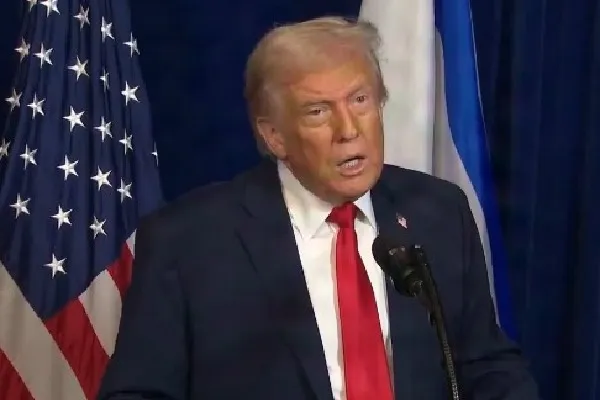
Washington, Dec 30 : US President Donald Trump warned that Iran could face consequences “more powerful than the last time” if it resumes prohibited military activity, while also signaling openness to renewed diplomatic engagement with Tehran.
“Iran may be behaving badly,” Trump said at a Mar-a-Lago news conference with the Israeli Prime Minister Benjamin Netanyahu. “But if it's confirmed… consequences will be very powerful,” he said in response to a question.
Trump said intelligence suggested Iran might be seeking alternative locations following earlier US strikes.
“The sites were obliterated, but they're looking at other sites,” he said. “And if they're doing that, they're making a big mistake.”
Asked whether the US would support bilateral discussions with Iran, Trump replied simply, “Yeah. I would. Sure.”
He said he had previously urged negotiations before conflict escalated.
“I said, let's negotiate and they didn't believe what was going to happen would happen,” Trump said. “Now they believe me.”
Trump argued that curbing Iran’s influence was central to broader regional peace.
“If they build up, there can't be peace in the Middle East,” he said.
Netanyahu echoed Trump’s assessment, linking Iran’s weakened position to regional stability.
“If we didn't do what we did to Iran… you wouldn't have peace in the Middle East,” Trump added.
“You wouldn't have a deal, because other Arab nations, which are great, great, great people. I know them very well,” he said.
“I know them. They're great people. They wouldn't be able to have agreed to peace in the Middle East because you would have had a dark cloud hanging over everything. It wouldn't have been possible. So Iran has been greatly reduced in power, prestige. I don't want to use the word humiliation because, you know, they're trying to build up again,” he said.
“But we can't let them build up because if they build up, there can't be peace in the Middle East. It was a mistake. You know, when they wiped out Iraq, Iraq and Iran were about the same power and they fought each other with different names for a thousand years. And then our country came out and blew up one of those two countries, namely Iraq,” he added.
“All of a sudden, Iran had the whole Middle East all to itself. But that's not true anymore, that's not true anymore,” he said.
Trump also addressed Syria, praising the country’s new leadership.
“I respect him. He's a very strong guy,” Trump said of Syria’s president.
Netanyahu said Israel’s priority was border security and minority protection.
“Our interest is to have a peaceful border with Syria,” he said. “We want to secure our Druze friends… and especially the Christians.”
Trump credited Turkish President Recep Tayyip Erdogan for developments in Syria.
“President Erdogan did it and we give him a lot of credit,” Trump said.
On Lebanon, Trump said Hezbollah remained a concern.
“Hezbollah has been behaving badly,” he said. “So we'll see what happens.”
In response to a question, Trump emphasised deterrence paired with diplomacy. “There’s no reason for them to do it,” he said of Iranian escalation.
The Trump administration previously pursued a “maximum pressure” strategy while leaving open the possibility of negotiations, a dual approach reflected again in the remarks at the joint press conference.
Trump warns Iran of stronger retaliation if it rearms, signals readiness for new talks