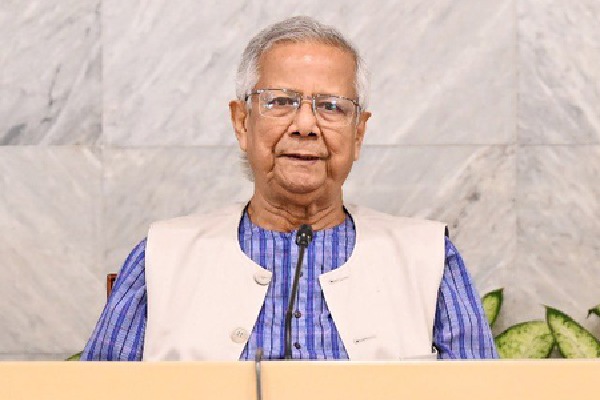
Bangladesh Army watches as Yunus administration grapples with violence, chaos
Dhaka is no stranger to Army involvement in governance with several takeovers and attempted coups marking its history, adding up to more than a dozen, since the country attained Independence from Pakistan's repression in 1971.
In August 1975, the architect of Bangladesh's freedom movement, Sheikh Mujibur Rahman and his family was assassinated in a military coup that toppled the founding government and triggered years of instability.
Mujibur Rahman's daughters -- Sheikh Hasina and Sheikh Rehana -- survived the assassination, being in Europe at that time. This was followed by tumultuous times that witnessed a series of coups and counter‑coups for the next two years.
There were multiple assassinations and power shifts, culminating in Lieutenant General Ziaur Rahman's consolidation of power.
Lieutenant General Rahman, known as President Zia, founded the Bangladesh Nationalist Party (BNP) in September 1978, which was later led by his wife Begum Khaleda Zia after his assassination by a group of military personnel on May 30, 1981.
Khaleda Zia, the country's first woman Prime Minister, remains critical in a hospital, while her son, Tarique Rahman is expected to return home after 17 years of self-imposed exile in Britain.
BNP's Acting Chairperson Khaleda Zia is considered a frontrunner in the February 2026 general elections in Bangladesh.
Following Lieutenant General Ziaur Rahman's assassination, General Hussain Muhammad Ershad seized power in a bloodless coup in March 1982 and ruled until mass protests forced his resignation in 1990.
General Ershad, died of old age in 2019. He is considered among the most controversial but also consequential political leaders in Bangladesh, often referred to as "the dictator".
Many of those he considered against him ended up assassinated or jailed for life.
Between 1996-2011, there were reports of several coup attempts and alleged plots, but none produced long‑term military rule.
On the current situation, a recent report on "Future of India-Bangladesh Relationship" from the Parliamentary Committee on External Affairs has addressed this issue.
The report, submitted in the just-concluded Winter Session of Lok Sabha, noted "that the situation in Bangladesh will not descend into chaos and anarchy due to some very strong fundamental characters of Bangladeshi society and polity".
It said that "Bangladeshi identity is not solely religious, it has a strong cultural and linguistic Bengali identity. Secondly, Bangladesh has a mass-based political parties with a tradition of old democratic or semi-democratic politics". And thirdly, "Bangladesh Army is not the Pakistan Army and has refused to fire on its own people".
However, of late, Pakistan has extended its footprints in Bangladesh, including the Army where the ISI Commander Muhammad Asim Malik was in Dhaka a few months ago.
Additionally, there have been threats of capturing the "Seven Sister" states in India's Northeast.
Therefore, Islamabad's hand at further destabilising Bangladesh can not be ruled out.
The current state of affairs and the failure of the Yunus-led administration in containing violence have been criticised internally by various student leaders involved in the August 2024 Uprising, and prominent politicians.
Former BNP Minister, Amir Khasru Mahmud Chowdhury, has termed the situation as "mobocracy" after an attack on the India's Consulate in Chattogram amidst nationwide violence.
BNP Secretary General Mirza Fakhrul Islam Alamgir alleged that deterioration of law-and-order situation was due to failure of the interim government in Bangladesh.
The interim administration's failure in addressing security aspects ahead of the crucial general election and a nationwide referendum had led to reports of likely Army interference.
The Inter‑Services Public Relations (ISPR) Directorate of Bangladesh has protested what it called a "spate of baseless and unfounded reports" of a possible coup and breakdown in the Army's command chain.
The ISPR, earlier, has affirmed that the Bangladesh Army remains "strong, united, and fully committed to its constitutional duties".
The official denial was seen as being aimed at domestic and international audiences to counter narratives of instability.
Amid the developments, Bangladesh Army Chief General Waker-Uz-Zaman called up his Indian counterpart General Upendra Dwivedi recently and has assured him the security of all Indian assets.