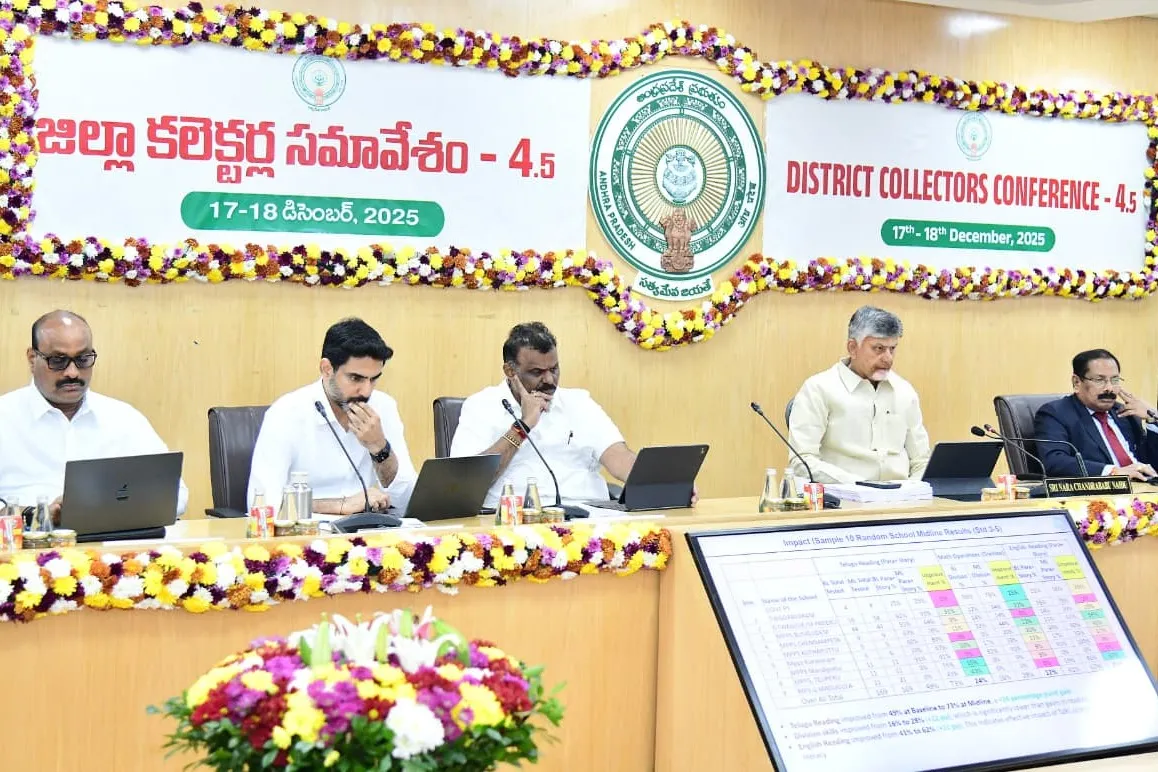
Amaravati, Dec 18 : With Andhra Pradesh ageing faster than India, the state government is considering a "second child onwards" incentive similar to models implemented in France and Hungary to avoid future demographic collapse, a top official said on Thursday.
Andhra Pradesh is ageing faster than India, with a median age of 32.5 years compared to the national average of 28.4 years.
The state's Total Fertility Rate (TFR) has declined to 1.5, well below the replacement level of 2.1, placing Andhra Pradesh on a trajectory similar to developed economies facing a demographic crisis.
The state has only a demographic window until 2040 before the dependency ratio skews heavily towards the elderly population.
The alarming demographic trends were highlighted by state Health, Medical & Family Welfare Secretary, Sourabh Gaur, at the 5th Collectors' Conference here.
He presented Andhra Pradesh's transformative approach to Population Management and Human Resource Development as the third ‘sutra’ in ‘Padi Sutralu’ (10 points) under Swarna Andhra Vision 2047 and underlined the need to shift from population control to population sustainability.
Chief Minister N. Chandrababu Naidu emphasised the urgent need to address the state's declining fertility rate and improve overall health outcomes.
Once a champion of family planning initiatives, he underlined the dramatic shift in policy priorities required to address current demographic challenges.
"We are now facing the same problem that developed nations are experiencing - a growing non-working-aged population. Our focus must shift to enabling and incentivising families to have children," Saurabh Gaur stated, suggesting a "second child onwards" incentive principle similar to models implemented in France and Hungary to arrest the TFR decline and avoid future demographic collapse.
In a groundbreaking initiative, he presented the plans for the establishment of Fertility Colleges as Centres of Excellence for Reproductive Medicine. This first-of-its-kind public sector initiative will train professionals and provide state-supported IVF treatment for couples facing infertility challenges, addressing a critical barrier to sustainable population growth.
Gaur also outlined a comprehensive life-cycle approach to population management encompassing five strategic pillars: Supportive Fertility Ecosystem, Preventive Healthcare through the Sanchara Chikitsa concept, Augmenting Lifelong Skilling through a Skill Passport System starting from Grade 6, Incentivising Women Workforce Participation through safe mobility and mandatory crèches, and Active Ageing & Community through the establishment of Elderly Clubs at the Mandal level.
The Secretary told the Collectors that closing the female workforce participation gap from the current 31 per cent to match the male participation rate of 59 per cent can boost the state's GSDP by 15 per cent. To achieve this, the government will implement women-friendly transport systems and mandatory crèches in major workplaces to reduce the "motherhood penalty" on careers.
On healthcare outcomes, the Secretary set ambitious targets to reduce Maternal Mortality Ratio from the current 30 to global best standards (below 5, matching Norway, Poland, and Belarus) and Infant Mortality Rate from approximately 17 to below 2 (matching Singapore and Iceland).
Andhra Pradesh ageing faster, mulls ‘second child onwards’ incentive