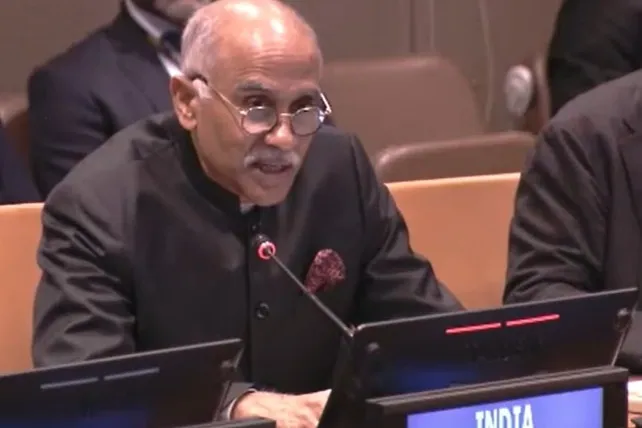
United Nations, Dec 11 : As everything from social lives to critical infrastructure becomes digitised, protecting them from terrorism is of utmost importance, and India is committed to developing global standards to meet the threats, India's Permanent Representative P. Harish has said.
"The dangers of deep fakes, cybersecurity threats, data thefts, and malicious applications of high-risk AI get serious as technology develops further," he said on Wednesday (local time) at a meeting here that India sponsored on 'Building Operational Capacities to Use AI in Counter-Terrorism'.
Therefore, "neutralising cyber vulnerabilities and disrupting terror threats has become a prime necessity", he said.
It is very important to further strengthen the capabilities of law enforcement and security agencies in using AI tools, he added.
India and the United Arab Emirates co-sponsored the meeting with UN counter-terrorism units at which experts from around the world discussed emerging threats from AI, from drones to deep fakes, and ways to face them.
India and the UAE, together, have been at the forefront of efforts to create global standards to meet the threats, Harish said.
UAE's Permanent Representative Mohamed Abushahab drew attention to the Delhi Declaration on counter-terrorism that was adopted by the Security Council's Counter-Terrorism Committee (CTC) during its visit to India in 2022.
The declaration promoted by India "marked a significant commitment to address the threats posed by new and emerging technologies in counter-terrorism", he said.
The declaration called for international action to counter terrorists using new and emerging technologies, including drones, information communications technologies, and new payment systems.
Abushahab said this was followed by the CTC's adoption next year of the Abu Dhabi Guiding Principles that targeted the use of drones by terrorists.
The acting under-secretary-general for counter-terrorism, Alexandre Zouev, said that law enforcement agencies were using AI to fight terrorism and gave some examples.
"Investigators now use AI-assisted tools to process digital evidence at unprecedented speed," he said.
Analysis using AI helps agencies "identify patterns early enough to proactively intervene" and "national cybersecurity authorities deploy AI to detect anomalies in real time to prevent and mitigate cyber attacks", he said.
He warned about terrorist groups trying to recruit young people with AI expertise.
"The worst of my nightmares is that many terrorist groups attract the best minds, best minds from their universities, from their networks".
He said that proactive action was necessary to attract them to work in different areas of counter-terrorism.
UAE's head of cybersecurity, Mohamed Al Kuwaiti, said that online games were vulnerable to terrorists using them to recruit or radicalise the "younger generation (that) lives in these games".
Black Ops, Call of Duty, Red Redemption, and Grand Theft Auto are among the adventure games that terrorists use to target youth.
He said that the UAE made an agreement with Roblox, a popular platform for games, to take down those that posed this danger.
India says committed to developing global standards to meet proliferating terrorist threats from AI