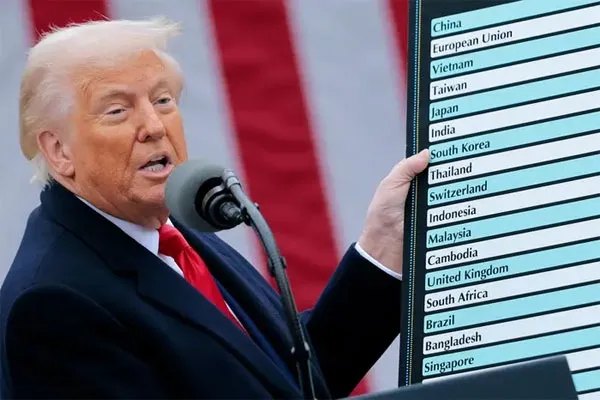
President Donald Trump, after assuming office for a second term, has made several controversial decisions. One of the most significant among these was the imposition of sweeping tariffs on numerous countries worldwide under the initiative titled "Liberation Day." However, Trump has recently encountered a major legal setback concerning these tariffs. The United States Court of International Trade has blocked the implementation of Trump’s tariffs.
The court clarified that President Trump does not possess unilateral authority to impose tariffs. It ruled that under the International Emergency Economic Powers Act (IEEPA), a president may only enforce economic sanctions on foreign nations during declared emergencies. During the hearings, the Trump administration cited the ongoing India–Pakistan tensions as justification for the tariff imposition. However, the court rejected this argument.
Trump’s administration had urged the court to uphold the president’s authority over tariffs, arguing that such powers enabled President Trump to facilitate the recent ceasefire agreement between India and Pakistan. The administration requested the court to treat the issue as highly sensitive until July 7, which was set as the deadline to finalize certain trade deals. It also brought to the court’s attention that discussions were ongoing with several countries regarding tariffs. Nonetheless, the court dismissed all arguments made by the Trump administration.
The Court of International Trade in Manhattan, comprising three judges, unequivocally stated that the U.S. Congress did not grant the president unlimited powers under the IEEPA. The bench emphasized that presidential authority to impose economic sanctions is limited to emergency situations involving extraordinary threats.
The judgment further highlighted that the U.S. Constitution confers specific powers to Congress to regulate foreign trade, even in the interest of protecting the nation’s economy. It stressed that these powers cannot be overridden by the president under emergency provisions unless extraordinary circumstances justify it.