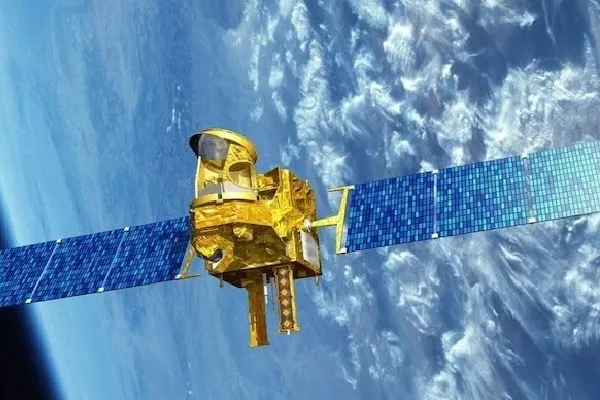
India’s national security and border surveillance capabilities are set to receive a significant boost with the launch of an advanced radar imaging satellite. The Indian Space Research Organisation (ISRO) is scheduled to launch the 'Radar Imaging Satellite-1B' (RISAT-1B), also referred to as Earth Observation Satellite-09 (EOS-09), from the Satish Dhawan Space Centre in Sriharikota on May 18.
Equipped with a cutting-edge C-band Synthetic Aperture Radar (SAR) system, RISAT-1B will be capable of capturing high-resolution images of the Earth's surface under all weather conditions, including heavy rainfall, thick fog, and dense cloud cover, as well as during complete darkness. In contrast to optical camera-based satellites, which often struggle in adverse weather or at night, RISAT-1B overcomes these limitations and enables uninterrupted surveillance. The timing of this launch, coming shortly after the recent 'Operation Sindoor,' adds to its strategic importance.
Experts have stated that the satellite will provide invaluable support to India's defence forces by enhancing monitoring of sensitive border areas with countries such as Pakistan and China, and by securing the nation’s extensive coastline. The radar technology embedded in RISAT-1B is considered vital for defence applications. "It can detect enemy movements, identify infiltrations, and support counter-terror operations by delivering continuous and reliable surveillance data," they said.
The ultra-high-resolution radar images can even detect subtle changes on the ground caused by the movement of military equipment, emergence of new camps, or vehicular traffic. Conventional surveillance systems may not always be able to identify such micro-level shifts. According to ISRO officials, RISAT-1B is a more advanced continuation of the RISAT satellite series, previously utilized in crucial missions such as the Balakot strikes. The agency believes that RISAT-1B can accurately detect suspicious cross-border movements and play a key role in anti-terror operations.
RISAT-1B supports five different imaging modes, ranging from ultra-high-resolution imaging capable of identifying even the smallest objects, to broader scans suitable for monitoring large regions. This versatility ensures the satellite’s utility not only for defence, but also for civilian purposes such as agriculture, forest resource monitoring, soil moisture estimation, geological studies, and disaster response during floods.
Designed with a configuration similar to that of its predecessor RISAT-1, the new satellite will complement data received from other Earth observation satellites in ISRO’s arsenal, including ResourceSat, CartoSat, and the RISAT-2B series. Scientists stated that RISAT-1B will play a pivotal role in building an integrated Earth observation network, significantly enhancing India's surveillance capabilities as the nation’s ‘eye in the sky’.