New Delhi, Feb 28 : After nearly four months of border closures following sporadic skirmishes along the Durand Line and intermittent aerial bombardment by Islamabad inside Afghan territory, tensions between Pakistan and Afghanistan have sharply escalated, with the conflict now resembling an “all-out” confrontation.
The British-era Durand Line, stretching roughly 2,600 km across rugged mountainous terrain, divides the two neighbours but has never been formally recognised by Kabul. Successive Afghan governments have laid claim to Pashtun-dominated regions within Pakistan, making the border a persistent flashpoint.
Since clashes erupted in October, Islamabad has carried out multiple airstrikes inside Afghanistan, accusing the Taliban regime of harbouring leaders and fighters of the Tehreek-e-Taliban Pakistan (TTP), also known as the Pakistani Taliban, as well as elements linked to the Islamic State. Kabul has repeatedly denied the allegations, but the issue has dominated a series of inconclusive diplomatic engagements between the two sides, some mediated by regional stakeholders.
Pakistan has, in recent months, been rocked by a spate of deadly attacks, including a February 6 suicide bombing at a mosque in Islamabad that killed more than 30 people. Authorities alleged that the assault was orchestrated by militants operating under the direction of leadership based in Afghanistan. The TTP, formed in 2007 as an umbrella platform for militant outfits active in Pakistan’s northwest, has claimed responsibility for numerous attacks targeting religious sites, civilians, and security installations.
Ironically, both the Afghan Taliban and the Pakistani Taliban draw heavily from the Pashtun community, which straddles both sides of the Durand Line. During the US-led intervention in Afghanistan, the two groups were aligned in their fight against foreign forces, with militants reportedly receiving logistical support, training, and medical assistance from sanctuaries within Pakistan.
What began in the 1980s as Islamabad’s strategic backing of Afghan mujahideen against Soviet occupation -- supported covertly by Washington -- has, over the decades, evolved into a complex and increasingly adversarial dynamic. The present hostilities reflect a dramatic reversal of fortunes, with former allies now confronting each other across a disputed frontier.
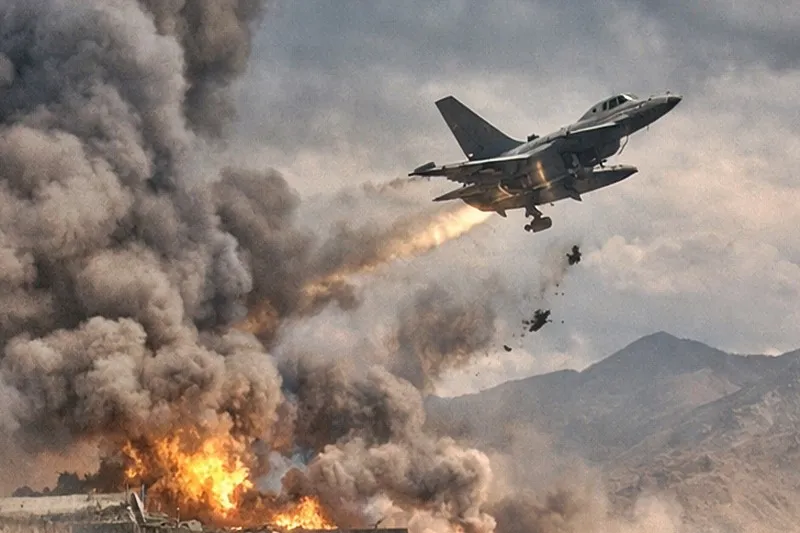
In a significant development, Afghanistan’s Ministry of Defence claimed on Friday that its air force had carried out strikes on military targets inside Pakistani territory. Kabul-based broadcaster TOLO news reported the statement, marking what would be a rare instance of cross-border aerial retaliation by the Taliban regime.
The Taliban are believed to have inherited a limited air fleet after the US withdrawal in 2021, including a handful of Russian-origin fighter aircraft and helicopters. However, analysts remain divided over the operational readiness of these assets and the availability of adequately trained pilots and maintenance infrastructure.
Pakistan, by contrast, retains significant conventional superiority, with an air force comprising around 400 fighter jets -- many of American and Chinese origin -- and an active military strength of approximately 600,000 personnel. The Taliban’s estimated 170,000-strong militia is comparatively less equipped. Pakistan’s status as a nuclear-armed state further adds a strategic dimension to the standoff.
When Kabul fell to the Taliban in August 2021 following the withdrawal of US-led forces, Islamabad had publicly welcomed the development. Then Prime Minister Imran Khan described it as Afghans having “broken the shackles of slavery.” Around the same time, a widely circulated photograph showed Faiz Hameed, then Director-General of Pakistan’s Inter-Services Intelligence (ISI), meeting Taliban leaders in Kabul -- an image seen by many as emblematic of Islamabad’s influence.
Hameed was later arrested and court-martialled in August 2024 on charges including political interference, violation of the Official Secrets Act, and abuse of authority. In December 2025, he was reportedly sentenced to 14 years in prison, with some analysts linking his downfall to internal power struggles and controversies surrounding Pakistan’s Afghanistan policy.
Today, as cross-border strikes and accusations intensify, the Afghan theatre once again appears to be at the centre of a shifting geopolitical contest. The mountains along the Durand Line -- long a symbol of strategic depth and insurgent sanctuary -- now stand on the brink of another potentially transformative chapter in what many describe as a renewed “Great Game” in the region.
From covert Cold War ally to overt adversary: Pakistan faces blowback in a renewed 'Great Game'
Advertisement