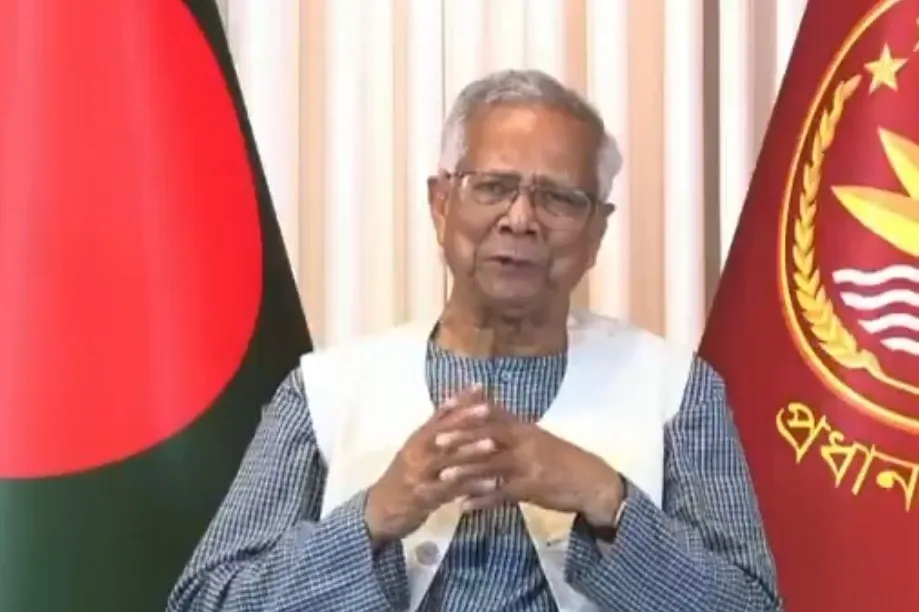
Dhaka, Feb 17 : Bangladesh's outgoing interim government Chief Advisor Muhammad Yunus, in his farewell address, highlighted the "economic promise" of deeper regional integration involving Nepal, Bhutan and the "Seven Sisters" -- a term widely used to refer to India's northeastern states -- according to local media reports.
His mention of India's northeastern region alongside sovereign nations has drawn criticism from several quarters, with observers calling it diplomatically insensitive at a time when Dhaka and New Delhi are seeking to steady bilateral ties.
In a televised address to the nation, Yunus said, "Our open sea is not only a geographical boundary, but it is an open door to engage with the world economy for Bangladesh. This region, along with Nepal, Bhutan and Seven Sisters, has great economic potential".
The remarks come against the backdrop of strained ties between the two neighbours following the removal of the Sheikh Hasina-led Awami League government in 2024.
Yunus's statements have repeatedly touched upon sensitive issues concerning Indian territory, prompting strong reactions from New Delhi.
Earlier in March 2025, during a visit to China, Yunus sparked controversy by referring to India's northeastern states as "landlocked" and describing Bangladesh as the region's "only guardian of the ocean".
Those comments were sharply criticised in India, including by Assam Chief Minister Himanta Biswa Sarma, who termed the remarks "offensive and strongly condemnable".
Subsequently, in April 2025, India announced the withdrawal of a trans-shipment facility that had allowed Bangladesh to export cargo to third countries via Indian customs stations, citing operational concerns.
Explaining the decision during a media briefing, Ministry of External Affairs spokesperson Randhir Jaiswal said, "The Transhipment facility extended to Bangladesh had, over a period of time, resulted in significant congestion at our airports and ports. Logistical delays and higher costs were hindering our own exports and creating backlogs. The facility, therefore, has been withdrawn w.e.f. April 8, 2025. To clarify, these measures do not impact Bangladesh exports to Nepal or Bhutan transiting through Indian territory."
The decision followed Yunus's controversial remarks and was seen by some analysts as reflective of mounting friction in bilateral ties.
Meanwhile, Bangladesh has continued to grapple with rising violence, crime, mob lynchings and incidents targeting minorities and women in the aftermath of the July 2024 protests that led to the ouster of the democratically elected Sheikh Hasina government.
The Yunus-led interim administration has faced sustained criticism over the deteriorating law and order situation and a reported rise in attacks on minorities, particularly Hindus, across Bangladesh.
The interim administration headed by Yunus had pledged to restore stability and uphold the rule of law. However, more than a year after he assumed charge as Chief Advisor, the internal situation in the country remains challenging.
Experts caution that Bangladesh faces a formidable task in addressing persistent unrest and countering the growth of Islamist extremism that has marked the 18-month tenure of the Yunus-led interim government, even as the country navigates a sensitive phase in its regional diplomacy.
Yunus brings up India's 'Seven Sisters' in farewell speech
Advertisement