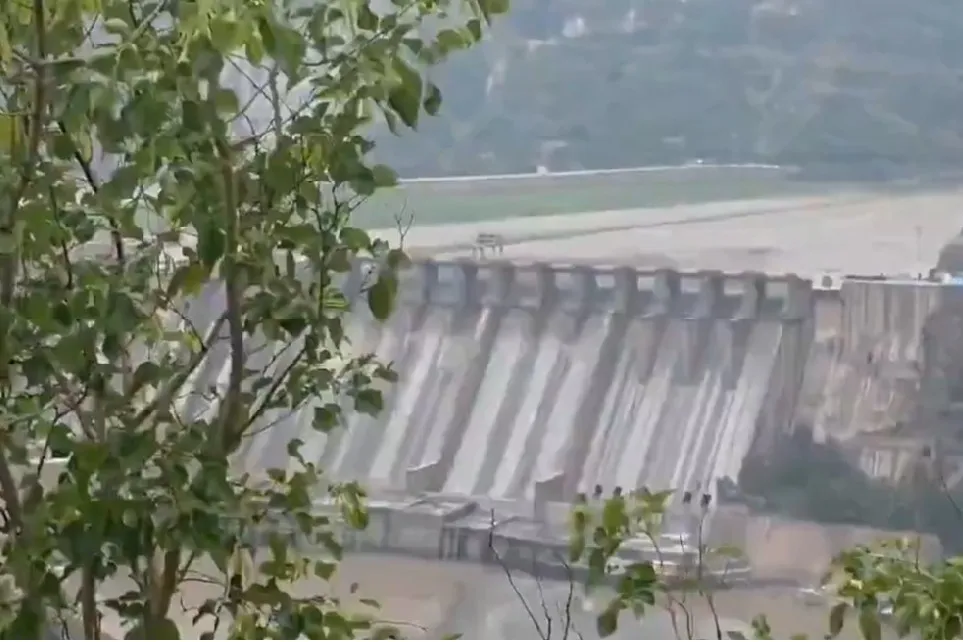
In the wake of the recent terrorist attack in Pahalgam, India has shifted its focus to water resource projects, with national media reporting that it has initiated efforts to enhance the water storage capacities of the Salal and Baglihar hydroelectric projects located on the Chenab River. According to reports, India has already blocked the flow from these dams. As India has suspended the Indus Waters Treaty, it has not informed Pakistan about these developments.
The enhancement works at the reservoirs of these two dams are reportedly being carried out under the supervision of the government-run National Hydroelectric Power Corporation (NHPC). Recently, the process of "flushing"—to remove silt accumulated in one of the reservoirs—was undertaken. This process, which began last Thursday, continued for nearly three days. Officials stated that this flushing operation is expected to improve power generation capacity and increase the longevity of the turbines.
Experts have observed that this marks the first time India has taken such steps that deviate from the spirit of the Indus Waters Treaty since suspending it. Former Central Water Commission Chairman Kushvinder Vohra clarified, "Since the treaty has been suspended, India has no obligation to inform Pakistan about any modifications it undertakes in its projects." In this context, India now has the opportunity to make changes to its projects in line with its domestic needs.
The Salal Dam was commissioned in 1987 and the Baglihar Dam in 2009. In addition to these, India controls about half a dozen more projects that fall under the Indus river system. Experts estimate that increasing the storage capacity of all these projects could, in the long run, lead to water scarcity in Pakistan. However, they clarified that there is no immediate risk of a complete halt in water supply to Pakistan.
Neither the Government of India nor NHPC has issued any official statement regarding the ongoing works. On the other hand, Pakistan is left with limited options to respond to India’s actions concerning the Indus Waters Treaty. Besides approaching the World Bank, which acted as a mediator for the treaty, other avenues may yield limited outcomes. Experts noted that the World Bank’s role is confined to mediation; it does not have the authority to enforce the treaty. Its responsibilities are limited to facilitating discussions, encouraging dialogue, and appointing neutral experts or the chair of a Court of Arbitration in case of disputes.